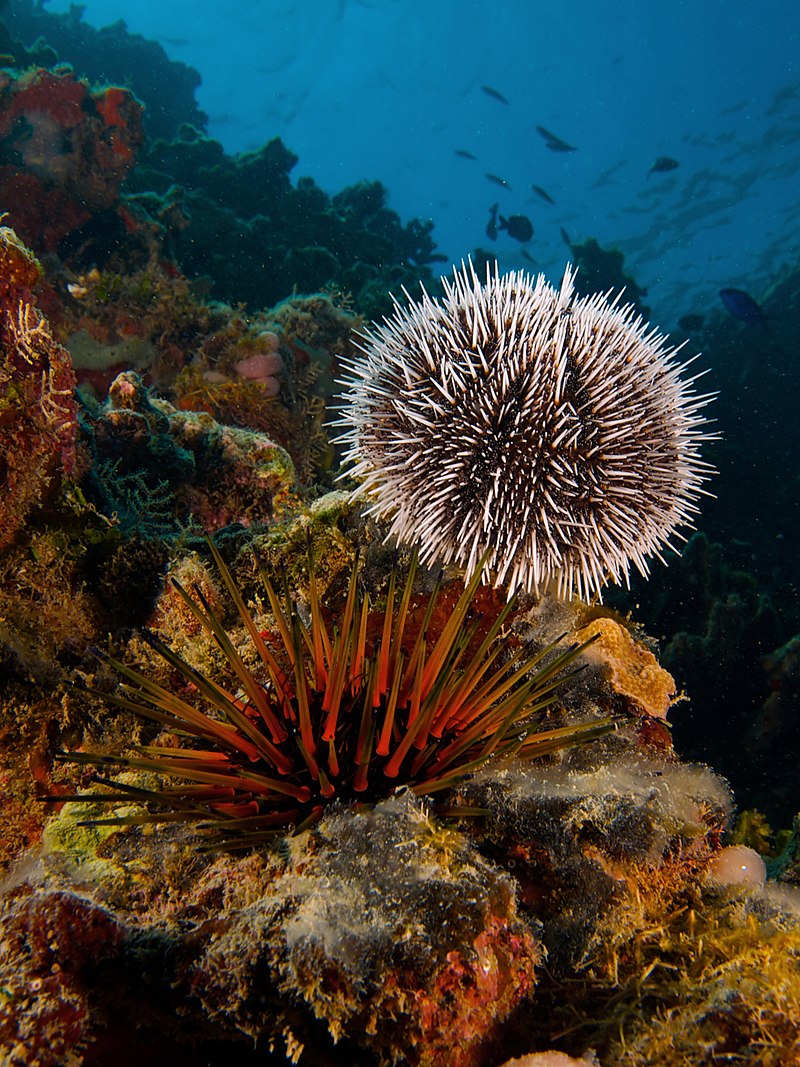
File:Tripneustes_ventricosus_(West_Indian_Sea_Egg-top)_and_Echinometra_viridis_(Reef_Urchin_-_bottom).jpg · Wikimedia Commons · See Wikimedia Commons
OverviewAI-generated
Echinoidea is a class of marine organisms within the phylum Echinodermata and kingdom Animalia. The group, commonly known as sea urchins, is classified under the subphylum Echinozoa. The taxon was described by Schumacher in 1817 and is currently accepted. It has served as a model organism and is documented in sources including the Armenian Soviet Encyclopedia, Brockhaus and Efron Encyclopedic Dictionary, Encyclopædia Britannica 11th edition, and New International Encyclopedia.
The temporal range of Echinoidea begins in the Ordovician period. The group is the subject of 11,175 records in PubMed and 2,333,651 occurrences in GBIF. In iDigBio, there are 14,103 records and 1,064 media files, with specimens held by institutions such as LACM, SDNHM, and NHMUK in the United States and United Kingdom. The taxon is referenced by 2,263 other encyclopedia articles.
Synthesized by Vinony from 37 facts across 8 sources: Wikidata, GBIF, Firecrawl, PubMed, Gbif Occ, iDigBio, WoRMS, Vinony graph. Generated from structured data (not the Wikipedia text) and checked against those facts — may still contain errors.
Species
sea urchins
Echinoidea
CLASS
- KingdomAnimalia
- PhylumEchinodermata
- ClassEchinoidea
海膽是棘皮动物門分類下的一個綱,其正式學名是海膽綱(Echinoidea),意思是「像豪豬般的動物」),又名「海刺蝟」。海膽生活在海洋中,廣泛分佈於世界各地的海洋,從潮間帶至數千公尺的深海底都可發現其蹤跡。全世界現存約有1000種海膽,化石700種以上。 目录 1 物種特徵 1.1 外形構造 1.2 防禦系統 1.3 運動及挖洞 1.4 攝食和排泄 1.5 氣體交換 1.6 感應外界 1.7 生殖 1.8 幼蟲成長 2 天敵 3 考古 4 食用 5 参考 物種特徵 外形構造 海膽的身體由一個球形或盤形的體殼所包圍,海膽成體的體殼通常是3至10公分大,外形大多是呈球形、心形或扁薄形。外形是球狀及五輻對稱的,而當中包括幾個不同類群的海膽:正海膽目、頭帕目及其他。海膽一般都是較深色的,如有綠色、橄欖色、棕色、紫色及黑色。 海膽是棘皮动物(棘皮動物門),與海星、海參、蛇尾及海百合屬同一門。與其他棘皮動物相似,海膽都是五輻性對稱的,但並不易見,要在其空殼上才易看出。 防禦系統 海膽的膽殼佈滿棘刺,一般約1-2厘米長,1或2毫米厚,呈圓錐形。活躍於加勒比海的冠的棘刺更長達10-20厘米長。棘剌本身中空及易碎,斷掉的棘刺可以再生長出來。棘刺以球窩關節與底部連接,能指向任何方向。若作出輕微的接觸,棘刺會隨即聚合指向接觸點。這樣可以保護海膽免受捕食者的侵害,某些海膽的棘刺末端更有毒囊。盔海膽目的棘刺一般都是短鈍,可以對抗海浪的衝擊,更有助保持海膽表面的水份。 除了棘刺外,海膽更有叉棘抵禦外來敵人。叉棘散佈於整個海膽體表上及圍口區,有些海膽的叉棘區與棘刺區分開,如白棘三列海膽 運動及挖洞 海膽給人的印象並不是生物,或是沒有運動能力。其實海膽是會隨著攝食而作出運動:若食物稀少,每天海膽可能只移動10厘米;若食物豐富的話,則每天可以移動超過1公尺。 海膽的運動是靠透明、細小、數目繁多及帶有黏性的管足及棘刺來進行的。管足在運動時,與海星相似,可以抓緊岩石,而位於底部的棘刺則是把海膽的身體抬起,以幫助海膽隨意的運動。牠們運動時可以隨時以步帶的方向作為前導,不用轉頭。當海膽被反轉時,牠的棘刺及管足更可以把牠翻正。 有些海膽是穴居形的,如梅氏長海膽,牠們為避免給海浪沖到深水的海床,於出生後就不停的挖掘,把自己藏在洞穴中。牠們利用在新陳代謝時所排放出來的碳酸(因排出的二氧化碳溶於水中生成)軟化洞穴壁,並以口器及棘刺來把洞穴弄大。 攝食和排泄 多數海膽的口器,稱做亞里斯多德燈籠,位於口面(即腹面)的中央,並被嘴唇的軟組織包圍。海膽的唇包括五根管足,在許多種類裡還有五對的腮。 相對於口器的另一端是肛門,肛門附近有數塊的硬片。在有些種類裡還有過濾海水的組織,稱為 madreporite。 海膽的食糧十分廣泛,肉食性的會以海底的蠕蟲其他棘皮动物為食糧,而草食性的主要食物是藻類,另外,亦有以有機物碎屑
via GBIF
Museum specimens
- Specimen records
- 14,103
- With media
- 1,064
- Collections
- LACM, SDNHM, NHMUK
- Recorded in
- United States, United Kingdom
Research
11,175 papers- Attribution of the taxon name Echinoidea to Schumacher, 1817.Zootaxa · 2022Stokes RB, Kroh ADOI: 10.11646/zootaxa.5182.2.3
- Prickly Defenders: A Review of Venomous Sea Urchins (Echinoidea).ReviewMarine drugs · 2025Ehlert-Flaskämper S, Motti CA, Harris RJDOI: 10.3390/md23060253
- Aquatic Antagonists: Dermatologic Injuries From Sea Urchins (Echinoidea).Cutis · 2024Brailsford CJ, Elston DMDOI: 10.12788/cutis.1034
- A combined morphological and molecular phylogeny for sea urchins (Echinoidea: Echinodermata).ReviewPhilosophical transactions of the Royal Society of London. Series B, Biological sciences · 1995Littlewood DT, Smith ABDOI: 10.1098/rstb.1995.0023
- Arbacia ballenensis sp. nov. (Echinoidea, Arbacioida): A new species reveals diversification of the genus in Central America.Zootaxa · 2023Courville E, Mooi R, Poulin E et al.DOI: 10.11646/zootaxa.5336.4.6
- Serendipity and Sea Urchins.The Biological bulletin · 2022Burnett LEDOI: 10.1086/721915
- Combining Morphological Characteristics and DNA Barcoding Techniques Confirm Sea Urchins of the Genus Echinometra (Echinodermata: Echinoidea) in Marine Habitat Located at Extreme Regions of the Caribbean Sea.Integrative and comparative biology · 2024Belford SGDOI: 10.1093/icb/icae083
- Promoter logic.Science (New York, N.Y.) · 1998Wray GADOI: 10.1126/science.279.5358.1871
via PubMed
Wikidata facts
- Instance of
- model organism
- Parent taxon
- Echinozoa
- Image
- Paracentrotus lividus profil.JPG
Show 9 more facts
- taxon name
- Echinoidea
- taxon rank
- class
- Commons category
- Echinoidea
- topic's main category
- Category:Echinoidea
- Commons gallery
- Sea urchin
- described by source
- Pauly–Wissowa
- taxon common name
- Seeigel
- temporal range start
- Ordovician
Sources (6)
via Wikidata · CC0
~37 min read
Encyclopedic overview
Sea urchins or urchins (/ˈɜːrtʃɪnz/) are the class Echinoidea within the echinoderms. Approximately 950 species live on the seabed, inhabiting all oceans and depth zones from the intertidal zone which actually is not a fixed number but varies greatly, usually defined by the range between the highest and lowest tide, to deep seas of 5,000 m (16,000 ft). They typically have a globular body covered by spiny protective tests (hard shells), typically from 3 to 10 cm (1 to 4 in) across. Sea urchins move slowly, crawling with their tube feet, and sometimes pushing themselves with their spines. They feed primarily on algae but also eat slow-moving or sessile animals such as crinoids and sponges. Their predators include sharks, sea otters, starfish, wolf eels, triggerfish, and humans. When unchecked by predators, urchins can create urchin barrens, damaged environments devoid of large algae and the animals associated with them.
Like all echinoderms, adult sea urchins have pentagonal symmetry with their pluteus larvae featuring bilateral (mirror) symmetry; The latter indicates that they belong to the Bilateria, along with chordates, arthropods, annelids and molluscs. Sea urchins are found in every ocean and in every climate, from the tropics to the polar regions, and inhabit marine benthic (sea bed) habitats, from rocky shores to hadal zone depths. The fossil record of the echinoids dates from the Ordovician period, some 450 million years ago. The closest echinoderm relatives of the sea urchin are the sea cucumbers (Holothuroidea), which like them are deuterostomes, a clade that includes the chordates.
Excerpted from Wikipedia’s “Echinoidea” article, available under the CC BY-SA 4.0 licence.
Gallery (14)
Available in 91 languages
- Español
- Français
- Deutsch
- 中文
- 日本語
- Русский
- Português
- Italiano
- العربية
- हिन्दी
- Afrikaans
- Armenian
- Asturian
- azb
- Azerbaijani
- Bahasa Indonesia
- Basque
- be_x_old
Show 72 more
- Belarusian
- Betawi
- Bikol
- Bosnian
- Breton
- Bulgarian
- Burmese
- Catalan
- Cebuano
- Cherokee
- Croatian
- Czech
- Danish
- Egyptian Arabic
- Erzya
- Esperanto
- Estonian
- Filipino
- Finnish
- Galician
- Georgian
- Greek
- Hebrew
- Hungarian
- Icelandic
- Ido
- Irish
- Kabyle
- Kazakh
- Kyrgyz
- Latin
- Latvian
- Limburgish
- Lingua Franca Nova
- Lithuanian
- Macedonian
- Malagasy
- Malay
- Malayalam
- mnw
- Navajo
- Nederlands
- Northern Frisian
- Norwegian
- Norwegian Nynorsk
- Nyanja
- Occitan
- Polski
- Quechua
- Romanian
- Scots
- Serbian
- Serbian (Latin)
- Sicilian
- simple
- Slovak
- Slovenian
- Svenska
- Tamil
- Tiếng Việt
- Türkçe
- Turkmen
- Ukrainian
- Uzbek
- Waray
- West Flemish
- Western Mari
- Wu Chinese
- zh_yue
- فارسی
- ไทย
- 한국어
via Wikidata sitelinks · CC0