Category
page 6Lichen genera

Chroodiscus
Chroodiscus is a genus of leaf-dwelling lichens in the family Graphidaceae. These lichens form thin, smooth crusts directly on living leaves and are characterized by distinctive star-shaped fruiting bodies that split into triangular segments, with centres ranging from grey to bright scarlet-red depending on their chemical composition. The genus is found throughout tropical regions worldwide, growing in the shaded understory of rainforests from lowland areas to mountain cloud forests, where they serve as sensitive indicators of undisturbed forest conditions.
Eremothecella
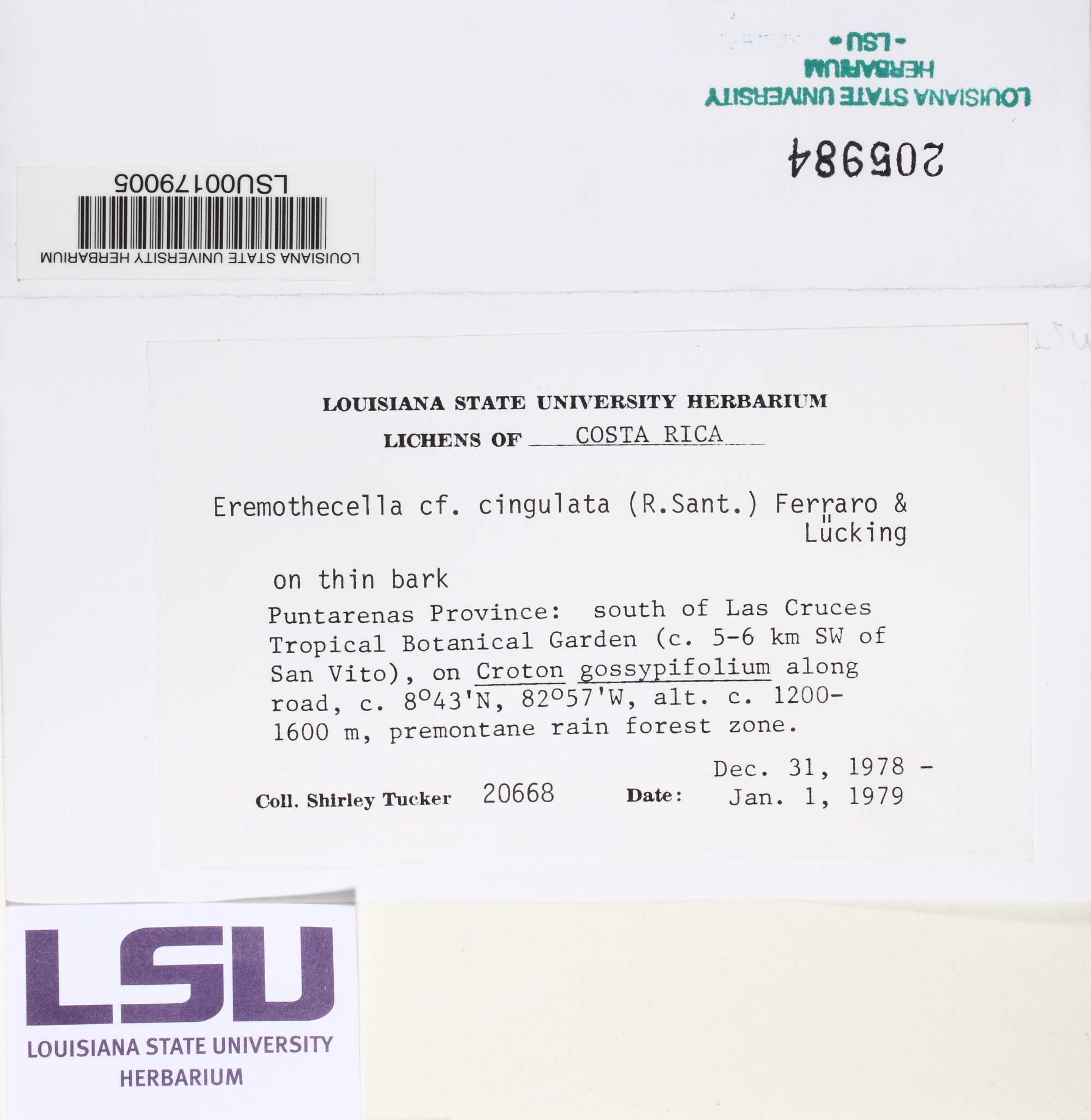
Eremothecella is a genus of lichenized fungi in the family Arthoniaceae. The genus is widespread in tropical areas.

Xylopsora
Xylopsora is a genus of lichen-forming fungi, belonging to the family Umbilicariaceae. The genus was established in 2013 when genetic studies showed that several scale-forming () lichens previously grouped together were not actually closely related. Species of Xylopsora typically grow on wood, especially old or fire-scarred timber, in forests of the Northern Hemisphere. The genus includes four recognized species, some of which were only recently discovered growing high in tree canopies or detected through environmental DNA techniques.
Lemmopsis
Lemmopsis is a genus of fungi in the family Lichinaceae. These lichens form extremely small, black, crust-like growths that often appear as a thin dusting of granules on limestone rock or clay soil and become noticeably gelatinous when moist. Distinguished by their partnership with cyanobacteria that enables nitrogen fixation, they produce minute cup-shaped reproductive structures with reddish-brown and are identified by their combination of gelatinous thallus, robust-rimmed apothecia, and single-celled spores.
Eiglera
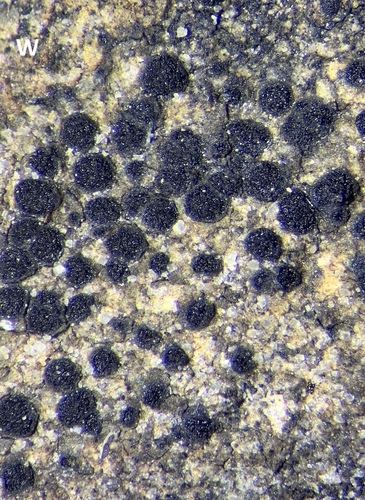
Eiglera is a small genus of rock-dwelling crustose lichens belonging to the monotypic family Eigleraceae. Eiglera species are found in Europe and Northern America.

Actinoplaca
Actinoplaca is a small genus of lichen-forming fungi in the family Gomphillaceae. The genus is foliicolous, meaning its species grow on the surface of living leaves in humid tropical forests, and has been recorded from Central and South America and tropical Africa. The genus produces distinctive spherical structures on the thallus surface, now understood to be a type of asexual reproductive structure called '''', which were among the first such structures ever described in lichens.

Thelenella
Thelenella is a genus of lichen-forming fungi in the family Thelenellaceae. These inconspicuous lichens form thin, crust-like growths that are tightly attached to their substrates and appear as dull whitish, pale grey, or light brown patches. Species of Thelenella are commonly found in damp, shaded environments where they grow on tree bark, living leaves, moss cushions, rock faces, and moss-rich soil. The genus is distinguished by its thick-walled fruiting bodies that are mostly embedded within the lichen crust and contain multicellular spores with multiple cross-walls.

Lithothelium
Lithothelium is a genus of lichen-forming fungi in the family Pyrenulaceae. Most of the species are found in tropical climates, and are usually corticolous (bark-dwelling) or saxicolous (rock-dwelling). These lichens form thin, crust-like layers that are often embedded within their substrate and are characterized by distinctive black, flask-shaped reproductive structures that may occur individually or in fused clusters with small openings for spore release. Established as a genus in 1885 by the Swiss botanist Johannes Müller Argoviensis, Lithothelium species can be distinguished from similar l
Catarrhospora
Catarrhospora is a genus of two species of lichens in the family Lecideaceae that are found in South Africa. The genus was circumscribed by the lichenologist Franklin Andrej Brusse in 1994.
Anzina
Anzina is a fungal genus of uncertain familial and ordinal classification in the subclass Ostropomycetidae. It is monotypic genus, containing the single crustose lichen species Anzina carneonivea. The lichen occurs mainly in mountainous regions of Europe and western North America, where it grows on the bark of coniferous trees and on decaying organic matter. The genus name honours the Italian botanist Martino Anzi, who first described the species in 1868. The genus was established more than a century later, after microscopic work indicated that the species had a distinctive set of .

Hymenelia
Hymenelia is a genus of lichen-forming fungi belonging to the family Hymeneliaceae.

Hydropunctaria
Hydropunctaria is a genus of saxicolous (rock-dwelling), crustose lichens in the family Verrucariaceae. The genus includes both aquatic and amphibious species, with members that colonise either marine or freshwater habitats. The type species, Hydropunctaria maura, was formerly classified in the large genus Verrucaria. It is a widely distributed species common to littoral zones. Including the type species, five Hydropunctaria lichens are considered marine species: H. adriatica, H. amphibia, H. aractina, H. orae, and H. oceanica.
Bathelium
Bathelium is a genus of lichen-forming fungi in the family Trypetheliaceae.

Llimonaea
Llimonaea is a genus of lichen-forming fungi in the order Arthoniales. The genus has been placed into the family Opegraphaceae. These lichens form thin, firmly attached crusts that vary from chalky white and grey to olive-green or dark brown, often edged by a neat black line and characterized by rounded or scribble-like reproductive structures that sit flush with the surface. Established as a genus in 1991, Llimonaea species are distinguished by their partnership with orange-tinged green algae, their spindle-shaped spores with multiple cross-walls that gradually turn brown with age, and their
Bryoplaca
Bryoplaca is a small genus of lichen-forming fungi belonging to the family Teloschistaceae. Established in 2013 by Ulrik Søchting, Patrik Frödén and Ulf Arup, this small genus comprises just three species that specialise in growing on moss-covered substrates in cold regions of the Northern Hemisphere. These lichens are distinguished by their bright orange fruiting that stand out like tiny sunbursts against the mossy cushions they inhabit, earning the genus its name which literally means 'moss-plate'.

Pterygiopsis
Pterygiopsis is a genus of lichen-forming fungi in the family Lichinaceae. It contains 12 species. These lichens form thin, blackish crusts that cling tightly to rock surfaces, especially in damp seepage zones or along stream margins, and develop pinpoint brown disc-like fruiting bodies on their surface. The genus is typically found in semi-aquatic to fully aquatic habitats, where the lichens lack distinct outer protective layers but have a slightly gelatinous texture when wet.

Lithographa
Lithographa is a genus of lichen-forming fungi in the family Xylographaceae. These rock-dwelling lichens form tightly attached crusts that crack into small tile-like patches, typically appearing in shades of grey, brown, or nearly black. The genus includes six species found primarily in cold regions and high mountains, where they grow on hard rock surfaces in harsh environments. They reproduce through distinctive elongated or round fruiting bodies that appear as dark slits or discs embedded in the crusty surface.

Malmidea
Malmidea is a genus of crustose lichens and the type genus of the family Malmideaceae. It was established in 2011 to contain a phylogenetically distinct group of species formerly placed in the genus Malcolmiella. The crust-like thallus of Malmidea lichens has a surface that varies from smooth to rough, featuring textures such as (wart-like), (grainy), or (pimpled). These textures are often formed by , which are spherical clusters of green algal cells from the family Chlorococcaceae, encased in fungal hyphae. Malmidea comprises nearly 70 mostly tropical species that grow on bark, although a few

Mycomicrothelia
Mycomicrothelia is a genus of lichen-forming fungi in the family Trypetheliaceae.

Athallia
Athallia is a genus of lichen-forming fungi in the family Teloschistaceae. Most species have a poorly developed or almost invisible thallus, with the fruiting bodies often appearing to sit directly on the substrate. The genus occurs on bark, wood, and rock, and is found mainly in temperate regions of the Northern Hemisphere. All species share a characteristic set of orange anthraquinone pigments known as A.
Ocellularia
Ocellularia is a genus of lichens in the family Graphidaceae. The genus was circumscribed by Georg Friedrich Wilhelm Meyer in 1825.
Athelopsis
Athelopsis is a genus of corticioid fungi in the family Amylocorticiaceae. The widespread genus, estimated to contain 10 species, is polyphyletic as currently circumscribed.
Mobergia
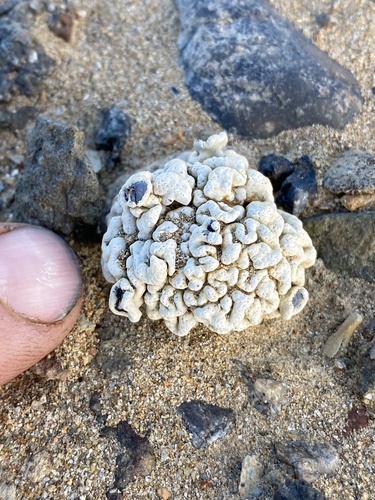
Mobergia is a genus of lichen-forming fungi in the family Physciaceae.
Fissurina
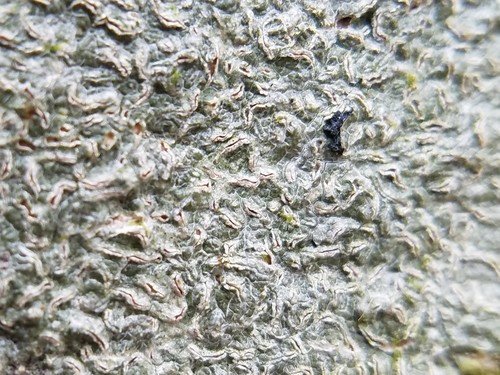
Fissurina is a genus of lichenized fungi in the family Graphidaceae. It has about 160 species, most of which are found in tropical regions.
Bulbothrix
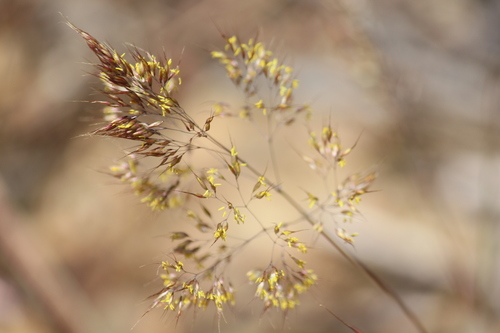
Bulbothrix is a genus of lichen-forming fungi in the family Parmeliaceae. Established in 1974 by the American lichenologist Mason Hale as a segregate from the genus Parmelia, Bulbothrix comprises about 40 accepted species as of 2025. These foliose lichens are distinguished by their characteristic black, bulb-tipped hairs () along the lobe edges and are found roughly equally divided between the Old World and New World, growing predominantly on trees in lowland rainforests and shrublands.

Stigmatochroma
Stigmatochroma is a genus of lichenized fungi in the family Caliciaceae. The genus has a widespread distribution, and contains 9 species.

Eopyrenula
Eopyrenula is a genus of lichen-forming fungi in the family Dacampiaceae. It comprises six species. The genus was established in 1973 by Richard C. Harris to separate these lichens from the related genus Pyrenula, based on differences in their reproductive structures and spore characteristics. Eopyrenula species are found on tree bark in temperate regions, particularly in Europe and North America, where they form thin, pale grey crusts dotted with tiny dark fruiting bodies. The genus occupies an uncertain position in fungal classification, with its family placement remaining provisional pendin

Bryodina
Bryodina is a genus of two species of crustose lichens in the family Lecanoraceae. It was first proposed as a distinct genus by Austrian lichenologist Josef Hafellner in the early 1990s, but the name was validly published only in 2001 when Hafellner supplied a formal Latin and typification. It is distinguished from the morphologically similar genus Bryonora by the clearly separated and , and by the thin-walled ascospores.
Botryolepraria
Botryolepraria is a genus of byssoid (cottony) lichens of uncertain familial placement in the order Verrucariales. It has two species. The thallus is an uncorticated, three-dimensional network of free fungal hyphae that holds clusters of green algal cells suspended within the lattice, so under low magnification it can resemble a pale, granular Lepraria-like crust. Reports are mostly from shady, humid, protected microhabitats on sheltered rock (often limestone) or on tree bark, including cave entrances and damp woodland or swamp habitats.

Clathroporina
Clathroporina is a genus of lichenized fungi in the family Porinaceae. It was circumscribed by Swiss lichenologist Johannes Müller Argoviensis in 1882.
Myochroidea
Myochroidea is a genus of lichen-forming fungi of uncertain familial placement in the order Lecanorales. It has four species of grey or brown-grey crustose lichens.

Blennothallia
Blennothallia is a genus of jelly lichens in the family Collemataceae. It has four species, which collectively have a cosmopolitan distribution.
Calotrichopsis
Calotrichopsis is a small genus of cyanolichens placed in the family Porocyphaceae. The genus was originally circumscribed by the Finnish lichenologist Edvard August Vainio in 1896. A 2024 multilocus study of the class Lichinomycetes emended Porocyphaceae and provisionally included Calotrichopsis in that family; earlier references had kept the genus in Lichinaceae. Species are minute, dark-coloured lichens partnered with cyanobacteria and are typically found on rock or soil in open, intermittently wet microhabitats. The family placement is considered tentative pending additional molecular samp

Celothelium
Celothelium is a genus of lichen-forming fungi in the family Celotheliaceae. These lichens typically have a thin, crust-like thallus that often grows beneath the surface of tree bark or rocks in tropical rainforests and coastal areas. Celothelium species are characterised by small, black, shiny reproductive structures (perithecia), and thread-like spores. The genus has had an uncertain taxonomic history since its original description in 1860, but recent genetic studies have placed it in its own distinct group within the fungal class Eurotiomycetes. Celothelium species have been found in variou
Platythecium
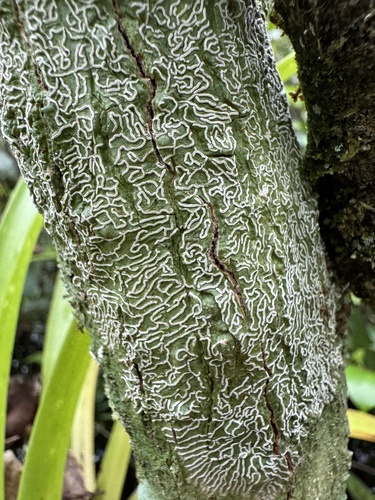
Platythecium is a genus of lichen-forming fungi in the family Graphidaceae. It comprises 25 species. Described in 2002 by the German lichenologist Bettina Staiger, these bark-dwelling lichens are found in humid, shaded forests across tropical and warm temperate regions worldwide. They are characterized by their flattened, plate-like fruiting structures with completely blackened walls and are sensitive to forest disturbance, making their presence an indicator of long-established woodland conditions.
Combea
Combea is a genus of lichens in the family Opegraphaceae. It has two species. The genus was circumscribed by Italian botanist Giuseppe De Notaris in 1846.
Clauzadeana
Clauzadeana is a genus of lichen-forming fungi in the family Lecanoraceae. The genus was circumscribed in 1984 by Claude Roux, with the crustose species C. instratula assigned as the type.

Farnoldia
Farnoldia is a small genus of lichen-forming fungi in the family Lecideaceae. These lichens grow as dark crusts on limestone and other calcium-rich rocks, especially in mountainous areas. The genus contains three known species and can be distinguished from similar lichens by their distinctive black fruiting bodies (apothecia) and violet reaction when tested with iodine staining.

Leiorreuma
Leiorreuma is a genus of script lichens in the family Graphidaceae. It has 18 species. The genus was circumscribed by Franz Gerhard Eschweiler in 1824, with Leiorreuma hepaticum assigned as the type species.
Anomomorpha
Anomomorpha is a genus of lichens in the family Graphidaceae. The genus, described in 1891, has a pantropical distribution. These lichens form pale grey to dull olive crusts on tree bark that often develop low wart-like bumps covered with powdery particles, and produce narrow, usually wavy slit-like fruiting bodies. They are found in tropical rainforests worldwide, growing on shaded to semi-exposed bark in primary or lightly disturbed evergreen forests, with some species being narrowly restricted to specific mountain cloud forests.
Baculifera
Baculifera is a genus of lichens in the family Caliciaceae. It was circumscribed in 2000 by Bernhard Marbach and Klaus Kalb. Species in this genus are characterized by having bacilliform conidia typically measuring 8–11 μm long, and a non- hymenium. The genus is roughly similar in morphology to Buellia.

Plectocarpon
Plectocarpon is a genus of lichenicolous (lichen-dwelling) fungi in the family Lecanographaceae. The genus, which was established in 1825 by the French botanist Antoine Laurent Apollinaire Fée, contains about 30 species that live as parasites on other lichens rather than forming their own independent body (thallus). These fungi are recognized by the small, wart-like swellings they create on their host lichens and by their distinctive dark fruiting bodies that often contain a green pigment that dissolves when treated with potassium hydroxide solution.

Phyllopsora
Phyllopsora is a genus of lichen-forming fungi in the family Ramalinaceae.
Thelignya
Thelignya is a genus of fungi within the family Lichinaceae. It is monotypic, containing only the single species Thelignya fuliginea.

Glypholecia
Glypholecia is a genus of lichenized fungi in the family Acarosporaceae.

Dufourea
genus of fungi

Asahinea
Asahinea is a genus of lichen-forming fungi in the family Parmeliaceae. The genus has a widespread circumpolar distribution, and contains four species. The species form medium to large, leaf-like, yellowish to brownish crusts on rocks and plant debris in open arctic and alpine habitats, and can be conspicuous in the field; A. chrysantha in particular produces bright yellow rosettes that stand out against the tundra. The genus is named in honour of the Japanese lichenologist Yasuhiko Asahina, who made foundational contributions to the understanding of lichen chemistry in the twentieth cent
Placocarpus
Placocarpus is a genus of lichens in the family Verrucariaceae. The genus was circumscribed by Italian botanist Vittore Benedetto Antonio Trevisan de Saint-Léon in 1860.

Clypeopyrenis
Clypeopyrenis is a genus of lichen-forming fungi in the family Pyrenulaceae. The genus was circumscribed in 1991 by Dutch lichenologist André Aptroot, with Clypeopyrenis microsperma assigned as the type species. This lichen, originally described from material collected in Costa Rica, is also found in the Caribbean and South America. Clypeopyrenis porinoides was added to the genus in 2011; it was discovered in Costa Rica, close to the type locality of the type species.
Sporopodiopsis
Sporopodiopsis is a genus of two species of lichenized fungi in the family Ectolechiaceae. The genus was circumscribed by the Belgian lichenologist Emmanuël Sérusiaux in 1997.
Aderkomyces
Aderkomyces is a genus of lichen-forming fungi in the family Gomphillaceae. Originally established in 1961 for a single species from Brazil, the genus was later expanded to include many species previously classified in the related genus Tricharia, all sharing distinctive white bristle-like structures and flattened fruiting bodies. Recent molecular studies suggest that Aderkomyces as currently defined may not represent a natural evolutionary group, leading to ongoing reclassification of many species into other genera.

Pseudopyrenula
Pseudopyrenula is a genus of lichen-forming fungi in the family Trypetheliaceae.
Niebla
genus of fungi
Cheiromycina
Cheiromycina is a genus of lichen-forming fungi belonging to the family Malmideaceae.
Steinia
Steinia is a genus of lichen-forming fungi in the family Aphanopsidaceae. The genus was established in 1873 by Gustav Wilhelm Körber and contains three recognised species. These lichens grow on disturbed soil and form very thin, powdery crusts that are often barely visible to the naked eye. They produce small, dark brown to black fruiting bodies that contain unusually large numbers of ascospores—up to 16 in each spore-bearing structure.

Halecania
Halecania is a genus of fungi in the family Leprocaulaceae. It has 24 species. These lichens form inconspicuous, crust-like films that spread over rock or other surfaces, with colours ranging from chalky white through bluish-grey to brownish-grey and textures that can be cracked like dried mud, granular, or covered in tiny warts. They reproduce through small, disc-shaped fruiting bodies that contain eight colourless ascospores divided by a single cross-wall, with the spore envelope swelling conspicuously when treated with certain chemicals—a key identifying feature.
Austrographa
Austrographa is a genus of lichen-forming fungi in the family Roccellaceae. It has three species. The genus was circumscribed in 2013 by lichenologists Laurens Sparrius, John Elix, and Alan Archer, with Austrographa kurriminensis assigned as the type species. The genus had been published invalidly on two separate occasions. All three species in the genus were found in a mangrove stand in Queensland, Australia. The genus was discovered in Australia, and the name Austrographa reflects this.

Montanelia
Montanelia is a genus of lichen-forming fungi belonging to the large family Parmeliaceae. The genus comprises foliose lichens recognised by its short, narrow with flat to slightly convex edges; a smooth, unperforated outer skin (); shallow, irregular pseudocyphellae—tiny pores—on the upper surface; slender, cylindrical to spindle-shaped asexual spores (conidia); and a white medulla that contains orcinol depsides.

Angiactis
Angiactis is a genus of crustose lichens of uncertain familial placement in the order Arthoniales. It has four species.
Crocynia
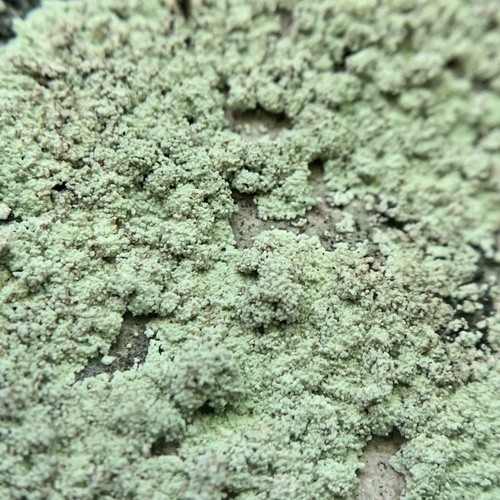
Crocynia is a genus of lichen-forming fungi in the family Ramalinaceae. It has five species. The genus is currently in taxonomic limbo because molecular studies have shown that Crocynia, which has nomenclatural priority over Phyllopsora, is phylogenetically nested within Phyllopsora. This has led to a proposal to conserve the name Phyllopsora over Crocynia to ensure nomenclatural stability and avoid taxonomic disarray.