Category
page 7Lichen genera
Pyxine
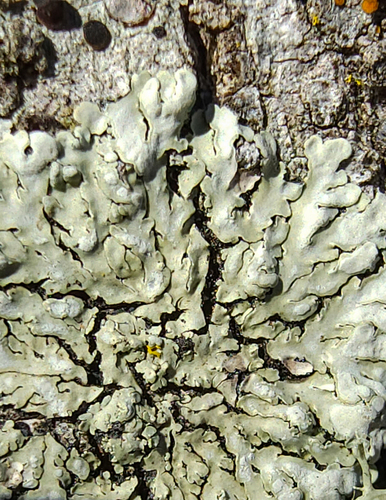
Pyxine is a genus of foliose lichens in the family Caliciaceae. The genus has a widespread distribution in tropical regions. It was established in 1825 by the Swedish botanist Elias Fries and is distinguished from similar lichens by its characteristic golden fluorescence under ultraviolet light due to the compound lichexanthone. These small, leaf-like lichens form radiating rosettes with narrow and tiny white lines called pseudocyphellae that act as air vents on their upper surface.
Gymnographopsis
Gymnographopsis is a genus of lichen-forming fungi in the family Graphidaceae. It was circumscribed by American lichenologist Carroll William Dodge in 1967, with Gymnographopsis chilena assigned as the type species. These lichens form dull grey-olive to yellow-brown crusts on tree bark and are characterized by straight to weakly curved fruiting bodies whose sides appear brown-black and whose openings expose -like surfaces. The genus has a pantropical distribution, growing on shaded tree trunks and lower branches in evergreen forests, where their intolerance of heavy disturbance makes them usef

Aspidothelium
Aspidothelium is a genus of lichen-forming fungi in the family Thelenellaceae. All species in the genus have a tropical distribution and are crustose with a photobiont partner. Most Aspidothelium species are foliicolous (leaf-dwelling), although some corticolous (bark-dwelling) species are known, as well as a single saxicolous (rock-dwelling) member.
Sulcopyrenula
Sulcopyrenula is a genus of lichen-forming fungi in the family Pyrenulaceae. It contains five species. Sulcopyrenula is a largely tropical American genus with a single outlier in East Asia, and all five species share a preference for relatively undisturbed, humid bark substrates—whether in savanna woodland, rainforest or shaded montane hardwood stands.

Eschatogonia
Eschatogonia is a genus of lichen-forming fungi in the family Ramalinaceae. It has seven species. The genus was circumscribed by the Italian lichenologist Vittore Benedetto Antonio Trevisan de Saint-Léon in 1853.
Aptrootia
Aptrootia is a genus of fungi in the family Trypetheliaceae. It has four species. The genus was circumscribed by Robert Lücking and Harrie Sipman in 2007, with Aptrootia terricola assigned as the type species. This species, originally described by Dutch mycologist André Aptroot as a species of Thelenella, is known from Papua New Guinea and Costa Rica. Later molecular work showed that the species did not belong in Thelenella (Aptroot himself had expressed doubt about this generic placement), but rather, in the Trypetheliaceae, with a sister taxon relationship to a branch including Bathelium and

Physma
Physma is a genus of cyanolichens in the family Pannariaceae. It has five species. The genus was circumscribed by Italian lichenologist Abramo Bartolommeo Massalongo in 1854, with Physma boryanum assigned as the type species.

Eremastrella
Eremastrella is a genus of lichen in the family Psoraceae. The genus was circumscribed by the lichenologist Stefan Vogel in 1955, with Eremastrella tobleri assigned as the type species.

Mycobilimbia
Mycobilimbia is a genus of lichen-forming fungi in the family Ramalinaceae. These lichens are characterized by their crust-like growth form that appears as a thin layer on various surfaces, ranging in colour from creamy white to greenish-grey. The genus was proposed by the German lichenologist Heinrich Rehm in 1890. Mycobilimbia species can be identified by their distinctive reproductive structures (apothecia) that start as flat discs and later become convex bumps, typically in beige to reddish-brown colours.
Dyplolabia
Dyplolabia is a genus of lichen-forming fungi in the family Graphidaceae. These lichens form smooth, rather thick grey-yellow to olive-buff crusts on tree bark and are characterized by narrow, elongate fruiting bodies that are commonly hidden beneath a conspicuous white powdery coating. The genus has a pantropical distribution, growing on the smooth bark of trees and shrubs in both shaded rainforest understories and moderately exposed coastal woodlands, where they serve as indicators of long-established woodland habitat.

Pyrenocollema
Pyrenocollema is a genus of lichenized fungi in the biological division Ascomycota. The genus was described by German botanist Johannes Reinke in 1895 and has been placed in the family Xanthopyreniaceae. Species in the genus form borderline lichen symbioses with cyanobacteria and are typically found in marine and freshwater environments, growing on rock surfaces or within calcareous substrates such as limestone and the shells of barnacles and limpets. Several species formerly placed in Pyrenocollema have been transferred to the related genus Collemopsidium.
Ameliella
Ameliella is a genus of lichenized fungi in the family Lecanoraceae. Described in 2008, the genus contains two species, A. andreaeicola and A. grisea, that were collected from high elevations in the Scottish Highlands. The two species have also been found in single instances in British Columbia and Northern Norway. The generic name is derived from the Greek , meaning "neglected" or "overlooked"; it was originally intended to be Amelia, which is also the first name of the daughter of one of the authors, but this name had previously been used for another genus and was therefore ineligi

Zahlbrucknerella
Zahlbrucknerella is a genus of filamentous, rock-dwelling lichens in the family Lichinaceae.
Endohyalina
Endohyalina is a genus of 10 species of corticolous (bark-dwelling) crustose lichens in the family Caliciaceae. These lichens either form thin, tightly attached crusts on tree bark or live as parasites on other lichens, sometimes becoming so reduced that they are nearly invisible to the naked eye. They produce small, black, disc-shaped fruiting bodies that begin buried in the crust and later emerge flush with the surface, containing spores that are divided once by a cross-wall and darken to brown as they mature.

Bilimbia
Bilimbia is a genus of lichen-forming fungi in the family Ramalinaceae. The genus forms crustose (crust-like) lichens that appear as whitish-grey to grey patches on calcium-rich soils or mosses growing over alkaline surfaces. The genus is distinguished by its sessile apothecia (fruiting bodies) that range from light ochre to black, eight-spored asci, and colourless spores with multiple cross-walls. Molecular phylogenetics studies have confirmed that Bilimbia forms a well-supported monophyletic group within the Ramalinaceae, and as of 2025, it contains 24 accepted species.

Gyalolechia
Gyalolechia is a genus of lichen-forming fungi belonging to the family Teloschistaceae. It contains about 20 species of crustose lichens.
Acanthotrema
Acanthotrema is a genus of lichens in the family Graphidaceae. The genus was circumscribed by German lichenologist Andreas Frisch in 2006, with Acanthotrema brasilianum assigned as the type species. Acanthotrema species are commonly found in rainforests ranging from lowland to montane environments.
Toniniopsis
Toniniopsis is a genus of crustose and squamulose lichens in the family Ramalinaceae. The genus was circumscribed by Swiss lichenologist Eduard Frey in 1926, with Toniniopsis obscura designated the type and only species. The genus name of Toniniopsis is in honour of Carlo Tonini (1803–1877), who was an Italian chemist and botanist (Lichenology), who worked in Verona and was a member and President of the Academy of Agriculture.
As a result of molecular phylogenetic studies, several species, formerly classified in genus Bacidia, have been transferred to Toniniopsis.
Pycnothelia
Pycnothelia is a small genus of lichen-forming fungi in the family Cladoniaceae. The genus contains three species that form distinctive upright, hollow stalks (podetia) rising from a grainy crust, topped with dark, round fruiting bodies. These lichens typically grow on soil or mossy ground in cool, humid habitats. The genus has a scattered global distribution, with one species found across Europe and parts of the Americas, while the other two are restricted to islands in the Southern Hemisphere.

Harpidium
Harpidium is a genus of lichen-forming fungi in the family Harpidiaceae. The genus contains three species. Harpidium was circumscribed in 1855 by German lichenologist Gustav Wilhelm Körber, with Harpidium rutilans assigned as the type species.
Protomicarea
thumb | right | alt=Lichens of Calvert Island. D. Protomicarea limosa, McMullin 19698 (CANL). | Lichens of Calvert Island. D. Protomicarea limosa, McMullin 19698 (CANL).
Protomicarea is a genus of lichen-forming fungi in the family Psoraceae. The genus contains two species: Protomicarea limosa (the type) and Protomicarea alpestris. Protomicarea was circumscribed by lichenologist Josef Hafellner in 2001.

Pyrenopsis
Pyrenopsis is a genus of lichen-forming fungi in the family Porocyphaceae. The lichens grow on constantly wet, shaded rock faces where they form gelatinous crusts that soften and show reddish tints when moistened. They reproduce through small, buried fruiting bodies that open as pore-like structures at the surface.

Heteroplacidium
Heteroplacidium is a genus of lichen-forming fungi in the family Verrucariaceae. The genus was circumscribed by Austrian lichenologist Othmar Breuss in 1996 with Heteroplacidium imbricatum assigned as the type species. It was proposed as a segregate of Catapyrenium. Other morphologically similar genera are Neocatapyrenium, Placidium, and Scleropyrenium, although molecular phylogenetic analyses indicate that they are independent monophyletic lineages within the Verrucariaceae.

Porocyphus
Porocyphus is a genus of lichen-forming fungi in the family Porocyphaceae. The genus was established in 1855 by the German lichenologist Gustav Wilhelm Körber to distinguish certain lichens from the related genus Collema, based on differences in their reproductive structures. Porocyphus species are found worldwide and are characterised by their pore-like fruiting bodies and simple spores. They form dark, gelatinous crusts on rocks, soil, and bark.
Coelopogon
Coelopogon is a genus of lichen-forming fungi in the family Parmeliaceae. The genus contains two species found in southern South America and South Africa.

Sigridea
Sigridea is a genus of lichenized fungi in the family Roccellaceae.
Caleniopsis
Caleniopsis is a genus of fungi in the family Gomphillaceae.

Orphniospora
Orphniospora is a small genus of lichen-forming fungi in the family Fuscideaceae. The genus was established in 1874 by the German lichenologist Gustav Wilhelm Körber and comprises three saxicolous (rock-dwelling) crustose species. These lichens are distinguished by their unusual spores, which are nearly spherical, single-celled, and produced only a few at a time in each spore-bearing structure. Despite being placed in the family Fuscideaceae in recent classifications, molecular studies have shown that Orphniospora does not actually belong to this family, leaving its correct taxonomic position
Pseudoramonia
Pseudoramonia is a genus of lichen-forming fungi in the family Graphidaceae. The genus was circumscribed by lichenologists Gintaras Kantvilas and Antonín Vězda in 2000, with the type species designated as Pseudoramonia stipitata.
Megalotremis
Megalotremis is a genus of lichen-forming fungi in the family Monoblastiaceae. It has 16 species. The genus was circumscribed by Dutch lichenologist André Aptroot in 1991, with Megalotremis verrucosa assigned as the type species. Megalotremis is a genus, meaning its species have ascocarps: spherical or flask-shaped, sessile or partly immersed in the thallus, with a single opening (ostiole) and enclosed by a distinct wall.

Fibrillithecis
Fibrillithecis is a genus of lichen-forming fungi in the family Graphidaceae. The genus was circumscribed in 2006 by the German lichenologist Andreas Frisch, with Fibrillithecis vernicosa assigned as the type species.
Dichosporidium
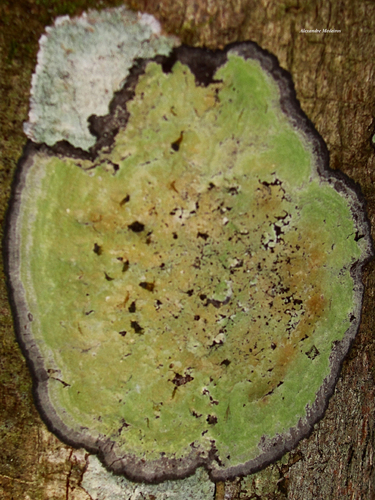
Dichosporidium is a genus of lichen-forming fungi in the family Roccellaceae.

Neophyllis
Neophyllis a small genus of lichen-forming fungi in the family Sphaerophoraceae. The genus is endemic to Australasia, occurring in southeastern Australia, Tasmania and New Zealand. It comprises two recognised species characterised by small, leaf-like structures () and black, spherical spore-producing structures (apothecia). The more common and widespread species, N. melacarpa, typically grows on rotting wood and soil in various forest and heathland habitats, while the rarer N. pachyphylla is found mainly on granite and sandstone substrates. First proposed in 1889 as Phyllis and renam

Herpothallon
Herpothallon is a genus of crustose lichens in the family Arthoniaceae. It has about 50 species.

Stegobolus
Stegobolus is a genus of lichen-forming fungi in the family Graphidaceae. Established in 1845 by the French botanist Camille Montagne, the genus contains 16 species distinguished by their unique fruiting structures that initially appear drum-shaped and closed, later bursting open by shedding their roof-like covering. These bark-dwelling lichens are found in humid tropical and warm temperate forests worldwide, where they serve as indicators of undisturbed woodland habitats due to their sensitivity to canopy opening and drought.

Ampliotrema
Ampliotrema is a genus of lichen-forming fungi in the family Graphidaceae. The genus was originally described invalidly in 2004, and validly two years later.
Cystocoleus
Cystocoleus is a fungal genus in the family Cystocoleaceae. The genus was established in 1849 by the British botanist G.H.K. Thwaites and is now considered to contain only one species, Cystocoleus ebeneus. These fungi form minute, sooty-brown to black patches made up of densely packed, brittle filaments that have a fluffy, felt-like appearance. They typically grow on shaded rock faces or damp bark near running water.
Alyxoria
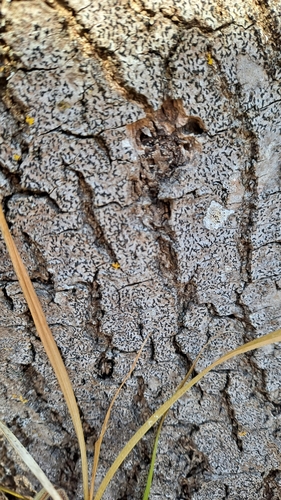
Alyxoria is a genus of lichen-forming fungi in the family Lecanographaceae. The genus has a cosmopolitan distribution. These lichens are often so inconspicuous that they appear as little more than faint cracks or weathered patches on tree bark and rock surfaces, making them easily overlooked in the field. The genus includes about 20 species that reproduce through distinctive elongated slits containing spores, and can also spread asexually through tiny flask-shaped structures that release microscopic propagules.

Aulaxina
Aulaxina is a genus of lichen-forming fungi in the family Gomphillaceae. Species of Aulaxina are found predominantly in humid tropical forests across Africa, Asia, and the Americas, where they grow on the surface of living leaves, a foliicolous lifestyle. The genus is recognised by its distinctive blackish fruiting bodies, which open in a star-like or slit-like pattern, and by the small dark hairs and club-shaped reproductive structures that dot the thallus surface. The exact number of species in the genus is uncertain, as different taxonomic databases currently disagree on which names are acc

Myriotrema
Myriotrema is a genus of lichen-forming fungi in the family Graphidaceae.
Gowardia
Gowardia is a genus of medium-sized, greyish hair lichens in the family Parmeliaceae. It is a circumpolar genus, mainly restricted to arctic-alpine habitats in northern Canada, Europe, and Russia.
Pallidogramme
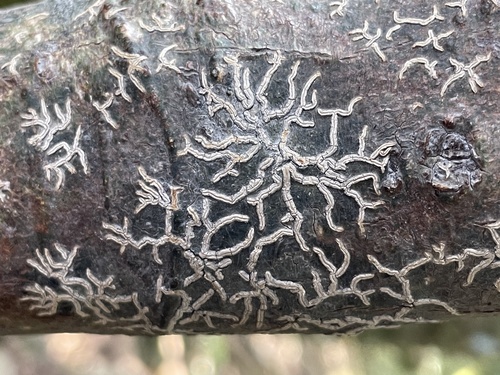
Pallidogramme is a genus of lichen-forming fungi in the family Graphidaceae. It has 8 species of corticolous (bark-dwelling), crustose lichens.
Puttea
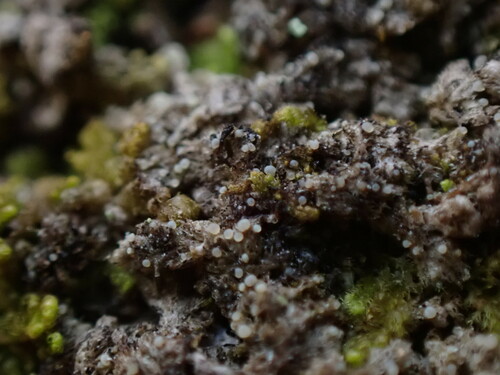
Puttea is a genus of lichen-forming fungi with uncertain familial placement in the order Lecanorales. The genus comprises four species. Finnish lichenologists Soili Stenroos and Seppo Huhtinen established the genus Puttea in 2009 for the lichen species formerly known as Lecidea margaritella, which has undergone various reclassifications. Molecular phylogenetics analyses have shown that Puttea margaritella does not align closely with genera like Fellhanera or Micarea, but its precise familial placement remains uncertain. Puttea is characterized by an indistinct, lichenized thallus composed of d

Tremotylium
Tremotylium is a genus of lichen-forming fungi in the family Graphidaceae. The genus was circumscribed by Finnish lichenologist William Nylander in 1865, but it was not published validly. He validated the genus and assigned T. angolense as the type species in 1868.

Muellerella
Muellerella is a genus of lichenicolous lichens in the family Verrucariaceae. The genus has a widespread distribution, especially in northern temperate areas, and contains species that live on other lichens, or on liverworts.
Henrica
Henrica is a genus of crustose lichens in the family Verrucariaceae. It has four species. These lichens grow as crusts that adhere tightly to limestone, sandstone, and other hard rocks, ranging from paper-thin films to thick, warted layers in subdued colours of white, pale grey, or fawn. They reproduce through black to dark-brown flask-shaped fruiting bodies that contain distinctive brown spores divided into numerous cells like a brick wall, giving them a characteristic appearance.

Ahtiana
Ahtiana is a fungal genus in the family Parmeliaceae. A monotypic genus, it contains the single species Ahtiana sphaerosporella, the mountain candlewax lichen, found in western North America. The species was originally classified as Parmelia sphaerosporella by Johannes Müller Argoviensis in 1891, before Trevor Goward established the new genus Ahtiana in 1985, naming it after Finnish lichenologist Teuvo Ahti. This foliose lichen is characterised by its pale yellowish-green thallus, spherical spores, laminal apothecia (fruiting bodies), and the presence of usnic and caperatic acids. It primarily

Thalloloma
Thalloloma is a genus of lichen-forming fungi in the family Graphidaceae. Established in 1853 by the Italian botanist Vittore Trevisan de Saint-Léon, the genus comprises 20 species distinguished by their narrow script-like slits immersed in a pale crusty surface, often with dark brown or occasionally crimson-dusted fruiting structures. Found throughout tropical regions from sea level to mountain forests above 3,000 metres, these bark-dwelling lichens are more tolerant of light and moisture variation than many related species, allowing them to colonise forest edges and moderately sun-exposed lo
Microcaliciaceae
Microcalicium is a genus of lichen-forming fungi in the order Pertusariales. It is the only genus in the monotypic family Microcaliciaceae. These taxa were circumscribed by the Finnish lichenologist Edvard August Vainio in 1927, with Microcalicium disseminatum assigned as the type species.

Pannoparmelia
Pannoparmelia is a genus of lichenised ascomycetes in the large family Parmeliaceae. It is a genus of five currently accepted species. Pannoparmelia species have a foliose growth habit. All members of the family have a symbiotic association with green alga and the majority of Parmeliaceae species have foloiose. The morphological diversity is enormous within this group and the specimen are difficult to identify in its species level. There are a range of habitats and climatic regions within this family and it includes tropical rainforest trees to subshrubs in Arctic tundra.[3]
Acantholichen
Acantholichen is a genus of basidiolichen-forming fungus species in the family Hygrophoraceae. The genus was established in 1998 by the Per Magnus Jørgensen based on a single species from Costa Rica, but has since grown to include seven recognized species found across Central and South America. These lichens form crusts made of tiny, scale-like flaps that give them a finely granular appearance, quite different from the thread-like growth of their close relatives. Acantholichen species partner with blue-green bacteria to create their living structures, using specialized fungal pegs to exchange
Dolichousnea
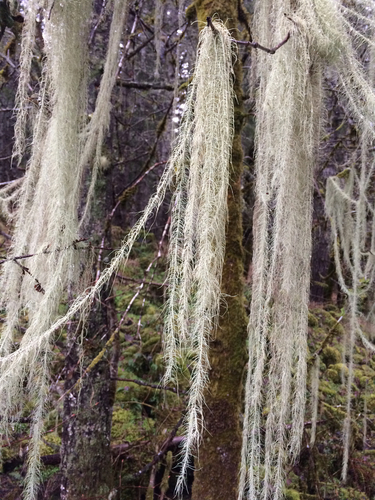
Dolichousnea is a genus of fruticose lichens in the family Parmeliaceae. It has three species. The widely distributed type species, Dolichousnea longissima, is found in boreal regions of Asia, Europe, and North America.

Lopadium
genus of fungi

Hypocenomyce
Hypocenomyce is a genus of lichen-forming fungi in the family Ophioparmaceae. Species in the genus grow on bark and on wood, especially on burned tree stumps and trunks in coniferous forest. Hypocenomyce lichens are widely distributed in the northern hemisphere.

Diorygma
Diorygma is a genus of lichen-forming fungi in the family Graphidaceae. The genus was circumscribed by Franz Gerhard Eschweiler in 1824. Species of the genus are widely distributed in tropical and subtropical regions of the world. These lichens form paint-like crusts on bark and rock that range from chalky white to light green, with elongated, pencil-like slits containing their spores that may flex and branch across the surface. The genus was established in 1824 for tropical script lichens with large, many-celled spores, but molecular studies in the 2000s and 2010s expanded it significantly by

Parabagliettoa
Parabagliettoa is a genus of crustose lichens in the family Verrucariaceae. It has 3 species. The genus was circumscribed in 2009 by Cécile Gueidan and Claude Roux, with Parabagliettoa dufourii assigned as the type species.

Polychidium
Polychidium is a genus of lichen-forming fungi in the family Massalongiaceae. These lichens form tiny, shrub-like tufts with branching filaments that create woolly cushions on moss-covered rocks and tree twigs. The genus was traditionally thought to include four similar-looking species, but molecular studies revealed that three of these actually belong to a different genus called Leptogidium. Today, Polychidium in the strict sense contains only P. muscicola and three closely related species, found from tropical to subarctic regions worldwide.
Parmelinella
Parmelinella is a genus of lichen belonging to the family Parmeliaceae. The genus was circumscribed in 1987 by John Elix and Mason Hale as a segregate of Parmelina, from which it differs in having larger ascospores and containing salazinic acid. Although the genus had been assumed to be well-defined morphologically, a 2021 molecular phylogenetic study suggests that the generic delimitations need to be revised.

Graphidastra
Graphidastra is a genus of lichen-forming fungi in the family Roccellaceae.
Arthrorhaphis
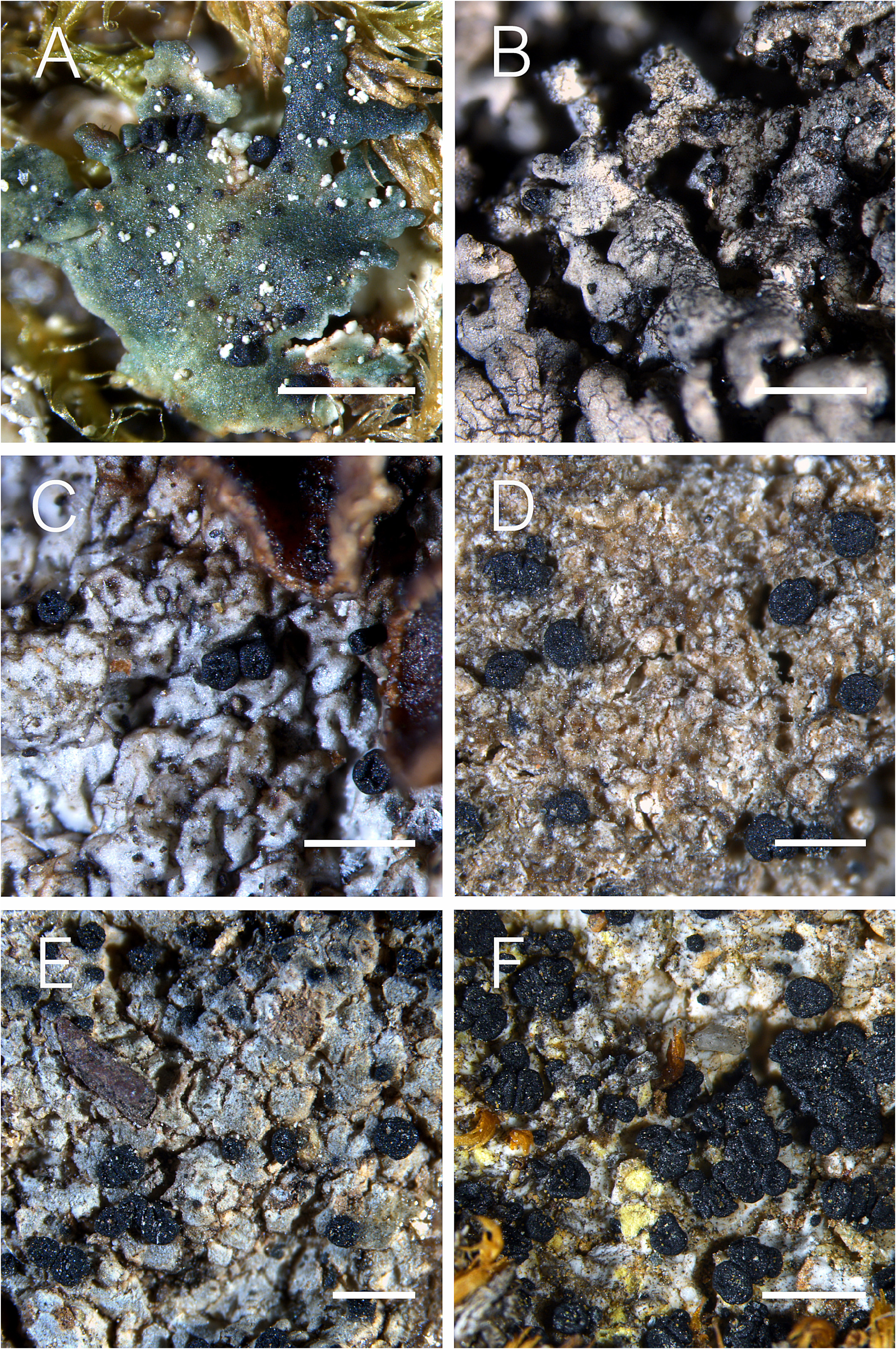
Arthrorhaphis is a genus of fungi in the monotypic family Arthrorhaphidaceae. It has 13 species. Species in this family have a widespread distribution in temperate and montane habitats. They grow symbiotically with green algae, or parasitically on other lichens. These fungi typically start as parasites on other lichens but can later become free-living, forming bright greenish-yellow to greyish scales on acidic soils and weathered rocks in cool upland regions.