Category
page 5Lichen genera
Normandina
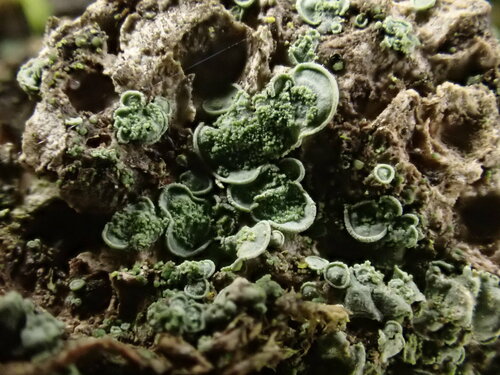
Normandina is a genus of lichen-forming fungi in the family Verrucariaceae. It has five species of crustose and squamulose (scaly) lichens.

Coccocarpia
Coccocarpia is a genus of lichen-forming fungi in the family Coccocarpiaceae. Recent genetic studies suggest the genus originated in the Australasia–Oceania region during the Late Cretaceous period, roughly 76–100 million years ago, and later spread to Asia and the Americas. Some South American lineages are thought to have reached the continent via warm rainforest corridors that crossed Antarctica during the Palaeogene period, around 50–60 million years ago.
Gypsoplacaceae
Gypsoplacaceae is a family of lichenized fungi in the order Lecanorales. This is a monotypic family, containing the single genus Gypsoplaca, which has a widespread distribution. The family and genus were described as new in 1990 by Norwegian lichenologist Einar Timdal. Gypsoplaca originally contained only the type species, Gypsoplaca macrophylla, but four species were added to the genus in 2018.

Sclerophyton
Sclerophyton is a genus of lichen-forming fungi in the family Opegraphaceae. It has about 15 species. The genus was circumscribed by German lichenologist Franz Gerhard Eschweiler in 1824, with Sclerophyton elegans assigned as the type species.

Piccolia
Piccolia is a small genus of crustose lichens in the class Lecanoromycetes. First circumscribed by Italian lichenologist Abramo Bartolommeo Massalongo in 1864, it contains ten species. Due to a lack of molecular data, it has not been assigned to an order or family.
Euopsis
Euopsis is a small genus of lichen-forming fungi in the family Harpidiaceae. The genus contains two species. The genus was established in 1881 by the Finnish lichenologist William Nylander, who transferred species from the genus Pyrenopsis based on differences in their reproductive structures. These lichens form dark reddish-brown crusts that become jelly-like when wet and grow primarily on damp, acidic rock faces and mossy surfaces.

Hemithecium
Hemithecium is a genus of lichen-forming fungi in the family Graphidaceae. These lichens form pale grey-white to yellow-olive crusts on tree bark and are characterized by straight to weakly curved fruiting bodies with charcoal-black walls that create sharp contrasts against the surface, along with distinctive spine-tipped filaments lining their interior chambers. The genus has a pantropical distribution, growing on shaded tree trunks and large branches in primary or lightly disturbed evergreen forests, where their marked sensitivity to canopy opening makes them practical indicators of intact,
Petractis
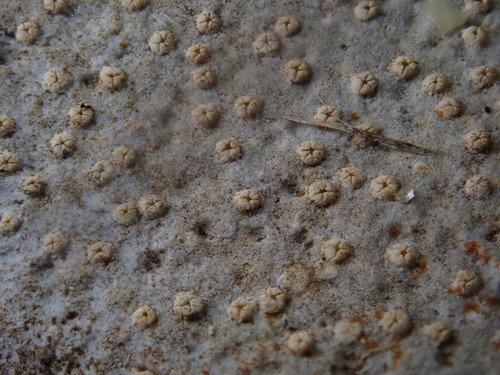
Petractis is a small genus of lichen-forming fungi of uncertain familial and ordinal placement in the Lecanoromycetes. These inconspicuous lichens grow as thin crusts embedded within rock surfaces, partnering with cyanobacteria to form barely visible films that are primarily detected by their small, star-shaped fruiting bodies. The genus contains two species that typically inhabit calcareous rocks, where their fruiting structures create distinctive pits in the stone surface after they decay.

Clauzadea
Clauzadea is a genus of lichen-forming fungi in the family Lecideaceae. The genus contains four species. These lichens grow almost exclusively on limestone and other calcium-rich rocks, often living mostly hidden within the upper layers of the stone with only a faint grey or brown film visible on the surface. They produce small, initially reddish-brown fruiting bodies that darken to black and may sit flush with the rock surface or be sunken so deeply that they leave neat pits when they weather away.
Cyphellostereum
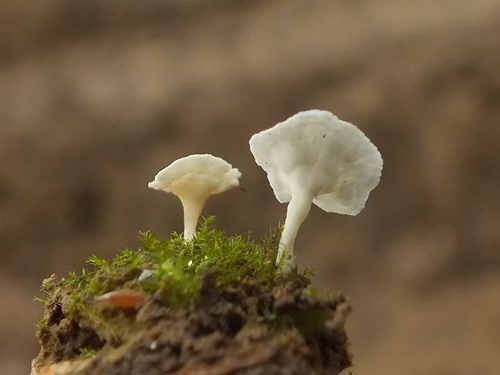
Cyphellostereum is a genus of basidiolichens. Species produce white, somewhat cup-shaped fruit bodies on a thin film of green on soil which is the thallus. All Cyphellostereum species have nonamyloid spores and tissues, lack clamp connections, and also lack hymenial cystidia.
Porina
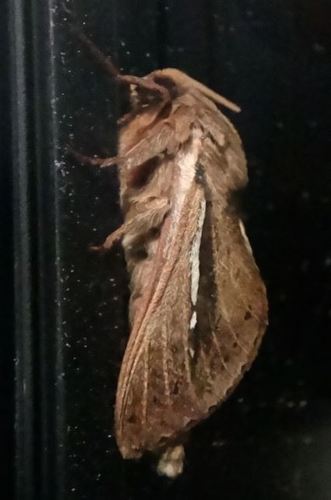
Porina is a genus of crustose lichens in the family Porinaceae. , Species Fungorum (in the Catalogue of Life) accepts 161 species of Porina.

Myriospora
genus of fungi

Protopannaria
Protopannaria is a genus of seven species of lichen-forming fungi in the family Pannariaceae. The genus was elevated from a subgenus of Pannaria to full genus status in 2000. Protopannaria lichens typically grow as small, overlapping patches on mossy tree trunks and branches in humid, old-growth forests. The genus is primarily distributed in subantarctic and temperate regions of the Southern Hemisphere.

Peccania
Peccania is a genus of lichen-forming fungi in the family Phylliscaceae. These lichens are small and form thin, crusty patches or tiny scale-like structures that are tightly attached to rock surfaces. They partner with blue-green bacteria instead of the green algae found in most other lichens, which helps them survive in harsh, drought-prone environments and quickly resume photosynthesis after wetting. Peccania species grow exclusively on rocks, favouring well-lit locations on both limestone and acidic substrates in arid and semi-arid regions, though they can also occupy locally dry spots in o

Scoliciosporum
Scoliciosporum is a genus of lichens in the family Scoliciosporaceae.

Peltula
Peltula is a genus of small dark brown to olive or dark grey squamulose lichens. These lichens typically grow on rocks in arid and semi-arid environments worldwide. They consist of a fungus living in symbiosis with a photosynthetic partner, specifically a cyanobacterium of the genus Chroococcidiopsis. Peltula is the only genus in the family Peltulaceae, which belongs to the Lichinomycetes, a class of fungi that form lichens. The genus includes about 50 recognised species, which have a variety of growth forms ranging from flat and crust-like to more complex, leaf-like structures. Peltula lichen

Thamnolia
Thamnolia is a genus of lichens in the family Icmadophilaceae. Members of the genus are commonly called whiteworm lichens.

Heppia
Heppia is a genus of olive, brownish, grey, or blackish squamulose, crustose, or peltate like lichens. Heppia was once the type genus of the family Heppiaceae, but that family was folded into synonymy with Lichinaceae.

Megalaria
Megalaria is a genus of lichen-forming fungi in the family Ramalinaceae. It contains 46 species of crustose lichens, the majority of which grow on bark. The genus was established in 1984 and has since grown to include species from diverse regions ranging from subantarctic islands to tropical forests. Most Megalaria species are recognised by their large, black fruiting bodies that sit directly on the lichen's surface, along with their thick-walled ascospores that are divided by a single internal partition. The genus primarily colonises tree bark in moist, shaded habitats, though some species al

Carbacanthographis
Carbacanthographis is a genus of corticolous (bark-dwelling) lichens in the family Graphidaceae. The genus was circumscribed by the German lichenologists Bettina Staiger and Klaus Kalb in 2002. An updated worldwide key to the genus was published in 2022 that added 17 new species. This revision allowed for further identification of undescribed species from other collections, and subsequently, 14 species were added in 2023 from the Amazonian lowland forests of Brazil and the Guianas.
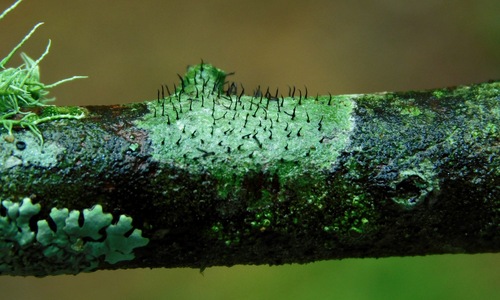
Tricharia
Tricharia is a genus of lichens in the family Gomphillaceae. It has an estimated 30 species.

Tomasellia
Tomasellia is a genus of lichen-forming fungi in the family Naetrocymbaceae. It comprises seven species of corticolous (bark-dwelling), crustose lichens.

Cetradonia linearis
Cetradonia is a lichen genus in the family Cladoniaceae. A monotypic genus, Cetradonia contains the single species Cetradonia linearis (formerly known as Cladonia linearis and as Gymnoderma lineare). The genus was circumscribed in 2002 by Jiang-Chun Wei and Teuvo Ahti. The genus was once placed in the family Cetradoniaceae (created in 2002) until that family was subsumed into the Cladoniaceae in 2006.

Koerberiella
Koerberiella is a genus of lichenized fungi within the Lecideaceae family.

Cryptodiscus
Cryptodiscus is a genus of fungi in the family Stictidaceae. These tiny fungi primarily decompose weathered wood, producing minute, cup-shaped fruiting bodies that remain mostly embedded within their substrate and open through small pores. Most species are wood-decaying saprotrophs found on bark-free branches and logs; one species forms thin, lichen-like crusts on soil and dead moss. The genus is distributed worldwide in boreal and temperate regions.
Hertelidea
Hertelidea is a genus of crustose lichens in the family Stereocaulaceae. Characteristics of the genus include carbon-black ring or outer margin (exciple) around the fruit body disc (apothecium), eight-spored, Micarea-type asci and mostly simple, hyaline ascospores that lack a transparent outer layer. Hertelidea species mostly grow on wood, although less frequently they are found on bark or soil. While the type species, Hertelidea botryosa, has a widespread distribution, most of the other species are found only in Australia.

Xerotrema
Xerotrema is a small genus of fungi in the family Odontotremataceae. It comprises two species. The genus was circumscribed by Martha Allen Sherwood and Brian John Coppins in 1980. The type species, Xerotrema megalospora, is found in the United States and Canada. X. quercicola was added to the genus in 2008. These fungi produce tiny, deeply cup-shaped fruiting bodies on weathered, barkless wood of conifers and hardwoods in temperate regions. While the genus was originally thought to be non-lichenized, at least one species appears to form facultative partnerships with green algae, meaning i

Teloschistes
Teloschistes is a genus of lichen-forming fungi in the family Teloschistaceae, of which it is the namesake. Species of Teloschistes are among the most visually striking lichens, typically forming small, bushy, much-branched growths in vivid shades of yellow to orange, colours produced by anthraquinone pigments, particularly parietin. The genus has a worldwide distribution, with species occurring on twigs, bark, and rock surfaces in open, well-lit habitats ranging from coastal scrub and semi-arid shrublands to alpine zones.
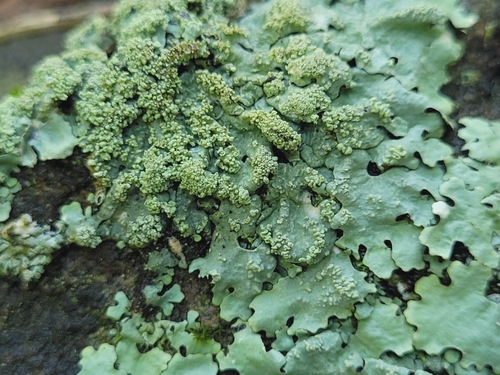
Myelochroa
Myelochroa is a genus of foliose lichens in the family Parmeliaceae. They are commonly known as axil-bristle lichens. It was created in 1987 to contain species formerly placed in genus Parmelina that had a yellow-orange medulla due to the presence of secalonic acids. Characteristics of the genus include tightly attached thalli with narrow lobes, cilia on the axils, and a rhizinate black lower surface. Chemical characteristics are the production of zeorin and related triterpenoids in the medulla. Myelochroa contains about 30 species, most of which grow on bark. The genus has centres of distribu

Cornicularia
Cornicularia is a genus of lichenised ascomycetes in the large family Parmeliaceae. It is a monotypic genus, with a single currently accepted species, the saxicolous lichen Cornicularia normoerica, and is sometimes referred to as the bootstrap lichen. The lichen forms small, dark tufts rarely exceeding 2 cm in height that are anchored so firmly to rocks, with narrow, stiff branches topped by shiny black reproductive discs. It grows on high-elevation, sun-exposed rocks and boulders, where its compact, shrub-like appearance and glossy black-brown surface make it distinctive among mountain l
Anema
genus of lichen
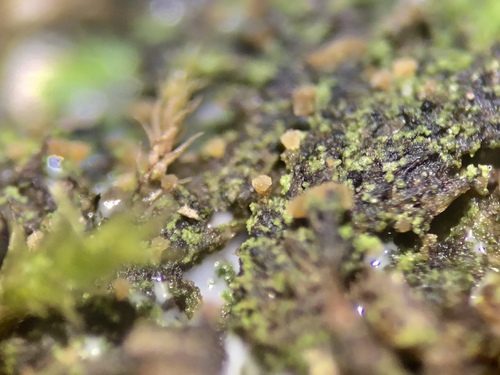
Vezdaea
Vezdaea is a genus of crustose lichens in the monotypic family Vezdaeaceae, which itself is the only taxon in the order Vezdaeales. The genus was established in 1976 and named after the Czech lichenologist Antonín Vězda for his contributions to lichen science. These lichens form extremely thin crusts that appear as dustings of tiny greenish to grey particles on decaying moss, plant debris, and soil, particularly in metal-enriched environments that other lichens avoid. The genus contains 14 species.

Lecanographa
Lecanographa is a genus of about 20 species of lichens in the family Lecanographaceae. These lichens typically form thin, extensive crusts that can be chalk-white, grey, or pale green, with dark brown to black reproductive structures that are often covered in a dense frosting () of white, bluish, or greyish crystals. Established as a genus in 1994 by José M. Egea and Pilar Torrente, the lichens are characterized by their partnership with orange-tinged filamentous algae and their production of slender, spindle-shaped spores with multiple cross-walls that are wrapped in a gelatinous outer layer.

Lethariella
Lethariella is a genus of fruticose lichens in the family Parmeliaceae. The genus was originally proposed as a subgenus of Usnea by Polish lichenologist Józef Motyka in his 1936 monograph of that genus. Norwegian botanist Hildur Krog elevated the taxon to generic status in 1976.

Roccellina
Roccellina is a genus of lichen-forming fungi in the family Roccellaceae.

Siphula
Siphula is a genus of lichen-forming fungi in the family Icmadophilaceae. The widespread genus was circumscribed by the Swedish mycologist Elias Fries in 1831.

Ephebe
genus of fungi
Tuckneraria
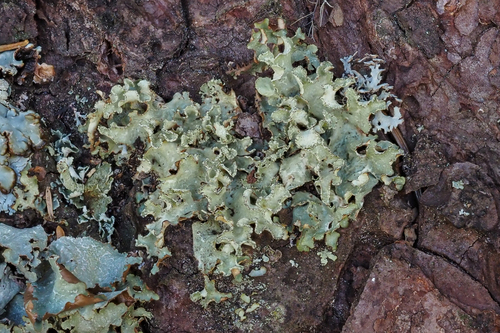
Tuckneraria is a genus of lichen-forming fungi in the family Parmeliaceae.
Waynea
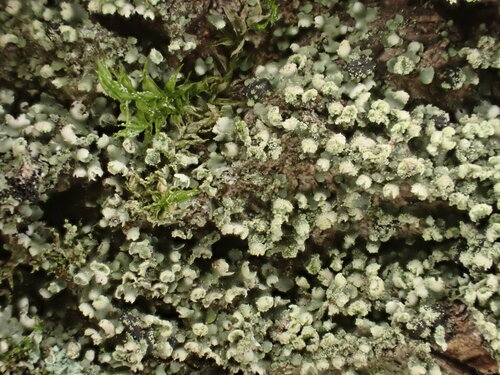
Waynea is a genus of lichen-forming fungi in the family Ramalinaceae. The genus was established in 1990 by the Swedish lichenologist Roland Moberg and named after the Wayne family who helped organize his collecting trip to California, where he collected the type species. The tiny lichens in Waynea form patches made up of scale-like lobes less than half a millimetre across, with powdery cushions that help them spread without sexual reproduction. The genus contains six species. Most records are from southern and western Europe, particularly around the Mediterranean region, but it has also been r

Ptychographa xylographoides
Ptychographa is a fungal genus in the family Xylographaceae. It is a monospecific genus, containing the single species Ptychographa xylographoides. This inconspicuous lichen grows as a barely visible coating of dark grains on rotting logs and branches in undisturbed old forests. The species is most readily identified by its narrow, elongated black fruiting structures that run parallel to the wood grain.

Psorotheciopsis
Psorotheciopsis is a genus of lichenized fungi in the family Gomphillaceae. It contains three species.

Byssoloma
Byssoloma is a genus of leaf-dwelling lichens in the family Ectolechiaceae.

Melanomma
genus of fungi

Bellemerea
Bellemerea is a genus of saxicolous (rock-dwelling) crustose lichens in the family Lecideaceae. These lichens form tough, crusty patches on hard rock surfaces, often appearing as a mosaic of small angular blocks in colours ranging from white and grey to brown. The genus includes nine species found primarily in mountainous and polar regions where they help colonize bare rock surfaces in harsh environments.
Psoroglaena
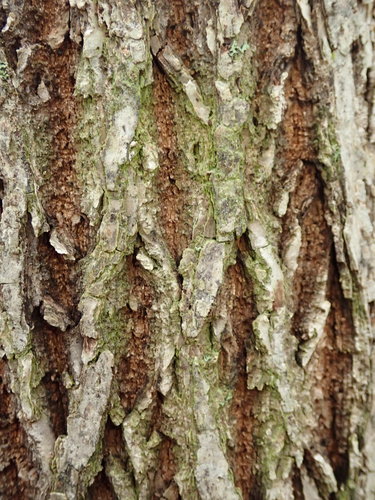
Psoroglaena is a genus of lichen-forming fungi in the family Verrucariaceae. The genus was circumscribed by Johann Müller Argoviensis in 1891, with Psoroglaena cubensis assigned as the type species.

Tylophoron
Tylophoron is a genus of lichen-forming fungi in the family Arthoniaceae. It comprises seven species of crustose lichens, most of which occur in tropical regions.

Tholurna dissimilis
Tholurna is a fungal genus in the family Caliciaceae. The genus is monotypic, containing the single species Tholurna dissimilis. Long thought to be confined to Scandinavia, it has since been recorded in western North America, where a 1983 survey documented 47 localities from coastal British Columbia to Oregon and as far north-east as the Yukon and Northwest Territories.
Dactylina
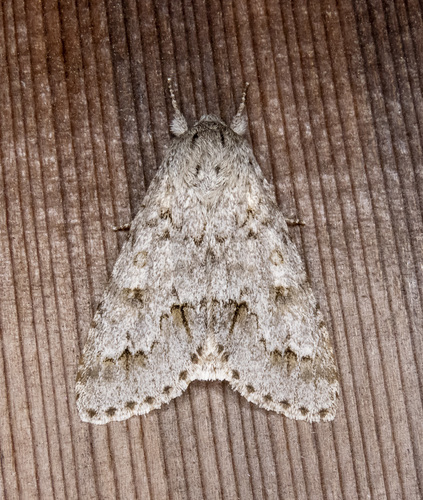
Dactylina is a genus of lichen-forming fungi in the family Parmeliaceae. The genus was circumscribed by Finnish botanist William Nylander in 1860, with Dactylina arctica assigned as the type species.

Thyrea
genus of fungi

Robergea
Robergea is a genus of fungi within the family Stictidaceae.

Trichothelium
Trichothelium is a genus of lichen-forming fungi in the family Porinaceae. It has an estimated 40 species. The genus was circumscribed by the Swiss lichenologist Johannes Müller Argoviensis in 1885, with Trichothelium epiphyllum assigned as the type species.

Ramonia
Ramonia is a genus of lichen-forming fungi in the family Gyalectaceae. Species form thin crusts on bark or rock and partner with the green alga Trentepohlia as their photosynthetic partner. They are recognized by their distinctive urn-shaped apothecia (fruiting bodies), whose inrolled rims nearly close over the spore-producing surface, leaving only a small central pore. About 22 species are accepted, found mainly in tropical and temperate regions.

Rimularia
Rimularia is a genus of lichen-forming fungi in the family Trapeliaceae. Established by the Finnish lichenologist William Nylander in 1868 from specimens collected on granitic rocks in France, the genus comprises 14 accepted species as of 2025. These rock-dwelling lichens form thin, crust-like growths that range from reddish-brown to dark olive-brown in colour and produce small black fruiting bodies with distinctive branched internal structures.

Sarcographa
Sarcographa is a genus of lichen-forming fungi in the family Graphidaceae. Established in 1825 by the French botanist Antoine Laurent Apollinaire Fée, the genus contains 22 species that are recognised by their distinctive star-shaped colonies of radiating, script-like fruiting structures with black borders. These bark-dwelling lichens are found in humid tropical and warm temperate forests worldwide and serve as indicators of undisturbed woodland, as they quickly decline when forest canopy is opened or disturbed.

Anthracocarpon
Anthracocarpon is a small fungal genus in the family Verrucariaceae. It is found in Mediterranean regions, the Caribbean, and South America. These lichens form low, crusty patches made up of overlapping scales that grow close to the ground on limestone and other rocky surfaces. The genus is recognized by its distinctive coal-black fruiting bodies, which give it its name—derived from Greek words meaning "coal" and "fruit". Established in 1996, the genus currently includes three species.

Herteliana
Herteliana is a genus of lichen-forming fungi. It contains four species of crustose lichens.
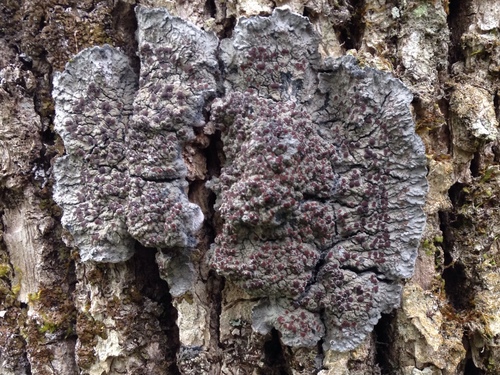
Degelia
Degelia is a genus of lichen-forming fungi in the family Pannariaceae. The genus is named after Swedish lichenologist Gunnar Degelius.
Catolechia
Catolechia is a genus of lichen-forming fungi in the family Rhizocarpaceae. It is a monotypic genus, containing the single species Catolechia wahlenbergii. The genus was circumscribed by the German botanist Julius von Flotow in 1850. He did not assign a type species for the genus; Catolechia pulchella was designated as the type by Gustav Wilhelm Körber in 1855. This species is synonymous with Catolechia wahlenbergii.
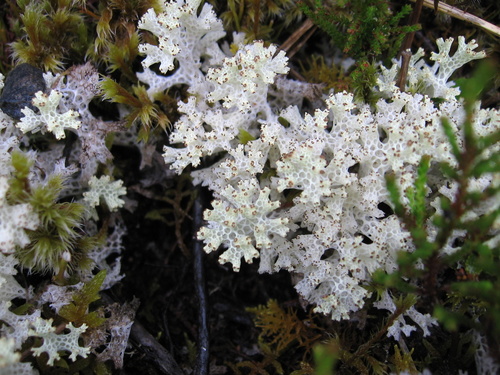
Cladia
Cladia is a genus of lichen-forming fungi in the family Cladoniaceae. Cladia species have a crustose or (scaly) primary thallus and a fruticose, secondary thallus, often referred to as pseudopodetium. The type species of the genus, Cladia aggregata, is widely distributed, occurring in South America, South Africa, Australasia and South-East Asia to southern Japan and India. Most of the other species are found in the Southern Hemisphere.

Schadonia
Schadonia is a genus of lichen-forming fungi. Established by German lichenologist Gustav Wilhelm Körber in 1859, this genus of crustose lichens is characterised by its black, sessile apothecia (fruiting bodies), ascospores, and growth on mosses, plant debris, and rocks in montane habitats. While traditionally placed in the family Ramalinaceae, recent studies have suggested its classification may be uncertain within the order Lecanorales, with some researchers proposing its placement in the Ectolechiaceae or the resurrection of the family Schadoniaceae. The genus currently comprises three recog