Category
page 8Lichen genera
Japewiella
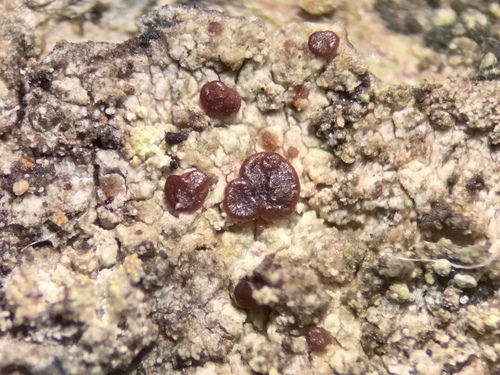
Japewiella is a genus of lichen in the family Lecanoraceae. It was circumscribed in 2000 by German botanist and lichenologist Christian Printzen as a segregate of the genus Japewia. The genus name of Japewia was in honour of Peter Wilfrid James (1930 - 2014), who was an English botanist (Mycology and Lichenology). The genus was circumscribed by Christian Printzen in Bryologist vol.102 on page 715 in 1999.
Ophioparma
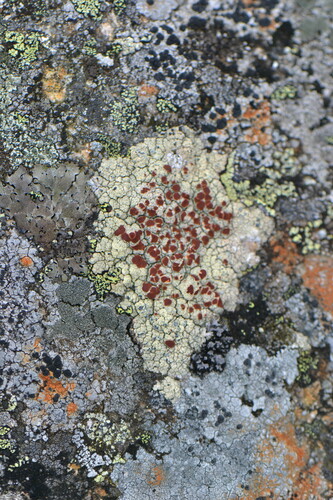
Ophioparma is a genus of crustose lichens in the family Ophioparmaceae.
Digitothyrea
Digitothyrea is a genus of fungi within the family Lichinaceae. The genus contains three species.
Anomalographis
Anomalographis is a genus of two species of lichen-forming fungi in the family Graphidaceae. These lichens form pale grey to yellow-brown crusts and are characterized by elongated, slit-like fruiting bodies containing very small spores divided by a single internal wall. One species grows on shaded volcanic rock faces in Madeira, while the other was discovered growing on tree bases in northeastern Queensland rainforest, showing the genus can colonize both rock and bark surfaces in humid, shaded environments.

Topeliopsis
Topeliopsis is a genus of lichen-forming fungi in the family Graphidaceae.

Gymnoderma
Gymnoderma is a genus of lichen-forming fungi in the family Cladoniaceae. Originally established in 1860 by the Finnish lichenologist William Nylander, this small genus is characterised by forming mats of small, yellow-green scales dotted with spherical brown fruiting bodies. The genus is distinguished from related lichens by a unique microscopic feature: its spore-containing structures (asci) turn deep blue when stained with iodine, which is uncommon among members of the Cladoniaceae.

Culbersonia
Culbersonia is a fungal genus in the family Caliciaceae. This is a monotypic genus, containing the single foliose lichen Culbersonia nubila (formerly called Culbersonia americana). This species, which grows on trees and rocks, is found in dry subtropical regions of the world, particularly in Africa and Central America.
Diploschistella
Diploschistella is a genus of fungi in the family Gomphillaceae.

Mazosia
Mazosia is a genus of lichen-forming fungi in the family Roccellaceae.

Calopadia
Calopadia is a genus of foliicolous (leaf-dwelling) lichens in the family Ectolechiaceae. The genus was established by the Czech lichenologist Antonín Vězda in 1986 and contains around 24 species found primarily in tropical regions. These lichens form thin, pale brownish to greyish crusts on leaf surfaces and produce small brown disc-shaped fruiting bodies. They are distinguished from similar genera by their non-black fruiting structures and characteristic curved or coiled asexual spores. The genus has its greatest diversity in the Neotropics, though species have also been recorded from tropic

Varicellaria
Varicellaria is a genus of crustose lichens. It is the only genus in the family Varicellariaceae. The genus contains 12 recognized species found worldwide. These lichens typically form pale bluish-grey or whitish-grey crusts on tree bark or rocks, and they produce a lichen product called lecanoric acid. Genetic studies have helped clarify the boundaries between species in this group, showing that where they grow (bark versus rock) and certain physical features are important for telling them apart.
Flavoplaca
Flavoplaca is a genus of crust-like or scaly lichens in the family Teloschistaceae. It has about 30 species with a mostly Northern Hemisphere distribution. The genus was established in 2013 when genetic studies revealed that these species formed their own distinct evolutionary group, separate from other lichen classifications where they were previously placed. These lichens typically grow on limestone and other calcium-rich rocks, forming distinctive orange to yellow crusty patches that are particularly common in coastal environments and sunny locations. Most species grow directly on rock surf
Monoblastia
Monoblastia is a genus of lichens in the Monoblastiaceae family of fungi.

Epilichen
Epilichen is a small genus of lichen-forming fungi in the family Rhizocarpaceae. These parasitic lichens live on other lichens, beginning as thin, crust-like patches that may break into small islands or scales, and in some cases produce no visible body at all except for their reproductive structures. They reproduce through black, disc-shaped fruiting bodies that contain distinctive brown spores with a "doughnut ring" appearance, and can eventually take over the space occupied by their host lichen once it dies.
Caprettia
Caprettia is a genus of lichenized fungi in the family Monoblastiaceae. The genus was circumscribed by Augusto Chaves Batista and Heraldo da Silva Maia in 1965, with Caprettia amazonensis assigned as the type species.
Gyrotrema
Gyrotrema is a genus of lichen-forming fungi in the family Graphidaceae. There are six species assigned to the genus:
Gyrotrema album
Gyrotrema aurantiacum
Gyrotrema flavum
Gyrotrema papillatum
Gyrotrema sinuosum
Gyrotrema wirthii

Ceramothyrium
Ceramothyrium is a genus of ascomycete fungi in the family Chaetothyriaceae.

Amygdalaria
Amygdalaria is a genus of lichen-forming fungi in the family Lecideaceae. These lichens are typically found growing as crusts on siliceous rocks in arctic and alpine environments. Members of this genus form crustose thalli and are distinguished by their unusually large, smooth ascospores enclosed in gelatinous sheaths. The lichens have cephalodia containing Stigonema, a blue-green alga that enables nitrogen fixation.
Ingaderia
Ingaderia is a genus of lichen-forming fungi in the family Opegraphaceae. Species in this genus form pale, crusty patches that often crack when thick, and produce elongated fruiting bodies that appear as narrow slits on the surface. The genus was originally established with a single species from South America, but molecular studies published in 2023 expanded its scope to include several species previously classified in other genera such as Llimonaea and Paraingaderia. Species are distinguished by their thick, dark fruiting body walls, elongated ascospores divided by cross-walls, and the presen
Ionaspis
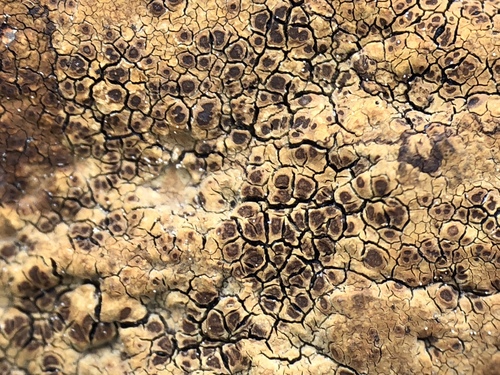
Ionaspis is a genus of lichen-forming fungi in the family Hymeneliaceae. It contains six species of saxicolous (rock-dwelling), crustose lichens. The genus was originally circumscribed in 1871 by Theodor Magnus Fries. He segregated the genus from Aspicilia based on the presence of Trentepohlia rather than Trebouxia as the partner.
Myelorrhiza
Myelorrhiza is a genus of two Australian species of lichen-forming fungi in the family Ramalinaceae. These lichens form leaf-like growths with narrow, overlapping lobes that attach to their substrate using root-like strands called rhizines. They are found in tropical rainforests of northern Queensland, where they grow on tree bark and rocks. The genus was initially thought to belong to the family Cladoniaceae, but molecular studies placed it outside Cladoniaceae and aligned it with ramalinoid lineages; it is now treated in Ramalinaceae.

Strangospora
Strangospora is a genus of lichen-forming fungi. It is the only genus in the family Strangosporaceae, which itself is of uncertain taxonomic placement in the Ascomycota. It contains 10 species.

Badimia
Badimia is a genus of foliicolous (leaf-inhabiting) lichens in the family Ramalinaceae.

Lichinella
Lichinella is a genus of lichen-forming fungi in the family Lichinellaceae. The genus is morphologically diverse, including species that form crusts, small scales, or tiny shrub-like tufts. Its members grow on rock surfaces and in biological soil crusts, mainly in warm-temperate to arid tropical regions worldwide. It was described by William Nylander in 1873, and was placed in the newly erected family Lichinellaceae following a 2024 molecular reclassification of the Lichinomycetes.

Placidiopsis
Placidiopsis is a genus of lichens in the family Verrucariaceae. The genus was circumscribed by Italian naturalist Francesco Beltramini de Casati in 1858, with Placidiopsis grappae assigned as the type species.
Neocatapyrenium
Neocatapyrenium is a genus of squamulose lichens in the family Verrucariaceae. It has five species. The genus was circumscribed by Hiroshi Harada in 1993, with Neocatapyrenium cladonioideum assigned as the type species.

Cratiria
Cratiria is a genus of lichen-forming fungi in the family Caliciaceae. The genus has a widespread distribution, especially in tropical regions, and contains about 20 species. The genus was circumscribed by Austrian lichenologist Bernhard Marbach in 2000, with Cratiria lauri-cassiae assigned as the type species.
Nodobryoria
Nodobryoria is a genus of medium to large, reddish-brown lichens that are hair-like to shrubby (fruticose) in shape and grow on conifer trees. The genus contains three species, distributed in North America and Greenland, which were previously included in the genus Bryoria. Nodobryoria is similar in appearance to Bryoria, but is differentiated because it does not contain the polysaccharide lichenin (which is present in high quantities in Bryoria), and it has a unique cortex composed of interlocking cells that look like pieces of a jigsaw puzzle when viewed under a light microscope.
==Taxonomy==
Tornabea
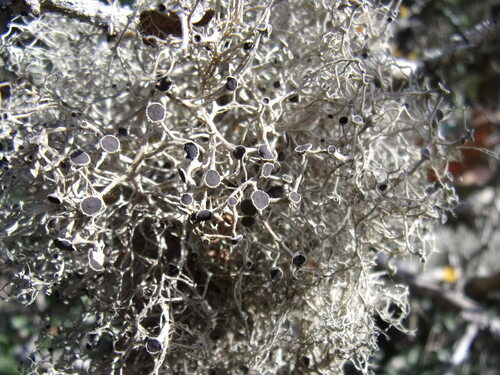
Tornabea is a monotypic genus of lichenized fungi in the family Physciaceae.
It only contains the one accepted species, Tornabea scutellifera

Phyllobathelium
Phyllobathelium is a genus of lichen-forming fungi in the family Strigulaceae. It comprises eight species of foliicolous (leaf-dwelling, crustose lichens.
Plurisperma dalbergiae
Plurisperma is a genus of fungi in the family Verrucariaceae; according to the 2007 Outline of Ascomycota, the placement in this family is uncertain. A monotypic genus, it contains the single species Plurisperma dalbergiae. The family Verrucariaceae is somewhat toxic to mammals due to the presence of vulpinic acid.

Phylliscum
Phylliscum is a genus of lichen-forming fungi in the family Phylliscaceae. These lichens are small and often appear as tiny dark patches or scales tightly pressed against rock surfaces. They are easily overlooked due to their minute size, but can be found on exposed rocks in dry, sunny locations around the world.

Mastodia
Mastodia is a genus of lichen-forming fungi in the family Verrucariaceae. It has six species.
Psorinia
Psorinia is a genus of fungi in the family Lecanoraceae.
Psoromella
Psoromella is a fungal genus of uncertain familial classification in the order Lecanorales. The genus is monotypic, containing the single species Psoromella pampana, a soil-dwelling lichen found in Argentina.

Protothelenella
Protothelenella is a genus of fungi in the family Protothelenellaceae. It contains 11 species, some of which form lichens. Protothelenella species have a crustose thallus with spherical to pear-shaped, dark brown to blackish . Microscopic characteristics of the genus include asci with an amyloid , and that are colourless and contain multiple internal partitions. Some species grow on acidic including rocks, soil, bryophytes, plant detritus or rotten wood. Other species are lichenicolous (lichen-dwelling), growing on species of Solorina, Peltigera, Pseudocyphellaria, or Cladonia.
Marchantiana
Marchantiana is a genus of lichen-forming fungi in the family Teloschistaceae. It contains seven species of corticolous (bark-dwelling), crustose lichens, recorded mainly from Australia. Originally proposed in 2014, the genus underwent significant revision in 2024 when molecular studies showed it comprised two distinct evolutionary lineages. This led to the creation of the new genus Taedigera to accommodate the cool-temperate species from New Zealand and Patagonia, while Marchantiana was retained for the warmer-climate Australian species. Later DNA-based work has treated Streimanniella as a se

Aciculopsora
Aciculopsora is a small genus of lichen-forming fungi in the family Ramalinaceae. The genus was established in 2006 and as of 2025 contains three recognised species, all found growing on tree bark in tropical regions. These lichens are distributed across Central and South America, East Africa, and Sri Lanka, though they appear to be rare or simply under-collected.

Pyrenocarpon
Pyrenocarpon is a fungal genus in the family Lichinaceae. It is monospecific, containing the single species Pyrenocarpon thelostomum, a lichen. This rare lichen is found only in shaded stream beds in parts of Britain, including Exmoor, the Pennines, and the Scottish Highlands. It was first described as a distinct genus in 1855 by the Italian lichenologist Vittore Trevisan based on its unique waxy fruiting structures. The species grows as a thin, reddish-brown crust on hard rocks that are kept constantly wet by flowing water.
Vahliellaceae
Vahliella is a genus of nine species of lichen-forming fungi in the order Peltigerales. It is the only member of Vahliellaceae, a family circumscribed in 2010 to contain this genus. Vahliella was formerly placed in the family Pannariaceae until molecular phylogenetics showed that it did not belong there. Vahliella species are found in the Northern Hemisphere – mainly in North America, but also in Europe and India.

Texosporium
Texosporium is a genus of lichenized fungi in the family Caliciaceae. It is a monotypic genus, containing the single species Texosporium sancti-jacobi, found in the United States. The genus is characterized by microscopic features: the ascospores are coated with a layer of cells that are derived from the paraphyses. Texosporium was originally circumscribed by Josef Nádvorník in 1942, albeit the name was not validly published. In 1968, Leif Tibell and Angelica van Hofsten published the name validly. In 2020, Texosporium sancti-jacobi was added to the global IUCN Red List, where it is classified
Synarthonia
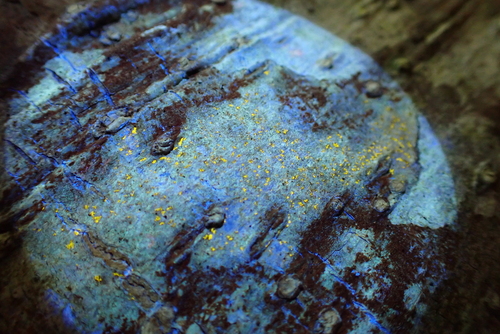
Synarthonia is a genus of lichen-forming fungi in the order Arthoniales. The genus has not been placed into a family. These crustose lichens typically form thin, crust-like growths on tree bark in tropical and temperate regions worldwide, though many species have restricted geographical ranges and are known only from single locations. The genus is distinguished by its reproductive structures, which appear as small grouped patches on the lichen surface, and by its spores that change from colourless to brownish as they mature and have distinctive enlarged tip cells. While most species form tradi
Notocladonia
Notocladonia is a genus of two Australasian species of lichen-forming fungi in the family Cladoniaceae. The genus was established in 2003 by Samuel Hammer to accommodate Australasian species previously misplaced in the neotropical genus Ramalea. Notocladonia species are distinguished by their spore-bearing discs (apothecia) that form at the tips of scale-like lobes or short stalks, rather than beneath the thallus as in Ramalea. Both species occur in temperate regions of southeastern Australia and New Zealand, typically growing on thin soils in open habitats.
Siphulastrum
Siphulastrum is a genus of lichen-forming fungi in the family Pannariaceae. It has five species. The genus was circumscribed by Johannes Müller Argoviensis in 1889, with S. triste assigned as the type species.
Calogaya
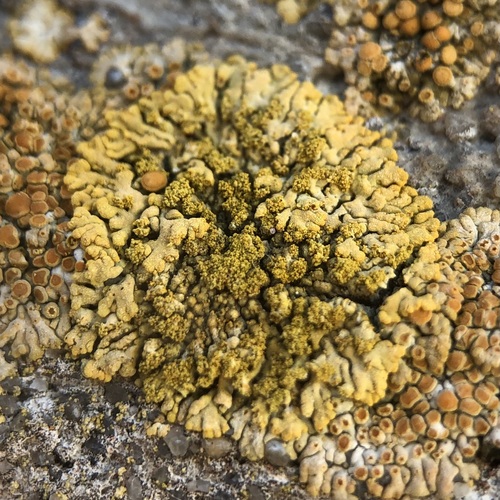
Calogaya is a genus of lichen-forming fungi belonging to the family Teloschistaceae. It has 19 species. The genus was circumscribed in 2013 by Ulf Arup, Ulrik Søchting, and Patrik Frödén.
The generic name Calogaya ("spectacular Gaya") honours Dr. Ester Gaya (fl. 2001), a Spanish botanist from the University of Barcelona.
Gallowayella
Gallowayella is a genus of lichen-forming fungi in the family Teloschistaceae. It has 15 species. The genus was circumscribed in 2012 by Sergey Kondratyuk, Natalya Fedorenko, Soili Stenroos, Ingvar Kärnefelt, Jack Elix, and Arne Thell, with Gallowayella coppinsii assigned as the type species. The generic name honours New Zealand lichenologist David John Galloway (1942–2014).

Pyrgillus
Pyrgillus is a genus of lichen-forming fungi in the family Pyrenulaceae. The genus was circumscribed by the Finnish lichenologist William Nylander in 1858.
Lathagrium
Lathagrium is a genus of lichen-forming fungi in the family Collemataceae. It has 10 species of gelatinous lichens. Species in this genus typically grow on calcareous rocks, often amidst mosses, but can also be found on siliceous or serpentine rocks, mortar, or soil.
Phloeopeccania
Phloeopeccania is a genus of fungi within the family Lichinaceae. It contains three species.
Septotrapelia
Septotrapelia is a genus of lichen-forming fungi in the family Ectolechiaceae. It comprises four species. Species in this genus form tiny, scale-like crusts on rocks and are distinguished by their chocolate-brown fruiting discs with pale margins and unusually large ascospores divided into three segments. These small, bluish-grey lichens grow primarily on volcanic boulders and weathered stone in tropical and subtropical regions, from Costa Rica and the Galápagos to Thailand and South Korea. The genus was established in 2007 after DNA studies showed that certain species with this distinctive spo
Rusavskia
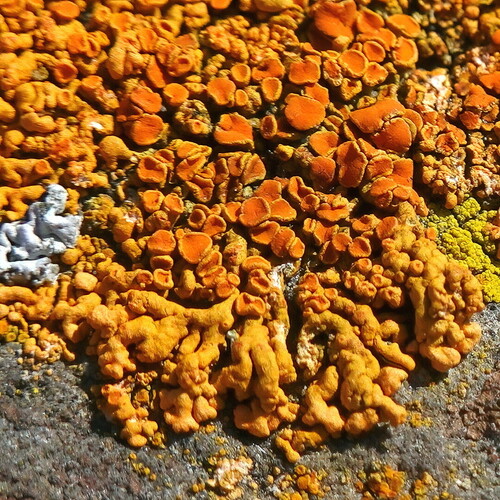
Rusavskia is a genus of lichen-forming fungi in the family Teloschistaceae. It has 12 species. It is a member of the subfamily Xanthorioideae. The thallus of Rusavskia is characterised by its foliose (leaf-like) structure with distinct and typically narrow that curve outwards.

Biatorella
Biatorella is a genus of lichen-forming fungi in the family Biatorellaceae.
Raciborskiella
Raciborskiella is a genus of foliicolous (leaf-dwelling) lichens in the family Strigulaceae. Characterized by their thin, dark bluish-grey thalli, these lichens form distinctive patches on leaf surfaces and develop between the leaf cuticle and epidermal cells. The genus was originally proposed by Franz Höhnel in 1909, later merged with Strigula, and then reinstated as a separate genus in 2020 based on molecular phylogenetics studies. Raciborskiella species are distinguished by their exposed, black perithecia, large with gelatinous appendages, and association with the green algal photobiont Cep
Ioplaca
Ioplaca is a genus of crustose lichens in the family Teloschistaceae. The genus was circumscribed in 1977 by Czech lichenologist Josef Poelt with Ioplaca sphalera assigned as the type species.

Bogoriella
Bogoriella is a genus of crustose lichens in the family Trypetheliaceae.
Parmotremopsis
Parmotremopsis is a genus of lichen-forming fungi in the family Parmeliaceae. The genus was circumscribed in 1987 by lichenologists John Elix and Mason Hale.
Bryobilimbia
Bryobilimbia is a genus of lichen-forming fungi belonging to the family Lecideaceae. It was circumscribed in 2014 by Alan Fryday, Christian Printzen, and Stefan Ekman. The type species is Bryolimbia hypnorum.
Melanotopelia
Melanotopelia is a genus of lichen-forming fungi in the family Graphidaceae. It has four species of corticolous (bark-dwelling), crustose lichens. This genus includes species characterised by dark pigmentation in their (a ring of tissue encircling their fruiting bodies), non-amyloid , and specific secondary metabolites.
Phylloblastia
Phylloblastia is a genus of foliicolous (leaf-dwelling) lichens in the family Verrucariaceae. The genus was circumscribed in 1921 by Finnish lichenologist Edvard August Vainio, with Phylloblastia dolichospora assigned as the type species.
Simonyella
Simonyella is a genus of lichenized fungi in the family Roccellaceae. A monotypic genus, it contains the single species Simonyella variegata .