Category
page 1Logic

logic
thumb|alt=Depiction of inference using modus ponens|Logic studies valid forms of inference like .

mathematical logic
subfield of mathematics
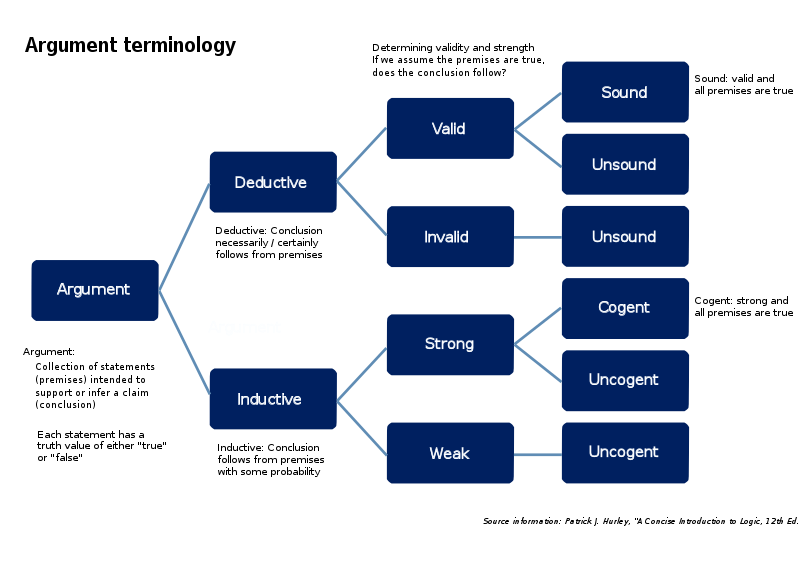
inductive reasoning
method of reasoning in which a body of observations is synthesized to hypothesize a general principle
deductive reasoning
method of reasoning by which premises understood to be true produce logically certain conclusions
inference
Inferences are steps in logical reasoning, moving from premises to logical consequences; etymologically, the word infer means to "carry forward". Inference is theoretically traditionally divided into deduction and induction, a distinction that dates at least to Aristotle (300s BC). Deduction is inference deriving logical conclusions from premises known or assumed to be true, with the laws of valid inference being studied in logic. Induction is inference from particular evidence to a universal conclusion. A third type of inference is sometimes distinguished, notably by Charles Sanders Peirce, c

Vaisheshika
Vaisheshika (IAST: Vaiśeṣika; ; ) is one of the six schools of Hindu philosophy from ancient India. In its early stages, Vaiśeṣika was an independent philosophy with its own metaphysics, epistemology, logic, ethics, and soteriology. Over time, the Vaiśeṣika system became similar in its philosophical procedures, ethical conclusions and soteriology to the Nyāya school of Hinduism, but retained its difference in epistemology and metaphysics.

Ship of Theseus
thought experiment concerning the continuity of identity of an item which has all its parts replaced

quantifier
logical operator specifying how many entities in the domain of discourse that satisfy an open formula

dichotomy
200px|thumb|In this image, the universal set U (the entire rectangle) is dichotomized into the two sets A (in pink) and its complement Ac (in grey).
A dichotomy () is a partition of a whole (or a set) into two parts (subsets). In other words, this couple of parts must be
jointly exhaustive: everything must belong to one part or the other, and
mutually exclusive: nothing can belong simultaneously to both parts.
modal logic
formal logic able to express concepts such as necessity, possibility, provability, obligation, knowledge etc.
logic programming
programming paradigm based on formal logic
counterexample
A counterexample is a specific example that contradicts a claim, hypothesis, or generalization. In logic a counterexample disproves a universally stated claim, and does so rigorously in the fields of mathematics and philosophy. For example, the statement that "student John Smith is not lazy" is a counterexample to the generalization "students are lazy", and both a counterexample to, and disproof of, the universal quantification "all students are lazy."
classical logic
class of formal logics

self-reference
thumb|The ancient symbol Ouroboros, a dragon that continually consumes itself, denotes self-reference.
informal logic
branch of logic related to reasoning and argumentation
neutrality
tendency not to side in a conflict
law of identity
logic statement saying that each thing is the same as itself

metamathematics
thumb|The title page of the Principia Mathematica (shortened version), an important work of metamathematics
philosophy of logic
study of the scope and nature of logic
history of logic
aspect of history
catch-22
situation in which an individual cannot or is incapable of avoiding a problem because of contradictory constraints or rules
difference
set of properties by which one entity is distinguished from another
apophasis
Apophasis (; , ) is a rhetorical device wherein the speaker or writer brings up a subject by either denying it, or denying that it should be brought up. Accordingly, it can be seen as a rhetorical relative of irony. A classic example of apophasis is "I'm not going to say that I told you so".

relevance
Relevance is the connection between topics that makes one useful for dealing with the other. Relevance is studied in many different fields, including cognitive science, logic, and library and information science. Epistemology studies it in general, and different theories of knowledge have different implications for what is considered relevant.
Colorless green ideas sleep furiously
sentence coined by Noam Chomsky to describe proper syntax with improper semantics
mutually exclusive events
two propositions or events that cannot both be true
unspoken rule
rules that are not written down
principle of bivalence
classical logic of two values, either true and false
term logic
type of logic whose elements are concepts
World Logic Day
International day proclaimed by UNESCO
canonical normal form
concept in Boolean algebra
What the Tortoise Said to Achilles
short story by Lewis Carroll

fluidics
thumb|A module with two input streams at the top, an AND gate|AND output bucket in the middle, and an XOR output stream at the bottom.
testability
Testability is a primary aspect of science and the scientific method. There are two components to testability:
Falsifiability or defeasibility, which means that counterexamples to the hypothesis are logically possible.
The practical feasibility of observing a reproducible series of such counterexamples if they do exist.
autological word
word that expresses a property it also possesses
linear logic
system of resource-aware logic

canon
rule or body of rules or principles generally established as valid and fundamental in a field of art or philosophy
System F
typed lambda calculus
natural kind
"natural" grouping, not an artificial one; family of entities possessing properties bound by natural law
ostensive definition
conveying the meaning of a term by pointing out examples
existential graph
diagrammatic notation for logical expressions proposed by Peirce
digital timing diagram
diagram that shows events over time
argument diagram
visual diagram of structured arguments
Morton's fork
false dilemma in which contradictory observations lead to the same conclusion
circumscription
definition of a taxon
tetralemma
The tetralemma is a figure that features prominently in the logic of India.
ontological commitment
linguistic and philosophical concept
erotetics
Erotetics or erotetic logic is a part of logic, devoted to logical analysis of questions. It is sometimes called the logic of questions and answers.
belief revision
process of changing beliefs to take into account a new piece of information
pragmatic maxim
maxim of logic formulated by Charles Sanders Peirce
train of thought
sequence of ideas expressed during a connected discourse or thought
definable set
n-ary relation on the domain of a structure whose elements satisfy some formula in the
self-refuting idea
idea that refutes itself
don't-care term
Input where a function output doesn't matter.
intension and extension
semantics of concepts
Markov's principle
in constructive mathematics and computability theory, the axiom that given a decidable predicate on natural numbers, if it cannot be false for all numbers, then it is true for some number
conditional proof
formal proof
segment addition postulate
identity on affine spaces
dialogical logic
a pragmatic approach to the semantics of logic
lexical definition
example of lexical used as an adjective is the phrase lexical similarity which means words that appear to be similar to other words