Category
page 1Magnetostatics
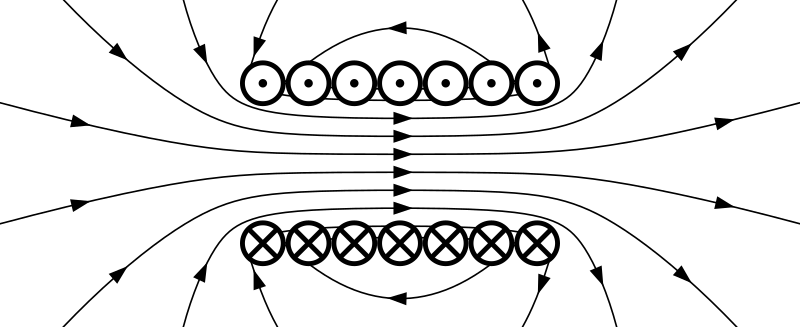
Ampère's circuital law
relates the integrated magnetic field around a closed loop to the electric current passing through the loop
magnetic moment
product of the electric current through a loop, the area enclosed by the loop and the unit vector perpendicular to the loop

magnetostatics
Magnetostatics is the study of magnetic fields in systems where the currents are steady (not changing with time). It is the magnetic analogue of electrostatics, where the charges are stationary. The magnetization need not be static; the equations of magnetostatics can be used to predict fast magnetic switching events that occur on time scales of nanoseconds or less. Magnetostatics is even a good approximation when the currents are not static – as long as the currents do not alternate rapidly. Magnetostatics is widely used in applications of micromagnetics such as models of magnetic stora
magnetic dipole
a magnetic dipole is the limit of either a closed loop of electric current
Ampère's force law
physical law
magnetic hysteresis
application of an external magnetic field to a ferromagnet
neutron magnetic dipole moment
intrinsic magnetic dipole moment of neutrons
micromagnetics
Micromagnetics is a field of physics dealing with the prediction of magnetic behaviors at sub-micrometer length scales. The length scales considered are large enough for the atomic structure of the material to be ignored (the continuum approximation), yet small enough to resolve magnetic structures such as domain walls or vortices.
Darwin Lagrangian
classical Lagrangian describing the interaction to order v²/c² between two charged particles in vacuo
Steinmetz's equation
empirical equation used to calculate the power loss magnetic materials