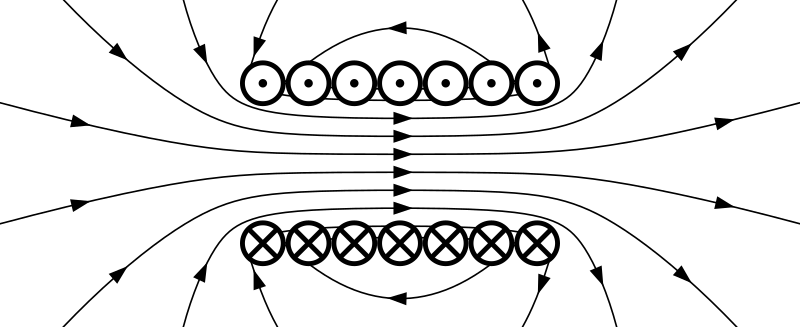
File:VFPt_Solenoid_correct2.svg · Wikimedia Commons · See Wikimedia Commons
magnetic moment
Sign in to saveAlso known as magnetic area moment
product of the electric current through a loop, the area enclosed by the loop and the unit vector perpendicular to the loop
A magnetic moment is a measurement of how strong a magnetic force is created by an electric current flowing through a loop, determined by multiplying the strength of that current by the area of the loop. This concept matters because it helps scientists and engineers understand and predict how magnetic objects and currents interact with magnetic fields, which is essential for everything from designing electric motors to studying the magnetic properties of atoms.
AI-generated from the Wikipedia summary — may contain errors.
Wikidata facts
Show 2 more facts
- on focus list of Wikimedia project
- Wikipedia:Vital articles/Level/4
- maintained by WikiProject
- WikiProject Mathematics
Sources (3)
via Wikidata · CC0
~35 min read
Encyclopedic overview
In electromagnetism, the magnetic moment or magnetic dipole moment is a vector quantity which characterizes the strength and orientation of a magnet or other object or system that exerts a magnetic field. The magnetic dipole moment of an object determines the magnitude of torque the object experiences in a given magnetic field. When the same magnetic field is applied, objects with larger magnetic moments experience larger torques. The strength (and direction) of this torque depends not only on the magnitude of the magnetic moment but also on its orientation relative to the direction of the magnetic field. Its direction points from the south pole to the north pole of the magnet (i.e., inside the magnet).
The magnetic moment also expresses the magnetic force effect of a magnet. The magnetic field of a magnetic dipole is proportional to its magnetic dipole moment. The dipole component of an object's magnetic field is symmetric about the direction of its magnetic dipole moment, and decreases as the inverse cube of the distance from the object.
Excerpted from Wikipedia’s “magnetic moment” article, available under the CC BY-SA 4.0 licence.