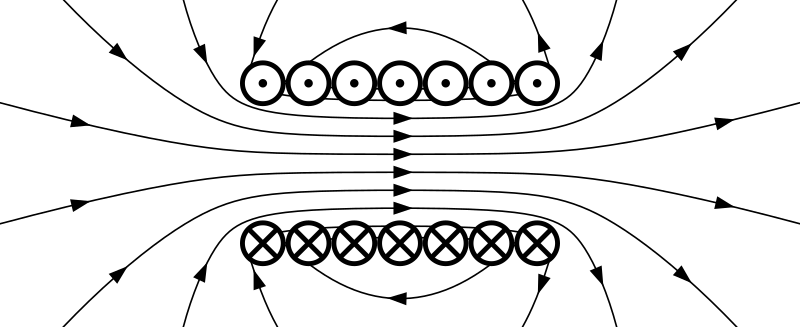
File:VFPt_Solenoid_correct2.svg · Wikimedia Commons · See Wikimedia Commons
magnetostatics
Sign in to saveMagnetostatics is the study of magnetic fields in systems where the currents are steady (not changing with time). It is the magnetic analogue of electrostatics, where the charges are stationary. The magnetization need not be static; the equations of magnetostatics can be used to predict fast magnetic switching events that occur on time scales of nanoseconds or less. Magnetostatics is even a good approximation when the currents are not static – as long as the currents do not alternate rapidly. Magnetostatics is widely used in applications of micromagnetics such as models of magnetic stora
Magnetostatics is the study of magnetic fields produced by steady electrical currents, similar to how electrostatics studies fields from stationary charges. It's a useful tool across many practical applications—including magnetic storage and data technology—and can even predict rapid magnetic changes even when currents aren't perfectly steady, as long as they don't oscillate too quickly.
AI-generated from the Wikipedia summary — may contain errors.
Wikidata facts
Show 3 more facts
- topic's main category
- Category:Magnetostatics
- Commons category
- Magnetostatics
- on focus list of Wikimedia project
- Wikipedia:Vital articles/Level/4
Sources (2)
via Wikidata · CC0
~6 min read
Encyclopedic overview
9 sectionsContents
- Applications
- Magnetostatics as a special case of Maxwell's equations
- Re-introducing Faraday's law
- Solving for the magnetic field
- Current sources
- Magnetization
- See also
- References
- External links
Magnetostatics is the study of magnetic fields in systems where the currents are steady (not changing with time). It is the magnetic analogue of electrostatics, where the charges are stationary. The magnetization need not be static; the equations of magnetostatics can be used to predict fast magnetic switching events that occur on time scales of nanoseconds or less. Magnetostatics is even a good approximation when the currents are not static – as long as the currents do not alternate rapidly. Magnetostatics is widely used in applications of micromagnetics such as models of magnetic storage devices as in computer memory.
==Applications==
Excerpted from Wikipedia’s “magnetostatics” article, available under the CC BY-SA 4.0 licence.