Category
page 1Mammal anatomy

nipple
The nipple is a raised region of tissue on the surface of the breast from which, in lactating females, milk from the mammary gland leaves the body through the lactiferous ducts to nurse an infant. The milk can flow through the nipple passively, or it can be ejected by smooth muscle contractions that occur along with the ductal system. The nipple is surrounded by the areola, which is often a darker colour than the surrounding skin.

fur
thumb|300px|Like many mammals, grizzly bears are covered in thick fur.
A fur is a soft, thick growth of hair that covers the skin of almost all mammals. It consists of a combination of oily guard hair on top and thick underfur beneath. The guard hair keeps moisture from reaching the skin; the underfur acts as an insulating blanket that keeps the animal warm.

thymus
The thymus (: thymuses or thymi) is a specialized primary lymphoid organ of the immune system. Within the thymus, T cells mature. T cells are critical to the adaptive immune system, where the body adapts to specific foreign invaders. The thymus is located in the upper front part of the chest, in the anterior superior mediastinum, behind the sternum, and in front of the heart. It is made up of two lobes, each consisting of a central medulla and an outer cortex, surrounded by a capsule.

wing
thumb|right|Two different planforms are shown with a swept wing [[KC-10 Extender (top) refueling a diamond-like delta wing F-22 Raptor]]

hoof
right|thumb|The feet of the roe deer (Capreolus capreolus) have [[cloven hooves with prominent dewclaws.]]

canine tooth
tooth located between the lateral incisor and the first premolar
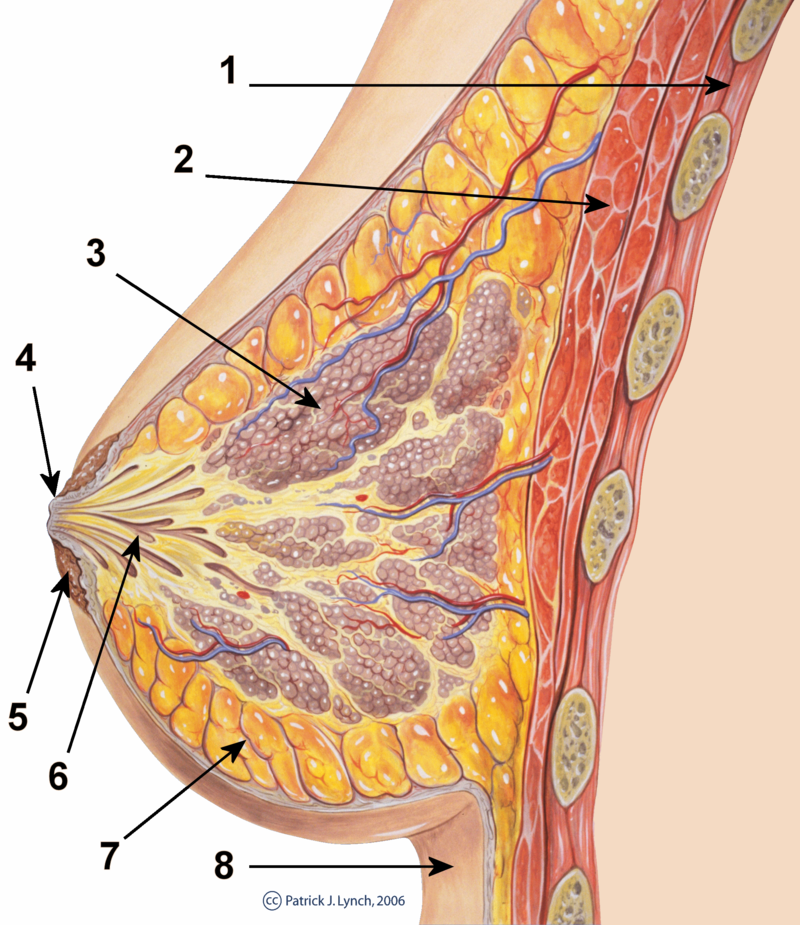
mammary gland
exocrine gland in humans and other mammals

tusk
Tusks are elongated, continuously growing front teeth that protrude well beyond the mouth of certain mammal species. Most commonly known as canine teeth, as with narwhals, chevrotains, musk deer, water deer, muntjac, pigs, peccaries, hippopotamuses and walruses, or, in the case of elephants and hyrax, elongated incisors. Tusks share common features such as extra-oral position, growth pattern, composition and structure, and lack of contribution to ingestion. In most tusked species both the males and the females have tusks. Although males' are usually larger displaying significant sexual dimorph

udder
thumb|250px|Udder of a Cattle|cow
An udder is an organ formed of two or four mammary glands on the females of dairy animals and ruminants such as cattle, goats, and sheep. An udder is equivalent to the breast in primates and other mammals. The udder is a single mass hanging beneath the animal, consisting of pairs of mammary glands with protruding teats. In cattle, camels and deer, there are normally two pairs, in sheep and goats, there is one pair, and in some animals, there are many pairs. In animals with udders, the mammary glands develop on the milk line near the groin. Mammary glands that

horn
weapon of some animals, hornlike growths excluding antlers and ossicones

whiskers
thumb|A cat with vibrissae
thumb|A chinchilla with large macrovibrissae

rumen
The rumen, also known as a paunch, is the largest stomach compartment in ruminants. The rumen and the reticulum make up the reticulorumen in ruminant animals. The diverse microbial communities in the rumen allows it to serve as the primary site for microbial fermentation of ingested feed, which is often fiber-rich roughage typically indigestible by mammalian digestive systems. The rumen is known for containing unique microbial networks within its multiple sac compartments to break down nutrients into usable energy and fatty acids.

antlers
thumb|upright|right|Mature red deer stag, Denmark
thumb|upright|Red deer at the beginning of the growing season
.png)
abomasum
thumb|right|The ruminant digestive system
The abomasum, also known as the maw, rennet-bag, or reed tripe, is the fourth and final stomach compartment in ruminants. It secretes rennet, which is used in cheese creation.

baculum
thumb|320px|Baculum of a dog's penis; the arrow shows the urethral sulcus, which is the groove in which the urethra lies.
thumb|Fossil baculum of a Indarctos|bear (Indarctos) from the [[Miocene]]

paw
thumb|right|upright=1.1|Right front paw of dog showing A) claw, B) digital pads, C) metacarpal pad, D) dewclaw, E) carpal pad.
omasum
thumb|right|The ruminant digestive systemThe omasum, also known as the green, the fardel, the manyplies and the psalterium, is the third compartment of the stomach in ruminants. The omasum comes after the rumen and reticulum and before the abomasum. Different ruminants have different omasum structures and function based on the food that they eat and how they developed through evolution.
reticulum
second chamber in the four-chamber alimentary canal of a ruminant animal

philtrum
The philtrum (, from Ancient Greek , lit. 'love charm') or medial cleft is a vertical indentation in the middle area of the upper lip, common to therian mammals, extending in humans from the nasal septum to the tubercle of the upper lip. Together with a glandular rhinarium and slit-like nostrils, it is believed to constitute the primitive condition for at least therian mammals. Monotremes lack a philtrum, though this could be due to the specialised, beak-like jaws in living species.

dentition
thumb|335px|Cast of a human upper jaw showing incisors, canines, [[premolars, and two of the three possible pairs of molars.]]

patagium
thumb|Patagia on a flying squirrel
The patagium (: patagia) is a membranous body part that assists an animal in obtaining lift when gliding or flying. The structure is found in extant and extinct groups of flying and gliding animals including bats, theropod dinosaurs (including birds and some dromaeosaurs), pterosaurs, gliding mammals, some flying lizards, and flying frogs. The patagium that stretches between an animal's hind limbs is called the uropatagium (especially in bats) or the interfemoral membrane.

Carnassial
thumb|Carnassials of a dog
Cloven hoof
A hoof split into two toes
rump
the portion of the posterior dorsum of an animal – that is, posterior to the loins and anterior to the tail
interdigital webbing
membranes of skin between fingers and toes of animals

ossicone
thumb|right|Ossicones of a giraffe
thumb|right|Ossicones of a male okapi

rhinarium
thumb|230px|
thumb|230px|
The rhinarium (Neo-Latin, "belonging to the nose"; : rhinaria) is the furless skin surface surrounding the external openings of the nostrils in many mammals. Commonly it is referred to as the tip of the snout, and breeders of cats and dogs sometimes use the term nose leather. Informally, it may be called a "truffle", "wet snout," or "wet nose” because its surface is moist in some species: for example, healthy dogs and cats.
hock
anatomical region
teat
thumb|upright=1.2|Teats protruding from the udder of a [[cow]]
thumb|upright=0.9|Part of a milking device that fits over the teats of a cow.
scent gland
exocrine glands found in most mammals
Nipple bleb
fluid filled blister on the nipple
Akidolestes
Akidolestes is an extinct genus of mammals of the family Spalacotheriidae, a group of mammals related to therians (the subclass containing marsupials and placentals).
Eimer's organ
type of organ
evolution of mammalian auditory ossicles
evolutionary event in which bones in the jaw of reptiles were co-opted to form part of the hearing apparatus in mammals
cheek teeth
mastozoology
guard hair
longest, most coarse hairs in a mammal's coat
Baubellum
bone in the clitoris
reticulorumen
The reticulorumen (; ) represents the first two chambers in the alimentary canal of ruminant animals. It is composed of the rumen and reticulum. The reticulum differs from the rumen with regard to the texture of its lining. The rumen wall is covered in small, finger-like projections called papillae, whereas the reticulum is lined with ridges that form a hexagonal honeycomb pattern. The ridges are approximately 0.1–0.2 mm wide and are raised 0.5 cm above the reticulum wall. The hexagons in the reticulum are approximately 2–5 cm wide in cattle. Despite the differences in the textu
anogenital distance
distance from midpoint of the anus to the genitalia
dander
thumb | right | alt=Flakes of dead skin cells | Flakes of dead skin cells
Dander is material shed from the body of humans and other animals that have fur, hair, or feathers. The term is similar to dandruff, when an excess of flakes becomes visible. Skin flakes that come off the main body of an animal are dander, while the flakes of skin called dandruff come from the scalp and are composed of epithelial skin cells. The surface layer of mammalian skin is called the stratum corneum, which is shed as part of normal skin replacement.
postorbital bar
straight or arched rod of bone that forms the posterior rim of the eye opening (orbit) in amniote skulls
Ungual
thumb|An ungual of the ground sloth [[Eremotherium]]
An ungual (from Latin unguis, i.e. nail) is a highly modified distal toe bone which ends in a hoof, claw, or nail. Elephants and ungulates have ungual phalanges, as did the sauropods and horned dinosaurs. A claw is a highly modified ungual phalanx.
preorbital gland
paired exocrine gland in many hoofed animals
club
bony mass