Category
page 1Measuring instruments

radar
Radar is a system that uses radio waves to determine the distance (ranging), direction (azimuth and elevation angles), and radial velocity of objects relative to the site. It is a radiodetermination method used to detect and track aircraft, ships, spacecraft, guided missiles, motor vehicles, weather formations and terrain. The term RADAR was coined in 1940 by the United States Navy as an acronym for "radio detection and ranging". The term radar has since entered English and other languages as an anacronym, a common noun, losing all capitalization.

sensor
thumb|Different types of light sensors
A sensor is often defined as a device that receives and responds to a signal or stimulus. The stimulus is the quantity, property, or condition that is sensed and converted into electrical signal.

seismometer
320px|thumb|Kinemetric seismograph

oscilloscope
thumb|A Tektronix model 475A portable analog oscilloscope, a typical instrument of the late 1970s
thumb|Oscilloscope cathode-ray tube, the left square-shaped end would be the blue screen in the upper device when built in.
thumb|Typical display of an analog oscilloscope measuring a sine wave signal with 10 kHz. From the grid inherent to the screen together with the user-set parameters of the device shown at the upper display rim, the user may calculate the frequency and the voltage of the measured signal. Modern digital oscilloscopes set the measurement parameters and calculate/display the

metronome
A metronome () is a device that produces an audible click or other sound at a uniform interval that can be set by the user, typically in beats per minute (BPM). Metronomes may also include synchronized visual motion, such as a swinging pendulum or a blinking light. Musicians—and others including dancers, athletes, and health professionals—often practise with a metronome to improve their timing, especially the ability to maintain a steady tempo with a regular beat or pulse. Composers and conductors often use numerical metronome markings to communicate their preferred tempos to musicians prepari

mass spectrometry
analytical technique based on determining mass to charge ratio of ions

voltmeter
thumb|Demonstration analog voltmeter

anemometer
thumb|A hemispherical-cup anemometer of the type invented in 1846 by Thomas Romney Robinson|John Thomas Romney Robinson
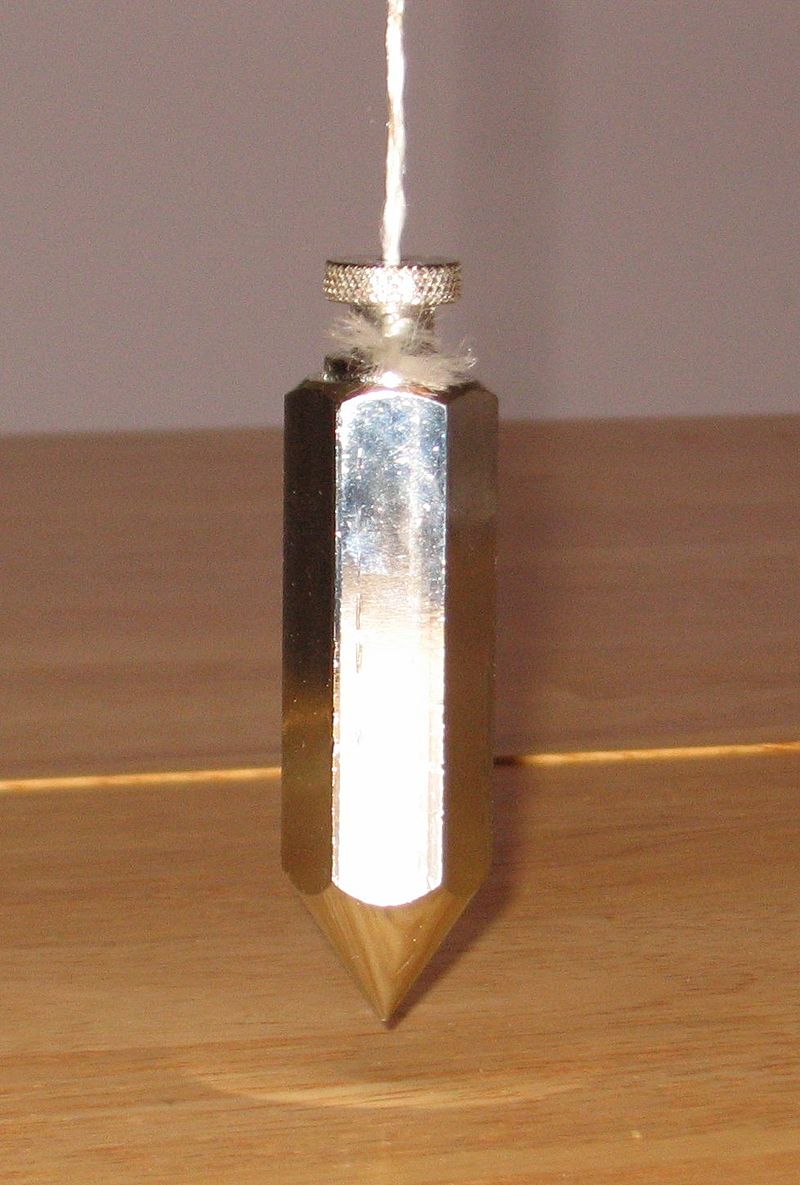
plumbline
weight, usually with a pointed tip on the bottom, suspended from a string and used as a vertical reference line

calorimeter
thumb|upright|The world's first ice-calorimeter, used in the winter of 1782–83, by Antoine Lavoisier and [[Pierre-Simon Laplace, to determine the heat involved in various chemical changes; calculations were based on Joseph Black's prior discovery of latent heat. These experiments mark the foundation of thermochemistry.]]
A calorimeter is a device used for calorimetry, or the process of measuring the heat of chemical reactions or physical changes as well as heat capacity. Differential scanning calorimeters, isothermal micro calorimeters, titration calorimeters and accelerated rate calorimeters

multimeter
thumb|Analog multimeter
thumb|Digital multimeter

speedometer
thumb|An animation of an Speedometer#Electronic|electronic [[Aston Martin speedometer's self-test routine, showing how an analogue speedometer hand may indicate the vehicle's speed]]
thumb|A Ford Motor Company|Ford speedometer, showing both mph (outer) and km/h (inner), as well as an [[odometer in miles]]
thumb|A digital, LCD speedometer in a [[Honda Insight]]

magnetometer
thumb |right |Helium vector magnetometer (HVM) of the Pioneer 10 and 11 spacecraft

electroscope
thumb|Gilbert's versorium
The electroscope is an early scientific instrument used to detect the presence of electric charge on a body. It detects this by the movement of a test charge due to the Coulomb electrostatic force on it. The amount of charge on an object is proportional to its voltage. The accumulation of enough charge to detect with an electroscope requires hundreds or thousands of volts, so electroscopes are used with high voltage sources such as static electricity and electrostatic machines. An electroscope can only give a rough indication of the quantity of charge; an instrument t

Wheatstone bridge
measuring instrument in electricity

bolometer
thumb|alt=Image of spiderweb bolometer for measurements of the cosmic microwave background radiation.|Spiderweb bolometer for measurements of the cosmic microwave background radiation. Image credit: NASA/JPL-Caltech.

diptych
thumb|Ivory consular diptych of Areobindus, [[Byzantium, 506 AD, Louvre]]
thumbnail|Wax tablet and a Roman [[stylus]]
thumb|Barberini Ivory, [[Constantinople, 6th century, Louvre]]

pitot tube
pressure measurement instrument used to measure fluid flow velocity

tachometer
thumb|300px|A tachometer that can indicate up to 7000 revolutions per minute|RPM (left)

stroboscope
thumb|A bouncing ball captured with a stroboscopic flash at 25 images per second.
thumb|A strobe light flashing at the proper period can appear to freeze or reverse cyclical motion

pyrometer
thumb|upright|An optical pyrometer
thumb|upright|A sailor checking the temperature of a ventilation system

radiosonde
thumb|Modern radiosondes showing progress of miniaturisationthumb|A Global Positioning System|GPS sonde, approx 220 × 80 ×75 mm (8.7 × 3.1 × 3 in) (with grounding station in the background, used to perform a 'ground check' and also recondition the humidity sensor)

dynamometer
thumb|360x360px|A chassis dynamometer.

refractometer
thumb|Hand-held refractometer
A refractometer is a laboratory or field device for the measurement of an index of refraction (refractometry). The index of refraction is calculated from the observed refraction angle using Snell's law. For mixtures, the index of refraction then allows the concentration to be determined using mixing rules such as the Gladstone–Dale relation and Lorentz–Lorenz equation.
echolocation
the general use of reflected sound waves to locate objects

pedometer
thumb|A digital Omron HJ-112 pedometer
thumb|Mechanical pedometer

Pyranometer
A pyranometer () is a type of actinometer used for measuring solar irradiance on a planar surface and it is designed to measure the solar radiation flux density (W/m2) from the hemisphere above within a wavelength range 0.3 μm to 3 μm.
pH meter
instrument that indicates acidity or alkalinity in water-based solutions, expressed as pH

electrometer
thumb|Kolbe electrometer, precision form of gold-leaf instrument. This has a light pivoted aluminum vane hanging next to a vertical metal plate. When charged the vane is repelled by the plate and hangs at an angle.

tachograph
thumb|250px|Analogue tachograph
thumb|250px|Tachograph chart

alidade
right|thumb|A simple alidade for use with a ceiling projector
An alidade () (archaic forms include alhidade, alhidad, alidad) or a turning board is a device that allows one to sight a distant object and use the line of sight to perform a task. This task can be, for example, to triangulate a scale map on site using a plane table drawing of intersecting lines in the direction of the object from two or more points or to measure the angle and horizontal distance to the object from some reference point's polar measurement. Angles measured can be horizontal, vertical or in any chosen plane.

variometer
In aviation, a variometer – also known as a rate of climb and descent indicator (RCDI), rate-of-climb indicator, vertical speed indicator (VSI), or vertical velocity indicator (VVI) – is one of the flight instruments in an aircraft used to inform the pilot of the rate of descent or climb. It can be calibrated in metres per second, feet per minute (1 ft/min = 0.00508 m/s) or knots (1 kn ≈ 0.514 m/s), depending on country and type of aircraft. It is typically connected to the aircraft's external static pressure source.
.png)
taximeter
thumb|North American taximeter
thumb|Indonesian taximeter
thumb|Japanese taximeter
thumb|Serbian taximeter
optical spectrometer
spectrometer for visible light

planimeter
A planimeter, also known as a platometer, is a measuring instrument used to determine the area of an arbitrary two-dimensional shape.

actinometer
thumb|255px|An actinometer instrument from the 1800s designed by John Herschel and used to estimate the temperature of the Sun's surface.
chip log
instrument used to measure the speed of a ship at sea
.jpg)
chronograph
thumb|right|An Omega Speedmaster Professional, which is commonly regarded as one of the most iconic chronographs ever produced
thumb|right|Gallet & Co.|Gallet MultiChron Astronomic () — Complex mechanical chronograph with 12-hour recording capabilities, automatic day, date, month, and moon phase display
thumb|Tianjin Seagull|Tianjin Sea-Gull ST1901 chronograph movement (based on the Swiss Venus 175)

pyrheliometer
alt=ISO 9060:2018 Class A Pyrheliometer|thumb|ISO 9060:2018 Class A, fast response & spectrally flat, pyrheliometer
thumb|1913 Balloon Borne Pyrheliometer
thumb|Typical pyrheliometer, for measurement of direct solar radiation

SQUID
thumb|Sensing element of a SQUID, 2008
flight instrument
instrument in the cockpit of an aircraft that provides the pilot with information about the flight situation of that aircraft

monochord
275px|thumb|A string, tied at A, is kept in tension by W, a suspended weight, and two bridges, B and the movable bridge C, while D is a pulley|freely moving wheel, density may be tested by using different strings

instrumentation
Instrumentation is a collective term for measuring instruments, used for indicating, measuring, and recording physical quantities. It is also a field of study about the art and science about making measurement instruments, involving the related areas of metrology, automation, and control theory. The term has its origins in the art and science of scientific instrument-making.

nilometer
thumb|Measuring shaft of the nilometer on Roda Island, Cairo built in 861 AD on the orders of the Abbasid Caliph [[al-Mutawakkil]]
A nilometer is a structure for measuring the Nile River's clarity and water level during the annual flood season in Egypt. There were three main types of nilometers, calibrated in Egyptian cubits: (1) a vertical column, (2) a corridor stairway of steps leading down to the Nile, and (3) a deep well with a culvert. If the water level was low, the fertility of the floodplain would suffer. If it was too high, the flooding would be destructive. There was a specific mark
sound level meter
device for acoustic measurements

heliometer
300px|thumb|right|Heliometer at the Kuffner observatory (Vienna, Austria)
alt=Brass Heliometer Split lens (glass lens held in brass housing, with split down the middle, and screw mechanism to move one half relative to the other)|thumb|Heliometer split lens, displayed at Custer Observatory, Long Island, New York.
A heliometer (from Greek 'sun' and 'measure') is an instrument originally developed from the mid-eighteenth to early nineteenth centuries for measuring the variation of the Sun's diameter at different seasons of the year, but the modern version of the instrument is capable of much wide
.svg)
Almucantar
right|thumb|250px|The celestial sphere with the [[zenith and almucantar marked in red, the horizon in green, and the path of a star or the Sun in blue.]]An almucantar (also spelled almucantarat or almacantara) is a circle on the celestial sphere parallel to the horizon. Two stars that lie on the same almucantar have the same altitude.
The term was introduced into European astronomy by monastic astronomer Hermann Contractus of Reichenau, Latinized from the Arabic word ' ("the almucantar, sundial", plural: '), derived from '''' ("arch, bridge")

hypsometer
thumb|Boiling Point Apparatus or Hypsometer. Image from "Maps and survey" (1913) by Hinks, Arthur R.
interferometer
REDIRECT Interferometry
radar altimeter
device which measures altitude above the terrain presently beneath an aircraft or spacecraft
Penning trap
device for the storage of charged particles
potentiometer
measuring instrument
Stevenson screen
meteorological device

lysimeter
thumb|Lysimeter station in Kittendorf, Germany
Kibble balance
experimental electromechanical weight measuring instrument
airspeed indicator
instrument used in an aircraft to display the craft's airspeed, typically in knots, to the pilot
Faraday cup
metal (conductive) cup designed to catch charged particles in vacuum
Full body scanner
device that detects objects on or inside a person's body without removing clothes
level staff
graduated wooden or aluminum rod, used with a levelling instrument
Load cell
type of force transducer