File:Wea00920.jpg · Wikimedia Commons · See Wikimedia Commons
anemometer
Sign in to saveAlso known as wind gauge
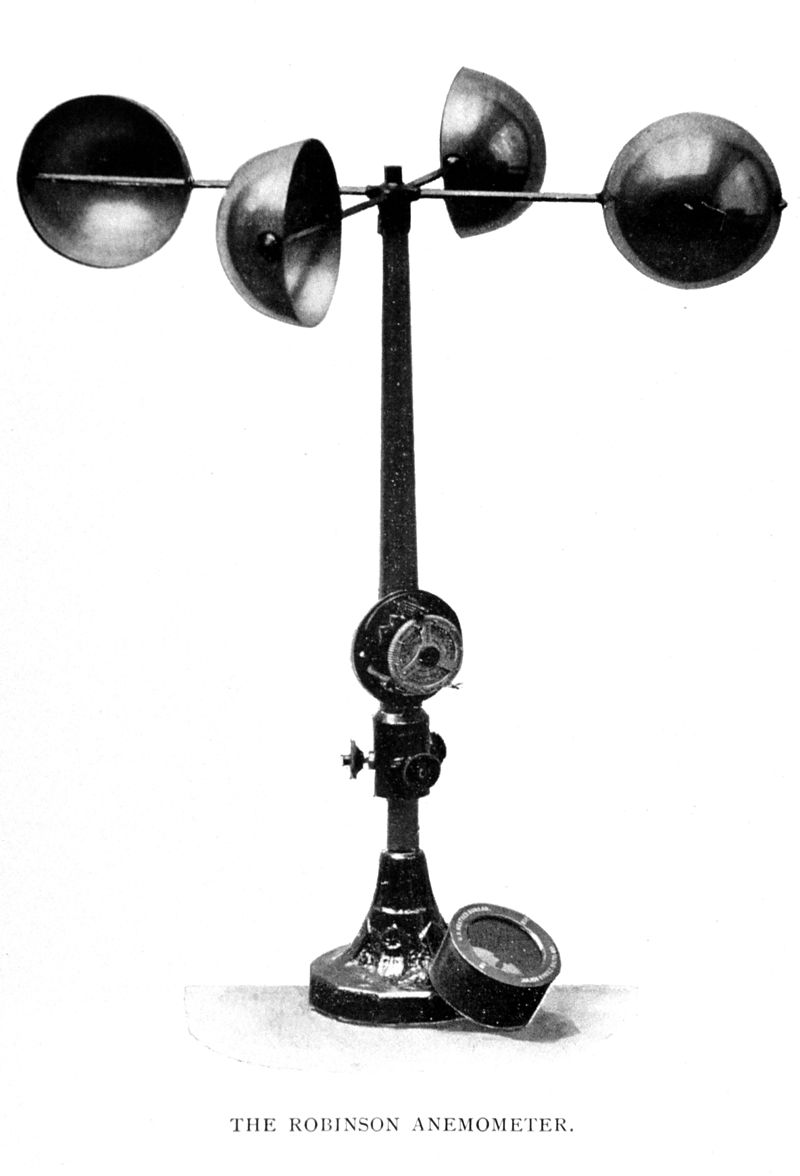
thumb|A hemispherical-cup anemometer of the type invented in 1846 by Thomas Romney Robinson|John Thomas Romney Robinson
An anemometer is a device used to measure wind speed, with one common design featuring hemispherical cups that spin as the wind pushes them. This instrument matters because it provides accurate wind measurements that are essential for weather forecasting, aviation safety, and understanding atmospheric conditions.
AI-generated from the Wikipedia summary — may contain errors.
Wikidata facts
- Instance of
- measuring instrument
- Subclass of
- meteorological instrument
- Image
- Anemometer.jpg
Show 6 more facts
- Commons category
- Anemometers
- Commons gallery
- Anemometer
- different from
- anemoscope
- measures
- wind speed
- used by
- farmer
- OpenStreetMap tag
- weather:anemometer=yes
via Wikidata · CC0
~21 min read
Encyclopedic overview
23 sectionsContents
- History
- Velocity anemometers
- Cup anemometers
- Four cup
- Three cup
- Three cup wind direction
- Vane anemometers
- Hot-wire anemometers
- Laser Doppler anemometers
- Ultrasonic anemometers
- Acoustic resonance anemometers
- Pressure anemometers
- Plate anemometers
- Tube anemometers
- Pitot tube static anemometers
- Ping-pong ball anemometers
- Effect of density on measurements
- Effect of icing
- Instrument location
- See also
- Notes
- References
- External links
thumb|A hemispherical-cup anemometer of the type invented in 1846 by Thomas Romney Robinson|John Thomas Romney Robinson
In meteorology, an anemometer () is a device that measures wind speed and direction. It is a common instrument used in weather stations. The earliest known description of an anemometer was by Italian architect and author Leon Battista Alberti (1404–1472) in 1450.
Excerpted from Wikipedia’s “anemometer” article, available under the CC BY-SA 4.0 licence.
Gallery (415)
Available in 64 languages
- Español
- Français
- Deutsch
- 中文
- 日本語
- Русский
- Português
- Italiano
- العربية
- हिन्दी
- Afrikaans
- Aragonese
- Armenian
- Asturian
- Azerbaijani
- Bahasa Indonesia
- Basque
- Belarusian
Show 45 more
- Bulgarian
- Catalan
- Croatian
- Czech
- Danish
- Esperanto
- Estonian
- Filipino
- Finnish
- Galician
- Hebrew
- Hungarian
- Ido
- Irish
- Kashubian
- Kazakh
- Kurdish
- Kyrgyz
- Latvian
- Lithuanian
- Macedonian
- Malay
- Malayalam
- Nederlands
- Norwegian
- Norwegian Nynorsk
- Odia
- Polski
- Romanian
- Scots
- Serbian
- Serbian (Latin)
- simple
- Slovak
- Svenska
- Tajik
- Tamil
- Tiếng Việt
- Türkçe
- Ukrainian
- Urdu
- Uzbek
- فارسی
- ไทย
- 한국어
via Wikidata sitelinks · CC0