Category
page 1Mechanical quantities

work
energy transferred to an object via the application of force on it through a displacement

momentum
In Newtonian mechanics, momentum (: momenta or momentums; more specifically linear momentum or translational momentum) is the product of the mass and velocity of an object. It is a vector quantity, possessing a magnitude and a direction. If is an object's mass and is its velocity (also a vector quantity), then the object's momentum (from Latin pellere "push, drive") is: \mathbf{p} = m \mathbf{v}.
In the International System of Units (SI), the unit of measurement of momentum is the kilogram metre per second (kg⋅m/s), which is dimensionally equivalent to the newton-second.

potential energy
energy held by an object because of its position relative to other objects or stresses within itself, rather than its velocity

torque
In physics and mechanics, torque is the rotational correspondent of linear force. It is also referred to as the moment of force, or simply the moment. Just as a linear force is a push or a pull applied to a body, a torque can be thought of as a twist applied to an object with respect to a chosen axis. For example, driving a screw uses torque to force it into an object. The torque is applied by the screwdriver, rotating around its axis, to the drive on the head of the screw.
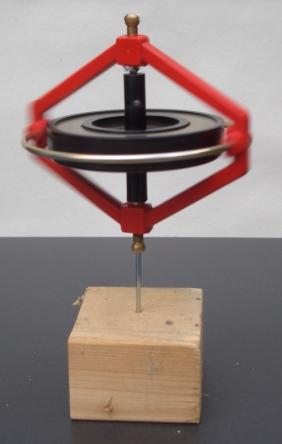
angular momentum
measure of the extent to which an object will continue to rotate in the absence of an applied torque

surface tension
tendency of a liquid surface to shrink to reduce surface area

moment of inertia
scalar measure of the rotational inertia with respect to a fixed axis of rotation

mechanical energy
potential and kinetic energy associated with the position and movement of a physical object

impulse
integral of a force over the time interval for which it acts; term in classical mechanics

Poisson's ratio
parameter of elastic materials: ratio of transverse strain to axial strain
elastic modulus
physical property that measures the stiffness of an elastic material
compressibility
In thermodynamics and fluid mechanics, the compressibility (also known as the coefficient of compressibility or, if the temperature is held constant, the isothermal compressibility) is a measure of the instantaneous relative volume change of a fluid or solid as a response to a pressure (or mean stress) change. In its simple form, the compressibility \kappa (denoted in some fields) may be expressed as
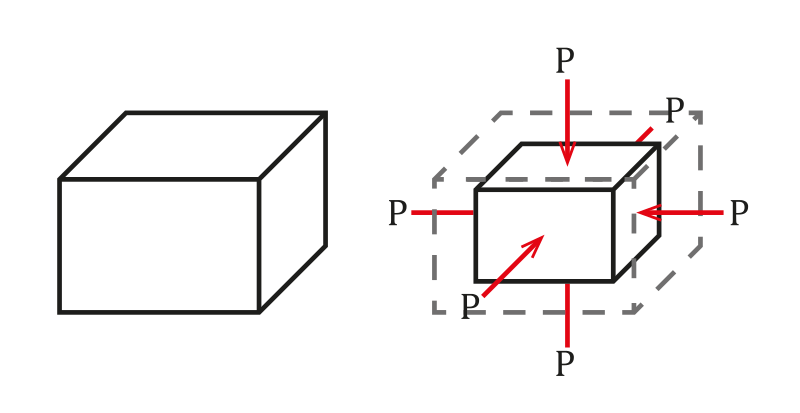
bulk modulus
measure of how incompressible / resistant to compressibility a substance is
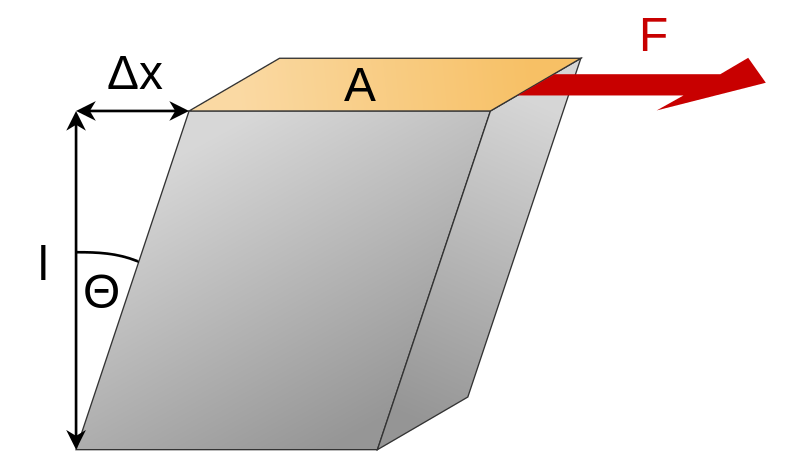
shear modulus
ratio of shear stress to the shear strain
shear stress
component of stress coplanar with a material cross section
mass flow rate
mass per time of a fluid passing through a cross section
volume flow rate
volume of fluid which passes per time
specific volume
ratio of a substance's volume to its mass
second moment of area
mathematical construct in engineering
generalized coordinate
parameters that describe the configuration of the system relative to some reference configuration
section modulus
concept in structural analysis
bending moment of force
moment that results in the bending of a structural element
coefficient of friction
dimensionless scalar value which describes the ratio of the force of friction between two bodies and the force pressing them together; depends on the materials used, ranges from near zero to greater than one
dynamic viscosity
physical property of a moving fluid
generalized force
in analytical mechanics, the rate of change of the virtual work along generalized coordinates
second polar moment of area
moment

mechanical impedance
quotient of force and resulting speed in the same direction

mechanical efficiency
quotient of mechanical output and input power
kinematic viscosity
the dynamic viscosity divided by mass density
moment of force
vector product of the position vector with respect to the axis of rotation and the force

generalized momentum
in mechanics, a quantity conjugate to generalized coordinates