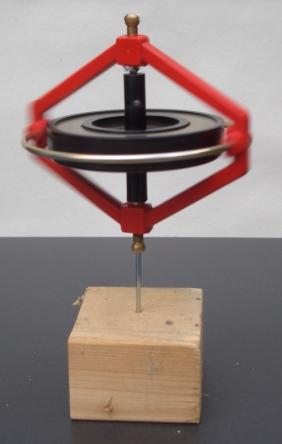
File:Gyroskop.jpg · Wikimedia Commons · See Wikimedia Commons
angular momentum
Sign in to saveAlso known as moment of momentum
measure of the extent to which an object will continue to rotate in the absence of an applied torque
Angular momentum is a property that measures how much an object tends to keep spinning once it's in rotation. It matters because it helps explain why spinning objects resist changes to their motion — like how a spinning top stays upright or how ice skaters spin faster when they pull their arms in.
AI-generated from the Wikipedia summary — may contain errors.
Wikidata facts
- Subclass of
- pseudovector
- Image
- Cup of Russia 2010 - Yuko Kawaguti (2).jpg
Show 5 more facts
- Stack Exchange tag
- physics.stackexchange.com/tags/angular-momentum
- Commons category
- Angular momentum
- topic's main category
- Category:Angular momentum
- on focus list of Wikimedia project
- Wikipedia:Vital articles/Level/4
- maintained by WikiProject
- WikiProject Mathematics
via Wikidata · CC0
~40 min read
Encyclopedic overview
Angular momentum (sometimes called moment of momentum or rotational momentum) is the rotational analog of linear momentum. It is an important physical quantity because it is a conserved quantity – the total angular momentum of an isolated system remains constant. Angular momentum has both a direction and a magnitude, and both are conserved. Bicycles and motorcycles, flying discs, rifled bullets, and gyroscopes owe their useful properties to conservation of angular momentum. Conservation of angular momentum is also why hurricanes form spirals and neutron stars have high rotational rates. In general, conservation limits the possible motion of a system, but it does not uniquely determine it.
The three-dimensional angular momentum for a point particle is classically represented as a pseudovector r × p, the cross product of the particle's position vector r (relative to some origin) and its momentum vector; the latter is p = mv in Newtonian mechanics. Unlike linear momentum, angular momentum depends on where this origin is chosen, since the particle's position is measured from it.
Excerpted from Wikipedia’s “angular momentum” article, available under the CC BY-SA 4.0 licence.
Gallery (11)
Available in 75 languages
- Español
- Français
- Deutsch
- 中文
- 日本語
- Русский
- Português
- Italiano
- العربية
- हिन्दी
- Afrikaans
- Albanian
- Armenian
- Asturian
- Azerbaijani
- Bahasa Indonesia
- Bangla
- Basque
Show 56 more
- Belarusian
- Bosnian
- Bulgarian
- Burmese
- Catalan
- Chuvash
- Croatian
- Czech
- Danish
- Esperanto
- Estonian
- Finnish
- Galician
- Georgian
- Greek
- Hebrew
- Hungarian
- Icelandic
- Irish
- Kabyle
- Kazakh
- Latvian
- Lithuanian
- Macedonian
- Malay
- Marathi
- Nederlands
- Northern Frisian
- Norwegian
- Norwegian Nynorsk
- Occitan
- Piedmontese
- Polski
- Punjabi
- Romanian
- Serbian
- Serbian (Latin)
- simple
- Sinhala
- Slovak
- Slovenian
- Sundanese
- Svenska
- Tamil
- Tatar
- Telugu
- Tiếng Việt
- Türkçe
- Ukrainian
- Urdu
- Wu Chinese
- zh_classical
- zh_yue
- فارسی
- ไทย
- 한국어
via Wikidata sitelinks · CC0