Category
page 1Meteor shower progenitors

Halley's Comet
short-period comet visible from Earth every 75–76 years

1566 Icarus
asteroid

Comet Encke
periodic comet
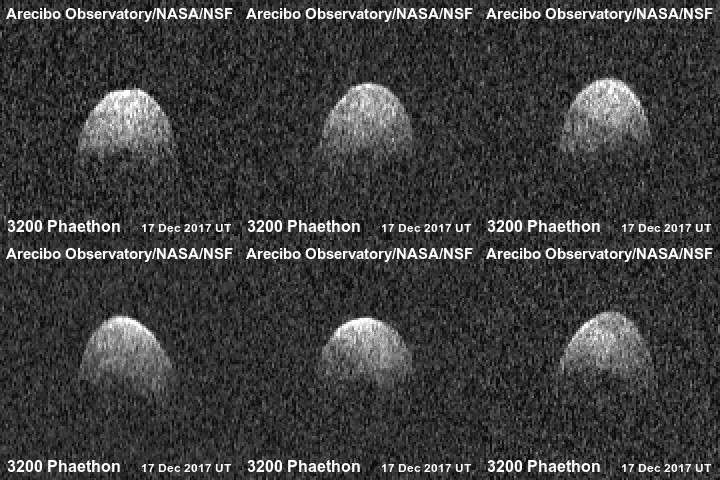
3200 Phaethon
Apollo asteroid notable for its very small perihelion and for being the progenitor of the Geminid meteor shower
Comet Swift–Tuttle
periodic comet and parent body of the Perseid meteor shower
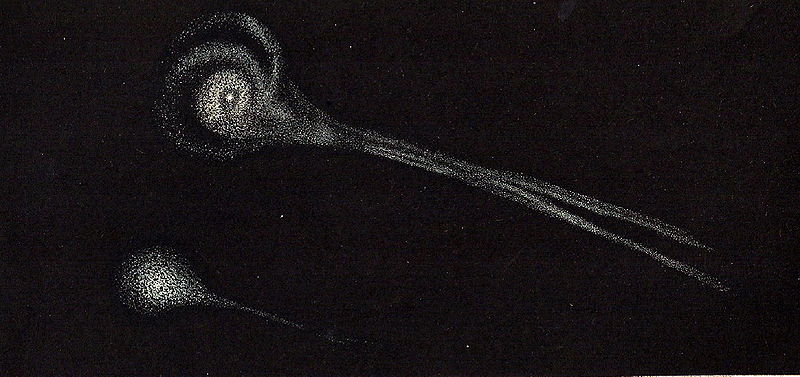
Biela's Comet
Comet that dissolved and assumed as gone
21P/Giacobini–Zinner
{| class=wikitable style="text-align:center; font-size:11px; float:right; margin:2px"
|- bgcolor= style="font-size: smaller;"
| colspan="8" style="text-align:center;"|Perihelion distanceat different epochs
|-
! Epoch !! Perihelion(AU)
|-
| 1894 || 1.23
|-
| 1900 || 0.93
|-
| 1985 || 1.03
|-
| 2031 || 1.07
|-
| 2078 || 0.97
|}

73P/Schwassmann–Wachmann
73P/Schwassmann–Wachmann, also known as Schwassmann–Wachmann 3 or SW3 for short, is a periodic comet that has a 5.4 year orbital period and that has been actively disintegrating since 1995. When it came to perihelion (closest approach to the Sun) in March 2017, fragment 73P-BT was separating from the main fragment 73P-C. Fragments 73P-BU and 73P-BV were detected in July 2022. The main comet came to perihelion on 25 August 2022, when the comet was 0.97 AU from the Sun and 1 AU from Earth. It will be less than 80 degrees from the Sun from 25 May 2022 until August 2023. On 3 April 2025 it made a

46P/Wirtanen
{| class=wikitable style="text-align:center; font-size:11px; float:right; margin:2px"
|- bgcolor= style="font-size: smaller;"
| colspan="8" style="text-align:center;"|Perihelion distanceat different epochs
|-
! Epoch !! Perihelion(AU)
|-
| 1967 || 1.61
|-
| 1974 || 1.26
|-
| 1986 || 1.08
|-
| 2013 || 1.05
|-
| 2035 || 1.08
|-
| 2046 || 1.22
|-
| 2059 || 1.98
|-
| 2095 || 2.01
|}

55P/Tempel–Tuttle
55P/Tempel–Tuttle (commonly known as Comet Tempel–Tuttle) is a retrograde periodic comet with an orbital period of 33 years. It fits the classical definition of a Halley-type comet with a period of between 20 and 200 years. It was independently discovered by Wilhelm Tempel on 19 December 1865, and by Horace Parnell Tuttle on 6 January 1866. It is the parent body of the Leonid meteor shower.

8P/Tuttle
8P/Tuttle (also known as '''Tuttle's Comet or Comet Tuttle''') is a periodic comet with a 13.6-year orbit. It fits the classical definition of a Jupiter-family comet with an orbital period of less than 20 years, but does not fit the modern definition of (2 Jupiter< 3). Its last perihelion passage was 27 August 2021 when it had a solar elongation of 26 degrees at approximately apparent magnitude 9. Two weeks later, on September 12, 2021, it was about from Earth which is about as far from Earth as the comet can get when the comet is near perihelion.
26P/Grigg–Skjellerup
Comet Grigg–Skjellerup (formally designated 26P/Grigg–Skjellerup) is a periodic comet. It was visited by the Giotto probe in July 1992. The spacecraft came as close as 200 km, but could not take pictures because some instruments were damaged from its encounter with Halley's Comet. The comet last came to perihelion (closest approach to the Sun) on 25 December 2023, but was 1.8 AU from Earth and only 31 degrees from the Sun.

12P/Pons–Brooks
Comet Pons–Brooks is a periodic comet with an orbital period of 71 years. Comets with an orbital period of 20–200 years are referred to as Halley-type comets. It is one of the brightest known periodic comets, reaching an absolute visual magnitude of about 5 in its approach to perihelion. Comet Pons–Brooks was conclusively discovered at Marseilles Observatory in July 1812 by Jean-Louis Pons, and on its next appearance in 1883 by William Robert Brooks. However it has been confirmed 12P/Pons–Brooks was observed before the 19th century.

7P/Pons–Winnecke
7P/Pons–Winnecke (also known as Comet Pons–Winnecke) is a periodic Jupiter-family comet with a six-year orbit around the Sun.
(196256) 2003 EH1
asteroid
15P/Finlay
Comet Finlay, also known as 15P/Finlay, is a Jupiter-family comet with an orbital period of 6.58 years. It discovered by William Henry Finlay from the Royal Observatory at Cape of Good Hope, South Africa on 26 September 1886. Of the known numbered periodic comets, the orbit of 15P/Finlay has one of the smallest minimum orbit intersection distances with Earth's orbit (E-MOID). In October 2060, the comet will pass about from Earth.
289P/Blanpain
289P/Blanpain, formerly D/1819 W1 (Blanpain) is a short-period comet with an orbital period of 5.2 years. It was discovered by Jean-Jacques Blanpain on November 28, 1819 but was considered lost until it was recovered in 2013. It was last observed in 2020.
C/2023 P1 (Nishimura)
comet
C/1861 G1 (Thatcher)
comet

96P/Machholz
Comet 96P/Machholz, also known as Machholz 1 is a periodic sunskirting comet discovered on 12 May 1986, by amateur astronomer Donald Machholz on Loma Prieta peak, in central California using binoculars. On 6 June 1986, 96P/Machholz passed from the Earth. 96P/Machholz last came to perihelion on January 31, 2023. The comet has an estimated diameter of around .
209P/LINEAR
209P/LINEAR is a periodic comet with an orbital period of 5.1 years. The comet has extremely low activity for its size and is probably in the process of evolving into an extinct comet.
Comet IRAS–Araki–Alcock
astronomical object
2004 TG10
near-Earth object
114P/Wiseman–Skiff
114P/Wiseman–Skiff is a Jupiter-family comet with a 6.67-year orbit around the Sun. It is the only comet discovered by Jennifer Wiseman and one of several by Brian A. Skiff.
169P/NEAT
169/NEAT is a periodic comet in the Solar System. It is the parent body of the alpha Capricornids meteor shower in late July. 169/NEAT may be related to comet P/2003 T12 (SOHO).
(155140) 2005 UD
asteroid
255P/Levy
255P/Levy, formerly P/2006 T1 and P/2011 Y1, is a Jupiter-family comet with an orbital period of 5.25 years. It last came to perihelion (closest approach to the Sun) on 14 January 2012. During the 2006 passage the comet achieved an apparent magnitude of ~9.5. Levy (PK06T010) was believed to have been recovered on 3 June 2011 at magnitude 19.8, but other observatories were unable to confirm a recovery. It was most likely a false positive because of large residuals. Levy was recovered on 17 December 2011 at magnitude 19.8, and given the second designation 2011 Y1. It was then numbered.
C/2007 W1
astronomical object
C/1917 F1 (Mellish)
comet
C/1963 A1 (Ikeya)
comet