Category
page 1Meteorological phenomena

wind
thumb|upright=1.35|Cherry tree moving with the wind blowing about 22 m/sec (about 79 km/h or 49 mph)
thumb|Sound of wind blowing in a pine forest at around 25 m/sec, with Wind gust|gust alterations
Wind is the natural movement of air or other gases relative to a planet's surface. Winds occur on a range of scales, from thunderstorm flows lasting tens of minutes, to local breezes generated by heating of land surfaces and lasting a few hours, to global winds resulting from the difference in absorption of solar energy between the climate zones on Earth. The study of wind is called anemology.

flood
thumb|Urban flooding in a street in Morpeth, England, 2008
.jpg)
sky
upright=1.25|thumb|The night sky over Slovenia in July
upright=1.25|thumb|cirrus cloud|Cirriform clouds and a quarter [[Moon in the blue daytime sky over Germany]]

tropical cyclone
rapidly rotating storm system that forms in the tropics

thunder
Thunder is the sound caused by lightning. Depending upon the distance from and nature of the lightning, it can range from a long, low rumble to a sudden, loud crack. The sudden increase in temperature and hence pressure caused by the lightning produces rapid expansion of the air in the path of a lightning bolt. In turn, this expansion of air creates a sonic shock wave, often referred to as a "thunderclap" or "peal of thunder". The scientific study of thunder is known as brontology and the irrational fear (phobia) of thunder is called brontophobia.

drought
A drought is a period of drier-than-normal conditions. A drought can last for days, months or years. Drought often has large impacts on the ecosystems and agriculture of affected regions, and causes harm to the local economy. Annual dry seasons in the tropics significantly increase the chances of a drought developing, with subsequent increased wildfire risks. Heat waves can significantly worsen drought conditions by increasing evapotranspiration. This dries out forests and other vegetation, and increases the amount of fuel for wildfires.

precipitation
In meteorology, precipitation is any product of the condensation of atmospheric water vapor that falls from clouds due to gravitational pull. The main forms of precipitation include drizzle, rain, rain and snow mixed ("sleet" in Commonwealth usage), snow, ice pellets, graupel and hail. Precipitation occurs when a portion of the atmosphere becomes saturated with water vapor (reaching 100% relative humidity), so that the water condenses and "precipitates" or falls. Thus, fog and mist are not precipitation; their water vapor does not condense sufficiently to precipitate, so fog and mist do not fa

cyclone
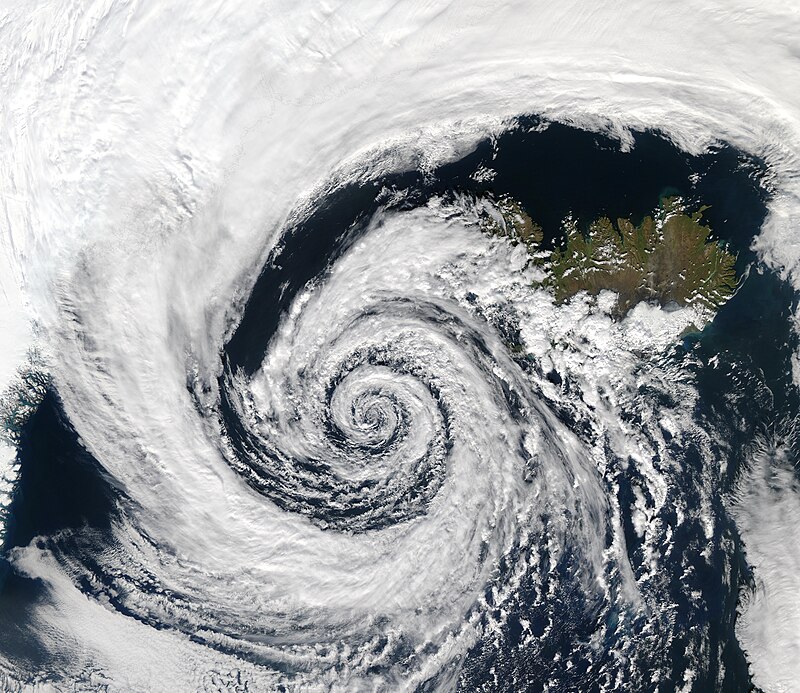
thumb|upright=1.3|An extratropical cyclone near Iceland

evaporation
thumb|right|Aerosol of microscopic water droplets suspended in the air above a cup of hot tea after the water vapor has sufficiently cooled and condensed. Water vapor is an invisible gas, but the clouds of condensed droplets refract and scatter the sunlight and are thus visible.
thumb|Droplets of water vapor in a pan.
thumb|right|280px|Demonstration of evaporative cooling. When the sensor is dipped in ethanol and then taken out to evaporate, the instrument shows progressively lower temperature as the ethanol evaporates.
thumb|Rain evaporating after falling on hot pavement

stratosphere
thumb|upright=1.25|Afterglow of the [[troposphere (orange), the stratosphere (blue) and the mesosphere (dark), at which atmospheric entry of objects begins, as in this case of a spacecraft reentry that leaves contrails.]]

heat wave
prolonged period of excessively hot weather

weather front
boundary separating two masses of air of different densities

air mass
widespread body of air approximately homogeneous in its horizontal extent with vertical temperature and moisture variations that are approximately the same over its horizontal extent
low pressure area
region of the atmosphere in which atmospheric pressure is lower than that of surrounding regions

evapotranspiration
thumb|right|260px|Water cycle of the Earth's surface, showing the individual components of transpiration and evaporation that make up evapotranspiration. Other closely related processes shown are runoff and [[groundwater recharge.]]

whirlwind
thumb|A whirlwind
thumb|A dust devil at school ground
thumb|Whirlwind, 61 km northeast of Broome, Western Australia
horse latitudes
A latitude of 25 deg to 35 degree of both hemispheres is called horse latitude.
cold wave
weather phenomenon
sea surface temperature
water temperature close to the ocean's surface
wind direction
geographic direction from which a wind blows
cold drop
meteorological term
high-pressure area
region where the atmospheric pressure at the surface of the planet is greater than its surrounding environment
atmospheric river
narrow corridor or filament of concentrated moisture in the atmosphere
clear-air turbulence
turbulence without visual cues
1561 celestial phenomenon over Nuremberg
uncomprehended phenomenon observed over Nuremberg in 1561
sea state
general condition of the free surface on a large body of water
heat dome
weather phenomenon

downwelling
thumb|Schematic of coastal downwelling in the Northern Hemisphere.|300x300pxDownwelling is the downward movement of a fluid parcel and its properties (e.g., salinity, temperature, pH) within a larger fluid. It is closely related to upwelling, the upward movement of fluid.
Polar high
regions of high atmospheric pressure around the Earth's poles
Saharan air layer
hot, dry and sometimes dust-laden atmospheric layer
atmospheric subsidence
movement of colder, more dense air downwards within the atmosphere
diurnal temperature variation
variation between a high temperature and a low temperature that occurs during the same day

1566 celestial phenomenon over Basel
uncomprehended phenomenon observed over Basel in 1566
pressure system
relative peak or lull in the sea level pressure distribution
white squall
sudden and violent windstorm at sea
anticyclogenesis
Anticyclogenesis is the development or strengthening of an anticyclonic circulation in the atmosphere. It is the opposite of anticyclolysis (the dissolution or weakening of an anticyclone) and has a cyclonic equivalent known as cyclogenesis. Anticyclones are alternatively referred to as high pressure systems.
outflow
air that flows outwards from a storm system
cold-core low
cyclone aloft which has an associated cold pool of air residing at high altitude within the Earth's troposphere
lithometeor
thumb|Large ash cloud from the Mount Redoubt volcano.
thumb|Lithometeor at sunset in [[Berlin on February 25, 2021, cloudless sky with Saharan dust.]]
post-tropical cyclone
former tropical cyclone
freezing level
altitude in which the temperature is at 0 °C

Mei-Yu front
weather system
solar factor
increase in thermal energy of a space, object or structure as it absorbs incident solar radiation
potential evaporation
amount of evaporation that would occur if a sufficient water source were available
secondary flow
relatively minor flow superimposed on the primary flowby inviscid assumptions
inflow
in meteorology, the flow of a fluid into a large collection of that fluid
fluctuations in the length of day
short-term changes in the length of the day