Category
page 1Migration Period

Huns
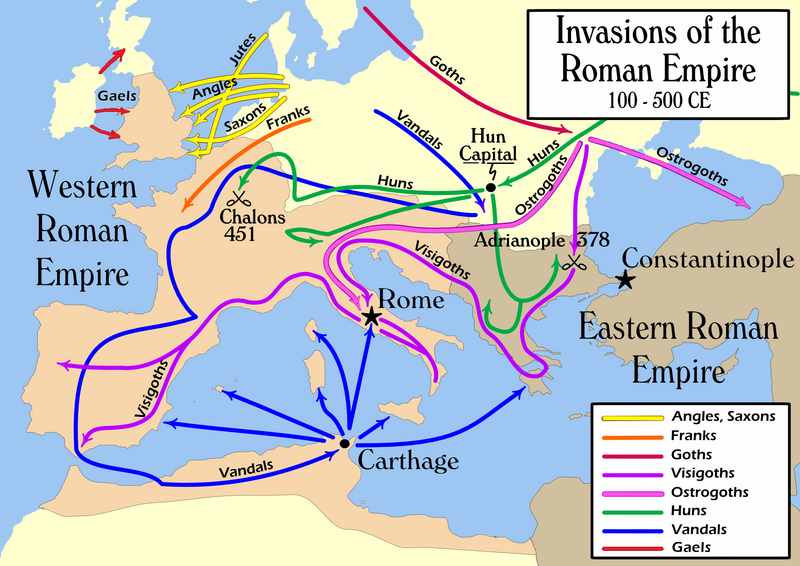
The Huns were a nomadic people who lived in Central Asia, the Caucasus, and Eastern Europe between the 4th and 6th centuries CE. According to European tradition, they were first reported living east of the Volga River, in an area that was part of Scythia at the time. By 370 CE, the Huns had arrived on the Volga, causing the westwards movement of Goths and Alans. By 430, they had established a vast, but short-lived, empire on the Danubian frontier of the Roman empire in Europe. Either under Hunnic hegemony, or fleeing from it, several central and eastern European peoples established kingdoms in
Migration Period
period in European history with large migration of peoples, from the 4th to the 6th centuries

Lombards
thumb|upright=1.2|Lombard possessions in Italy: the Lombard Kingdom (Neustria (Lombard)|Neustria, Austria and Tuscia) and the Lombard Duchies of Spoleto and Benevento

Alans
The Alans () were an ancient and medieval Iranic nomadic pastoral people who migrated to what is today the North Caucasus; some continued on to Europe and later North Africa. They are generally regarded as part of the Sarmatians, and possibly related to the Massagetae. Modern historians have connected the Alans with the Central Asian Yancai of Chinese sources and with the Aorsi of Roman sources. Having migrated westwards and becoming dominant among the Sarmatians on the Pontic–Caspian steppe, the Alans are mentioned by Roman sources in the . At that time they had settled in the region north of

Pannonian Avars
alliance of various Eurasian nomads – 6th to 9th centuries

Angles
North Sea Germanic people, from the eponymous area

Bulgars
thumb|right|300px|Bulgars led by Khan (title)|Khan [[Krum pursue the Byzantines at the Battle of Versinikia (813)]]

fibula
ancient pin or brooch for securing clothing

Ostsiedlung
thumb|Stages of German eastern settlement in pink and three shades of green; the black line represents Holy Roman Empire borders in 1348
thumb|German language areas in 1910 in today's Poland, [[Kaliningrad Oblast (Russia), Lithuania, and Czech Republic before expulsion of Germans ]]
'''' (, ) is the term for the early medieval and high medieval migration of Germanic peoples and Germanization of the areas populated by Slavic, Baltic and Uralic peoples; the most settled area is sometimes known today as . Germanization efforts included eastern parts of Francia, East Francia, and the Holy Roman Em

seax
thumb|upright|Merovingian seaxes
Early Germanic law
component of early Germanic culture
Onogurs
The Onoghurs, Onoğurs, or Oğurs (Ὀνόγουροι, Οὔρωγοι, Οὔγωροι; Onογurs, Ογurs; "ten tribes", "tribes") were a group of Turkic nomadic equestrians who flourished in the Pontic–Caspian steppe and the Volga region between the 5th and 7th centuries, and spoke an Oghuric language.
Anglo-Saxon settlement of England
process which changed the language and culture of most of what became England from Romano-British to Germanic
Chernyakhov culture
archaeological culture 100-500CE in modern Ukraine, Romania, Moldova Belarus
White Serbia
Historical region of the White Serbs
barbarian kingdom
series of medieval kingdoms founded and dominated by northern European tribes (primarily Germanic) after the collapse of the Western Roman Empire in 476
Vendel era
period of Swedish prehistory (540–790 CE)
Elder Futhark
system of runes for Proto-Germanic
.jpg)
bracteate
right|thumb|Bracteate Alu (runic)#DR BR42|DR BR42 bearing the inscription Alu and a figure on a horse
Insular art
style of art produced in the post-Roman history of the British Isles
End of Roman rule in Britain
the 27-year transition period from Roman Britain to post-Roman Britain from 383C-410C
Turkic migration
expansion of the Turkic tribes and Turkic languages, mainly between the 6th and 11th centuries
Crossing of the Rhine
military operation
White Croats
ethnic group

Taifals
right|thumb|200px|The dragon-and-pearl device of the shields of the Equites Honoriani Taifali iuniores unit based in Gaul. The dragon was blue, as was the "pearl". The boss was blue and the band around the boss was red. The field was white.
Migration Period art
art movement

Utigurs
thumb|300px|Eastern Hemisphere in c. 600 AD.
Utigurs were Turkic nomadic equestrians who flourished in the Pontic–Caspian steppe in the 6th century AD. They possibly were closely related to the Kutrigurs and Bulgars.
Germanic Iron Age
Treasure of Nagyszentmiklós
twenty-three early medieval gold vessels found in what is now Romania
viking expansion
exploration, settlement, and raids performed by Norse population

Tungri
The Tungri (or Tongri, or Tungrians) were a tribe, or group of tribes, who lived in the Belgic part of Gaul, during the times of the Roman Empire. Within the Roman Empire, their territory was called the Civitas Tungrorum. They were described by Tacitus as being the same people who were first called "Germani" (Germanic), meaning that all other tribes who were later referred to this way, including those in Germania east of the river Rhine, were named after them. More specifically, Tacitus was thereby equating the Tungri with the "Germani Cisrhenani" described generations earlier by Julius Caesar

Barbaricum
thumb|350px|Roman provinces in 116 AD with the adjacent land of Germania|Magna Germania
Barbaricum (from the , "foreign", "barbarian") is a geographical name used by historical and archaeological experts to refer to the vast area of barbarian-occupied territory that lay, in Roman times, beyond the frontiers or limes of the Roman Empire in North, Central and South Eastern Europe, the "lands lying beyond Roman administrative control but nonetheless a part of the Roman world". During the Late Antiquity, it was the Latin name for those tribal territories not occupied by Rome that lay beyond the Rh
Kyiv culture
archaeological culture
Lentienses
The Lentienses (German Lentienser) were a 4th-century Germanic tribe associated with the Alemanni, in the region between the river Danube in the North, the river Iller in the East, and Lake Constance in the South, in what is now southern Germany.
They were reported to be one of the most rebellious tribes at the time. There are only two mentions of the Lentienses, both by the Roman historian Ammianus Marcellinus (330–395).
Turcilingi
thumb|right|Thomas Hodgkin (historian)|Thomas Hodgkin's map of barbarian peoples during the time of Augustulus, from his Italy and Her Invaders. The location of the Turcilingi is only a guess.
The Turcilingi (also spelled Torcilingi or Thorcilingi) were an obscure barbarian people, or possibly a clan or dynasty, who appear in a small number of records relating to non-Roman soldiers serving within the empire under Odoacer in the 5th century AD. The 6th-century writer Jordanes indicated that Odoacer himself was considered a Turcilingian, although his descriptions of Odoacer's ethnic background a
Balkan–Danubian culture
archaeological culture from Europe
disk brooch
brooch in the form of a flat disk, with a pin back
lamellar helmet
helmet made of overlapping scales
Barbarian invasion of the 3rd century
barbarian invasions against the Roman Empire in the 3rd century
grave orb
Stone ball placed on a tomb
Grogarnsberget
Grogarnsberget or Grogarnsberg (lit. "The Grogarn Mountain" more appropriate "Grogarn Hill") is a plateau hill on the Östergarn coast, on the Swedish island of Gotland. On the hill are the remains of former hillfort, the second largest on Gotland and the fourth largest in Scandinavia.
Heaðobards
thumb|250px|A mention of Heaðobards in the Beowulf
The Heaðobards (Old English: Heaðubeardan, Old Saxon: Headubarden, "war-beards") were possibly a branch of the Langobards, and their name may be preserved in toponym Bardengau, in Lower Saxony, Germany.
Migration Period sword
Late Iron Age and Early Medieval type of sword
Geißkopf (Central Black Forest)
mountain