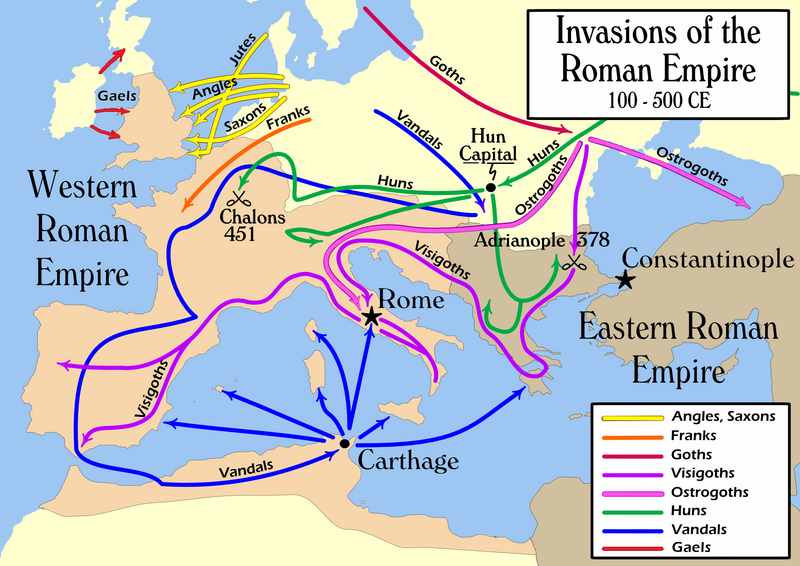
File:Invasions_of_the_Roman_Empire_1.png · Wikimedia Commons · See Wikimedia Commons
Migration Period
Sign in to saveAlso known as Great Barbarian Invasion, Germanic Invasions, Barbarian invasions of Rome, Germanic Invasions of Rome
period in European history with large migration of peoples, from the 4th to the 6th centuries
The Migration Period was a time in European history, roughly from the 4th to the 6th centuries, when large groups of people moved across the continent in significant numbers. This era reshaped the political and cultural map of Europe, leading to the fall of the Western Roman Empire and the rise of new kingdoms and societies.
AI-generated from the Wikipedia summary — may contain errors.
Wikidata facts
- Instance of
- human migration
- Location
- continental Europe
- Image
- Oton Ivekovic, Dolazak Hrvata na Jadran.jpg
Show 7 more facts
- described by source
- Granat Encyclopedic Dictionary
- Commons category
- Migration period
- topic's main category
- Category:Migration Period
- time period
- Roman Empire
- on focus list of Wikimedia project
- Wikipedia:Vital articles/Level/4
- start time
- 0375-00-00
- end time
- 0568-00-00
via Wikidata · CC0
~22 min read
Encyclopedic overview
The Migration Period (c. 300 to 600 AD), also known as the Barbarian Invasions, was a period in European history marked by large-scale migrations that saw the fall of the Western Roman Empire and subsequent settlement of its former territories by various tribes, and the establishment of post-Roman kingdoms there.
The term refers to the important role played by the migration, invasion, and settlement of various tribes, notably the Burgundians, Vandals, Goths, Alemanni, Alans, Huns, early Slavs, Pannonian Avars, Bulgars, and Magyars, within or into the territories of Europe as a whole and of the Western Roman Empire in particular. Historiography traditionally takes the period as beginning in AD 375 (possibly as early as 300) and ending in 568. Various factors contributed to this phenomenon of migration and invasion, and their role and significance are still widely discussed.
Excerpted from Wikipedia’s “Migration Period” article, available under the CC BY-SA 4.0 licence.
Gallery (8)
Available in 84 languages
- Español
- Français
- Deutsch
- 中文
- 日本語
- Русский
- Português
- Italiano
- العربية
- हिन्दी
- Afrikaans
- Albanian
- Albanian
- Armenian
- Asturian
- Azerbaijani
- Bahasa Indonesia
- Bashkir
Show 65 more
- Basque
- be_x_old
- Belarusian
- Breton
- Bulgarian
- Catalan
- Chuvash
- Croatian
- Czech
- Danish
- Egyptian Arabic
- Esperanto
- Estonian
- Faroese
- Finnish
- Galician
- Georgian
- Greek
- Haitian Creole
- Hausa
- Hebrew
- Hungarian
- Icelandic
- Ido
- Kurdish
- Latin
- Latvian
- Limburgish
- Lingua Franca Nova
- Lithuanian
- Luxembourgish
- Macedonian
- Malagasy
- Malay
- Mirandese
- nds_nl
- Nederlands
- Northern Frisian
- Norwegian
- Norwegian Nynorsk
- Old English
- Polski
- Romanian
- Sardinian
- Saterland Frisian
- Serbian
- Serbian (Latin)
- simple
- Slovak
- Slovenian
- Svenska
- Swahili
- Tatar
- Tiếng Việt
- Türkçe
- Ukrainian
- Urdu
- Uzbek
- Western Frisian
- Wu Chinese
- Zaza
- zh_yue
- فارسی
- ไทย
- 한국어
via Wikidata sitelinks · CC0