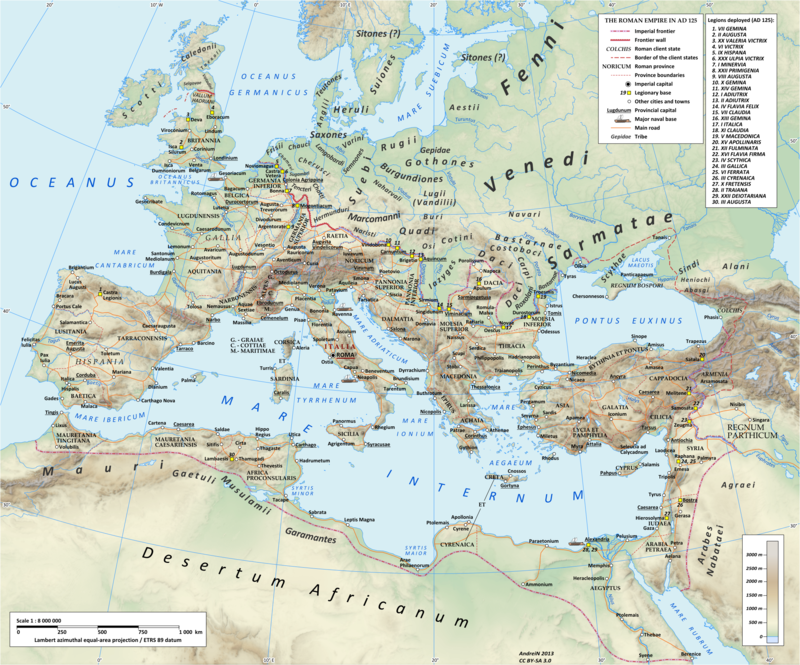
File:Roman_Empire_125.png · Wikimedia Commons · See Wikimedia Commons
Alans
Sign in to saveAlso known as Alani, Halani, Alains
The Alans () were an ancient and medieval Iranic nomadic pastoral people who migrated to what is today the North Caucasus; some continued on to Europe and later North Africa. They are generally regarded as part of the Sarmatians, and possibly related to the Massagetae. Modern historians have connected the Alans with the Central Asian Yancai of Chinese sources and with the Aorsi of Roman sources. Having migrated westwards and becoming dominant among the Sarmatians on the Pontic–Caspian steppe, the Alans are mentioned by Roman sources in the . At that time they had settled in the region north of
The Alans were an ancient nomadic people of Iranic origin who migrated from Central Asia to the North Caucasus and beyond, eventually spreading to Europe and North Africa, and they are significant to historians because Roman and other sources document their movements and dominance on the steppes, helping us understand the complex peoples and migrations of the ancient and medieval world.
AI-generated from the Wikipedia summary — may contain errors.
Key facts
- Ethnic group.group
- Alans
- Ethnic group.native_name
- Alani
- Ethnic group.image
- 250px
- Ethnic group.image_caption
- Map showing the migrations of the Alans
- Ethnic group.languages
- Scythian, Alanic
- Ethnic group.religions
- Ancient Iranic paganism, then Arianism (), and Nicene Christianity
- Ethnic group.related_groups
- Ossetians, Jasz people
via Wikipedia infobox
Wikidata facts
- Subclass of
- Sarmatians
- Part of
- Iranian peoples
- Native language
- Alanic
- Country
- Ciscaucasia
- Image
- Alans.jpg
- Said to be same as
- Yancai
Show 3 more facts
- topic's main category
- Category:Alans
- Commons category
- Alans
- on focus list of Wikimedia project
- Wikipedia:Vital articles/Level/4
Sources (3)
via Wikidata · CC0
~30 min read
Encyclopedic overview
20 sectionsContents
- Name
- The Alans and warfare
- History
- Timeline
- Origin
- Early Alans
- Link to ''Yancai'' (奄蔡) / ''Hesu'' (闔蘇) / ''Alan'' (阿蘭)
- Migration to Gaul
- Hispania and Africa
- Medieval Alania
- Genetics
- Archaeology
- Language
- Religion
- See also
- Explanatory notes
- References
- Citations
- General and cited sources
- External links
The Alans () were an ancient and medieval Iranic nomadic pastoral people who migrated to what is today the North Caucasus; some continued on to Europe and later North Africa. They are generally regarded as part of the Sarmatians, and possibly related to the Massagetae. Modern historians have connected the Alans with the Central Asian Yancai of Chinese sources and with the Aorsi of Roman sources. Having migrated westwards and becoming dominant among the Sarmatians on the Pontic–Caspian steppe, the Alans are mentioned by Roman sources in the . At that time they had settled in the region north of the Black Sea and frequently raided the Parthian Empire and the South Caucasus provinces of the Roman Empire. Between the Goths broke their hold on the Pontic Steppe, thereby assimilating a significant population of associated Alans.
After the Hunnic defeat of the Goths on the Pontic Steppe around , many of the Alans along with various Germanic tribes migrated westwards. They crossed the Rhine in 406 CE along with the Vandals and Suebi, settling in Orléans and Valence. Around 409 CE they joined the Vandals and Suebi in crossing the Pyrenees into the Iberian Peninsula, settling in Lusitania and Hispania Carthaginensis. The Iberian Alans, soundly defeated by the Visigoths in 418 CE, subsequently surrendered their autonomy to the Hasdingi Vandals. In 428CE, the Vandals and Alans crossed the Strait of Gibraltar into North Africa, where they founded a kingdom which lasted until its conquest by the Byzantine Emperor Justinian I in 534 CE.
Excerpted from Wikipedia’s “Alans” article, available under the CC BY-SA 4.0 licence.
Gallery (34)
Available in 76 languages
- Español
- Français
- Deutsch
- 中文
- 日本語
- Русский
- Português
- Italiano
- العربية
- हिन्दी
- Afrikaans
- Albanian
- Aragonese
- Armenian
- Asturian
- azb
- Azerbaijani
- Bahasa Indonesia
Show 57 more
- Bashkir
- Basque
- Belarusian
- Bulgarian
- Catalan
- Central Kurdish
- Chuvash
- Croatian
- Czech
- Danish
- Egyptian Arabic
- Esperanto
- Finnish
- Galician
- Georgian
- Greek
- Hebrew
- Hungarian
- hyw
- Icelandic
- Ido
- Ingush
- Kabardian
- Kazakh
- Kurdish
- Kyrgyz
- Latin
- Latvian
- Lithuanian
- Malagasy
- Malay
- Mingrelian
- Mirandese
- Mongolian
- Nederlands
- Norwegian
- Ossetic
- Polski
- Romanian
- Serbian
- Serbian (Latin)
- Sicilian
- Slovak
- Slovenian
- Svenska
- Tamil
- Tiếng Việt
- Türkçe
- Ukrainian
- Urdu
- Uzbek
- Western Frisian
- Wu Chinese
- zh_classical
- zh_yue
- فارسی
- 한국어
via Wikidata sitelinks · CC0