Category
page 1Military vehicles introduced in the 1930s

Panzer IV
German WWII medium tank
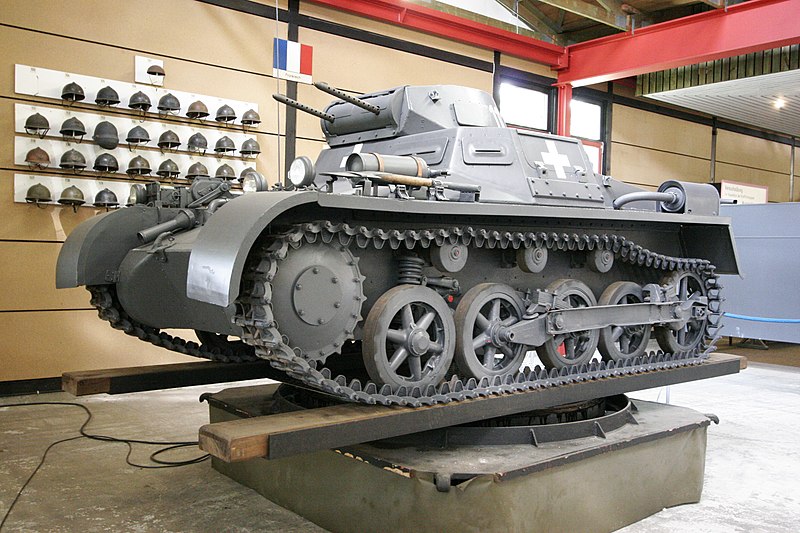
Panzer I
German light tank

Panzer II
German light tank

T-26

Panzer III
German medium tank

T-35
The T-35 was a Soviet multi-turreted heavy tank of the interwar period and early Second World War that saw limited service with the Red Army. Often called a "land battleship", it was the only five-turreted heavy tank in the world to reach production, but proved to be slow and mechanically unreliable. Most of the T-35 tanks still operational at the time of Operation Barbarossa were lost due to mechanical failure rather than enemy action. It was designed to complement the contemporary T-28 medium tank; however, very few were built.

LT-35
1935 Czechoslovakian light tank series

T-28
Soviet medium tank
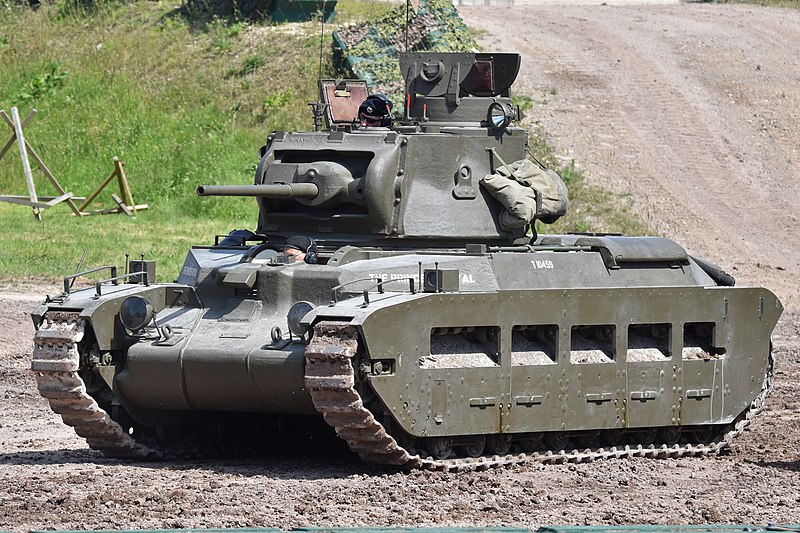
Matilda II
WWII infantry tank
Panzer 38(t)
1939 light tank family by ČKD
.jpg)
7TP
The 7TP (siedmiotonowy polski, lit. 'Polish 7-tonne') was a Polish light tank of the Second World War. It was developed from the British Vickers 6-ton. A standard tank of the Polish Army during the 1939 Polish Campaign, its production did not exceed 150 vehicles. Its chassis was used as the base for the C7P artillery tractor.
BT-series tank
series of Soviet light tanks produced in large numbers between 1932 and 1941
M2 Light Tank
1930s United States light tank that saw service in World War II.
Sd.Kfz. 251
1939 German half-track family

T-27
The T-27 was a tankette produced in the 1930s by the Soviet Union. It was based on the design of the Carden Loyd tankette, bought under license from the United Kingdom in 1930.
R-35
1936 light infantry tank
Matilda I
British infantry tank

L3/33
The Carro Veloce 33 (CV 33) or L3/33 was a tankette originally built in 1933 and used by the Italian Army before and during World War II. It was based on the imported British Carden Loyd tankette (license-built by Italy as the CV 29). Many CV 33s were retrofitted to meet the specifications of the CV 35 in 1935. In 1938, the CV 33 was renamed the "L3/33" while the CV 35 became the "L3/35s."
Kliment Voroshilov tank
family of Soviet heavy tanks
Type 95 Ha-Go
1936 light tank
T-37A
Soviet amphibious tank
.jpg)
TKS
The TK (TK-3) and TKS were Polish tankettes developed during the 1930s and used in the Second World War.
Type 97 Chi-Ha
1938 medium tank
Char B1
1935 heavy tank
M11/39
1939 medium tank
Hotchkiss H35
1936 French light tank
Cruiser Mk I
type of cruiser tank
Opel Blitz
type of truck manufactured by Opel

L3/35
The L3/35, also known as the Carro Veloce CV-35, was an Italian tankette that saw combat before and during World War II. It was one of the smallest tanks that faced combat. Although designated a light tank by the Italian Army, its turretless configuration, weight and firepower make it closer to contemporary tankettes. It was the most numerous Italian armoured fighting vehicle and saw service almost everywhere the Italians fought in the Second World War but proved inadequate for modern warfare, having too thin armour and weak armament of only machine guns. It was cheaply produced but because of
Type 89 I-Go
Japanese tank
S-35
1936 cavalry tank
T-38
Soviet amphibious tank
Type 94 tankette
type of Tankette
Light Tank Mk VII Tetrarch
1938 light tank

Neubaufahrzeug
The German ' ("new construction vehicle"—a cover name), abbreviated as PzKpfw Nb.Fz', series of tank prototypes were a first attempt to create a medium tank for the Wehrmacht after Adolf Hitler had come to power. Multi-turreted, heavy and slow, they were not considered successful, which led to only five being produced. These were primarily used for propaganda purposes and training, though three took part in the Battle of Norway in 1940. Pictures of the were displayed with different turret models and orientations to fool allied spies; American and Soviet agents independently reported that the G
.jpg)
BT-7
The BT-7 was the last of the BT series of Soviet cavalry tanks that were produced in large numbers between 1935 and 1940. It was lightly armoured, but reasonably well-armed for the time, and had much better mobility than other contemporary tank designs. The BT tanks were known by the nickname Betka from the acronym, or its diminutive, Betushka.
Type 92 Heavy Armoured Car
Japanese light tank
Light Tank Mk VI
1936 light tank family
Leichter Panzerspähwagen
German scout car family

ADGZ
The Steyr ADGZ was an Austrian heavy armored car used during World War II. It was originally designed for the Austrian Army (designated as the "M35 Mittlerer Panzerwagen") in 1934, and delivered in 1935–1937.
Komsomolets armored tractor
type of artillery tractor
BA-10
Leichttraktor
The Leichttraktor (Vs.Kfz.31) was a German experimental tank designed during the Interwar Period.
Sd.Kfz. 10
1938 German half-track family
Sd.Kfz. 9
German half-track family
M1 combat car
type of light tank
FCM 36
light infantry tank that was designed for the French Army prior to World War II
Cruiser Mk III
British cruiser tank of the Second World War
SMK tank
heavy tank
38M Toldi
light tank
Type 97 Te-Ke
type of weapon
Sd.Kfz. 6
German half-track family
Sd.Kfz. 11
German halftrack family
M3 Scout Car
armored car family by White
T-24
Soviet medium tank
FAI armored car
Soviet armored car
Sd.Kfz. 254
1940 German observation post vehicle
.svg)
BA-20
The BA-20 () was an armored car developed in the Soviet Union in 1934. It was intended to replace the FAI and its field trials were completed in 1935. The BA-20 was then used in the early stages of World War II.
ZIS-6
The ZIS-6 () is a Soviet general-purpose 6×4 army cargo truck, a three-axle version of the ZIS-5 two-axle truck. Prototypes were made in 1932 and serial production started in 1933. In October 1941 the Moscow Zavod imeni Stalina factory was evacuated, but a few more ZIS-6 trucks were assembled from parts in January 1942. A total of 21,239 units were produced. The ZIS-6 had a payload capacity of 4 tons.
M2
1930s United States Army tank