Category
page 1Minerals in space group 12

orthoclase
Orthoclase, or orthoclase feldspar (endmember formula KAlSi3O8), is an important tectosilicate mineral which forms igneous rock. The name is from the Ancient Greek for "straight fracture", because its two cleavage planes are at right angles to each other. It is a type of alkali feldspar, also known as potassium feldspar or K-spar. The gem known as moonstone (see below) is largely composed of orthoclase.
biotite series
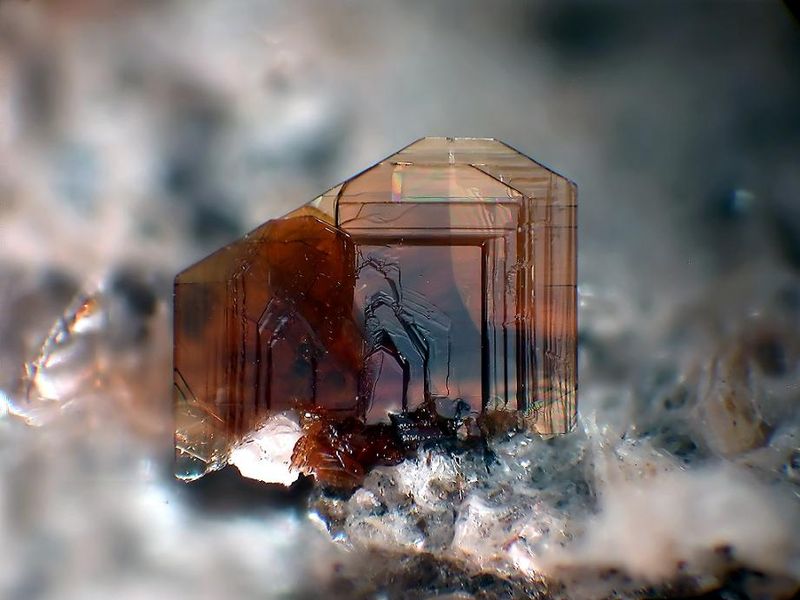
Biotite is a common group of phyllosilicate minerals within the mica group, with the approximate chemical formula . It is primarily a solid-solution series between the iron-endmember annite, and the magnesium-endmember phlogopite; more aluminous end-members include siderophyllite and eastonite. Biotite was regarded as a mineral species by the International Mineralogical Association until 1998, when its status was changed to a mineral group. The term biotite is still used to describe unanalysed dark micas in the field. Biotite was named by J.F.L. Hausmann in 1847 in honor of the French physicis

actinolite
thumb|upright=0.3|Gem-quality actinolite blade, from Mogok, Burma

montmorillonite
Montmorillonite is a very soft phyllosilicate group of minerals that form when they precipitate from water solution as microscopic crystals, known as clay. It is named after Montmorillon in France. Montmorillonite, a member of the smectite group, is a 2:1 clay, meaning that it has two tetrahedral sheets of silica sandwiching a central octahedral sheet of alumina. The particles are plate-shaped with an average diameter around 1 μm and a thickness of 0.96 nm; magnification of about 25,000 times, using an electron microscope, is required to resolve individual clay particles. Members of this group

vermiculite
Vermiculite is a hydrous phyllosilicate mineral which undergoes significant expansion when heated. Exfoliation occurs when the mineral is heated sufficiently; commercial furnaces can routinely produce this effect. Vermiculite forms by the weathering or hydrothermal alteration of biotite or phlogopite.
Large commercial vermiculite mines exist in the United States, Russia, South Africa, China, and Brazil.
lepidolite
Lepidolite is the common name for a lilac-gray or rose-colored series of minerals in the mica group. The mineralogical name for this series is the polylithionite-trilithionite series. Lepidolite has a chemical formula of . It is the most abundant lithium-bearing mineral and is a secondary source of this metal. It is also the major source of the alkali metal rubidium, which substitutes (as in all minerals) for potassium.

hornblende
Hornblende is a complex inosilicate series of minerals. It is not a recognized mineral in its own right, but the name is used as a general or field term, to refer to a dark amphibole. Hornblende minerals are common in igneous and metamorphic rocks.
glauconite
Glauconite is an iron potassium phyllosilicate (mica group) mineral of characteristic green color which is very friable and has very low weathering resistance.

tremolite
Tremolite is a member of the amphibole group of silicate minerals with composition Ca2(Mg5.0-4.5Fe2+0.0-0.5)Si8O22(OH)2. Tremolite forms by metamorphism of sediments rich in dolomite and quartz, and occurs in two distinct forms, crystals and fibers. Tremolite forms a series with actinolite and ferro-actinolite. Pure magnesium tremolite is creamy-white, but the color grades to dark green with increasing iron content. It has a hardness on Mohs scale of 5 to 6. Nephrite, one of the two minerals known as the gemstone jade, is a green crystalline variety of tremolite.

staurolite
Staurolite is a reddish brown to black, mostly opaque, nesosilicate mineral with a white streak. It crystallizes in the monoclinic crystal system, has a Mohs hardness of 7 to 7.5 and the chemical formula: Fe2+2Al9O6(SiO4)4(O,OH)2. Magnesium, zinc and manganese substitute in the iron site and trivalent iron can substitute for aluminium.

chrysotile
Chrysotile (/ˈkrɪsəˌtʌɪl/, /ˈkrɪsəˌtaɪl/, or /ˈkrɪsətɪl/) or white asbestos is the most commonly encountered form of asbestos, accounting for approximately 95% of the asbestos in the United States and a similar proportion in other countries. It is a soft, fibrous silicate mineral in the serpentine subgroup of phyllosilicates; as such, it is distinct from other asbestiform minerals in the amphibole group. Its idealized chemical formula is Mg(SiO)(OH). The material has physical properties which make it desirable for inclusion in building materials, but poses serious health risks when dispersed i
sanidine
Sanidine is the high temperature form of potassium feldspar with a general formula K(AlSi3O8). Sanidine is found most typically in felsic volcanic rocks such as obsidian, rhyolite and trachyte. Sanidine crystallizes in the monoclinic crystal system. Orthoclase is a monoclinic polymorph stable at lower temperatures. At yet lower temperatures, microcline, a triclinic polymorph of potassium feldspar, is stable.

glaucophane
Glaucophane is a mineral and a mineral group belonging to the sodic amphibole supergroup of the double chain inosilicates, with the chemical formula Na2(Mg3Al2)Si8O22(OH)2.
palygorskite
Palygorskite or attapulgite is a magnesium aluminium phyllosilicate with the chemical formula ) that occurs in a type of clay soil common to the Southeastern United States. It is one of the types of fuller's earth. Some smaller deposits of this mineral can be found in Mexico, where its use is tied to the manufacture of Maya blue in pre-Columbian times.

phlogopite
Phlogopite is a yellow, greenish, or reddish-brown member of the mica family of phyllosilicates. It is also known as magnesium mica.

illite
thumb|Structure of illite mica – USGS
%20-%20Bou%20Azzer%2C%20Atlas%2C%20Maroko.jpg)
erythrite
thumb|Erythrite (cobalt flower) - Bou Azzer, Atlas Mountains, Morocco.
Erythrite, also known as red cobalt, previously cobalt ochre is a secondary hydrated cobalt arsenate mineral with the formula . Erythrite and annabergite, chemical formula , or nickel arsenate form a complete series with the general formula .
thumb|left|Erythrite crystals

kainite
Kainite ( or ) (KMg(SO4)Cl·3H2O) is an evaporite mineral in the class of "Sulfates (selenates, etc.) with additional anions, with H2O" according to the Nickel–Strunz classification. It is a hydrated potassium-magnesium sulfate-chloride, naturally occurring in irregular granular masses or as crystalline coatings in cavities or fissures. This mineral is dull and soft, and is colored white, yellowish, grey, reddish, or blue to violet. Its name is derived from Greek [kainos] ("(hitherto) unknown"), as it was the first mineral discovered that contained both sulfate and chloride as anions. Kainite f
stilbite
Stilbite is the name of a series of tectosilicate minerals of the zeolite group. Prior to 1997, stilbite was recognized as a mineral species, but a reclassification in 1997 by the International Mineralogical Association changed it to a series name, with the mineral species being named:
.jpg)
riebeckite
Riebeckite is a sodium-rich member of the amphibole group of silicate minerals, chemical formula Na2(Fe2+3Fe3+2)Si8O22(OH)2. It forms a solid solution series with magnesioriebeckite. It crystallizes in the monoclinic system, usually as long prismatic crystals showing a diamond-shaped cross section, but also in fibrous, bladed, acicular, columnar, and radiating forms. Its Mohs hardness is 5.0–6.0, and its specific gravity is 3.0–3.4. Cleavage is perfect, two directions in the shape of a rhombus; fracture is uneven, splintery. It is often translucent to nearly opaque.
thortveitite
Thortveitite is a rare mineral consisting of scandium yttrium silicate (Sc,Y)2Si2O7. It is the most widespread scandium mineral, but natural thortveitite is not widely exploited as a source of scandium metal. Most scandium is derived from mine tailings, which can include thortveitite. Thortveitite mining in the United States ceased in 1969.

calaverite
Calaverite, or gold telluride, is an uncommon telluride of gold, a metallic mineral with the chemical formula AuTe2, with approximately 3% of the gold replaced by silver. It was first discovered in Calaveras County, California in 1861, and was named for the county in 1868.

grunerite
Grunerite is a mineral of the amphibole group of minerals with formula Fe7Si8O22(OH)2. It is the iron endmember of the grunerite-cummingtonite series. It forms as fibrous, columnar or massive aggregates of crystals. The crystals are monoclinic prismatic. The luster is glassy to pearly with colors ranging from green, brown to dark grey. The Mohs hardness is 5 to 6 and the specific gravity is 3.4 to 3.5.

heulandite
Heulandite is the name of a series of tectosilicate minerals of the zeolite group. Prior to 1997, heulandite was recognized as a mineral species, but a reclassification in 1997 by the International Mineralogical Association changed it to a series name, with the mineral species being named:
Heulandite-Ca
Heulandite-Na
Heulandite-K
Heulandite-Sr
Heulandite-Ba (described in 2002).
Heulandite-Ca, the most common of these, is a hydrous calcium and aluminium silicate with the formula . Small amounts of sodium and potassium are usually present replacing part of the calcium. Strontium replaces ca
hydrozincite
Hydrozincite, also known as zinc bloom or marionite, is a white carbonate mineral consisting of Zn5(CO3)2(OH)6. It is usually found in massive rather than crystalline form.

laumontite
right|thumb|250px|Laumontite crystals
Laumontite is a mineral, one of the zeolite group. Its molecular formula is , a hydrated calcium-aluminium silicate. Potassium or sodium may substitute for the calcium but only in very small amounts.
annabergite
Annabergite is an arsenate mineral consisting of a hydrous nickel arsenate. It is considered a member of the vivianite group and known for its ability to form crystals in a characteristic apple-green color.

arfvedsonite
Arfvedsonite () or soda hornblende (partiellement obsolète) is a sodium amphibole mineral with composition: [Na][Na2][(Fe2+)4Fe3+][(OH)2|Si8O22]. It crystallizes in the monoclinic prismatic crystal system and typically occurs as greenish black to bluish grey fibrous to radiating or stellate prisms.
saponite
Saponite is a trioctahedral mineral of the smectite group. Its chemical formula is . It is soluble in sulfuric acid. It was first described in 1840 by Svanberg. Varieties of saponite are griffithite, bowlingite and sobotkite.
bischofite
Bischofite is a hydrous magnesium chloride mineral with formula MgCl2·6H2O. It belongs to halides and is a sea salt concentrate. It contains many macro- and micro-elements vital for human health, in much higher concentrations than can be found in sea or ocean salt. The main bischofite compound is magnesium chloride (up to 350 g/L), moreover, it contains about 70 other elements as impurities, including potassium, sodium, bromine, boron, calcium, silicon, molybdenum, silver, zinc, iron and copper.

artinite
Artinite is a hydrated basic magnesium carbonate mineral with formula: . It forms white silky monoclinic prismatic crystals that are often in radial arrays or encrustations. It has a Mohs hardness of 2.5 and a specific gravity of 2.
cyanotrichite
Cyanotrichite is a hydrous copper aluminium sulfate mineral with formula Cu4Al2[(OH)12|SO4]·2H2O, also known as lettsomite. Cyanotrichite forms velvety radial acicular crystal aggregates of extremely fine fibers. It crystallizes in the monoclinic system and forms translucent bright blue acicular crystal clusters or drusey coatings. The Mohs hardness is 2 and the specific gravity ranges from 2.74 to 2.95. Refractive indices are nα = 1.588 nβ = 1.617 nγ = 1.655.
pumpellyite
Pumpellyite is a group of closely related sorosilicate minerals:
pumpellyite-(Mg):
pumpellyite-(Fe2+):
pumpellyite-(Fe3+):
pumpellyite-(Mn2+):
pumpellyite-(Al):

pargasite
nontronite
Nontronite is the iron(III) rich member of the smectite group of clay minerals. Nontronites typically have a chemical composition consisting of more than ~30% Fe2O3 and less than ~12% Al2O3 (ignited basis). Nontronite has very few economic deposits like montmorillonite. Like montmorillonite, nontronite can have variable amounts of adsorbed water associated with the interlayer surfaces and the exchangeable cations.
clinoptilolite
Clinoptilolite is a natural zeolite composed of a microporous arrangement of silica and alumina tetrahedra. It has the complex formula . It forms as white, green to reddish tabular monoclinic tectosilicate crystals with a Mohs hardness of 3.5 to 4 and a specific gravity of 2.1 to 2.2. It commonly occurs as a devitrification product of volcanic glass shards in tuff and as vesicle fillings in basalts, andesites and rhyolites. It was described in 1969 from an occurrence in the Barstow Formation, San Bernardino County, California. Sodium levels in clinoptilolite are generally higher than potassium
augelite
Augelite is an aluminium phosphate mineral with formula: Al2(PO4)(OH)3. The shade varies from colorless to white, yellow or rose. Its crystal system is monoclinic.
richterite
Richterite is a sodium calcium magnesium silicate mineral belonging to the amphibole group. If iron replaces the magnesium within the structure of the mineral, it is called ferrorichterite; if fluorine replaces the hydroxyl, it is called fluororichterite. Richterite crystals are long and prismatic, or prismatic to fibrous aggregate, or rock-bound crystals. Colors of richterite range from brown, grayish-brown, yellow, brownish- to rose-red, or pale to dark green. Richterite occurs in thermally metamorphosed limestones in contact metamorphic zones. It also occurs as a hydrothermal product in maf
volborthite
Volborthite is a mineral containing copper and vanadium, with the formula Cu3V2O7(OH)2·2H2O. Found originally in 1838 in the Urals, it was first named knaufite but was later changed to volborthite for Alexander von Volborth (1800–1876), a Russian paleontologist.
hyalophane
Hyalophane or jaloallofane is a crystalline mineral, part of the feldspar group of tectosilicates. It is considered a barium-rich potassium feldspar. Its chemical formula is , and it has a hardness of 6 to . The name hyalophane comes from the Greek , meaning "glass", and meaning "to appear".
edenite
Edenite or edenitic hornblende is a double chain silicate mineral of the amphibole group with the general chemical composition NaCa2Mg5(Si7Al)O22(OH)2. Edenite is named for the locality of Edenville, Orange County, New York, where it was first described.
buddingtonite
Buddingtonite is an ammonium feldspar with formula: NH4AlSi3O8 (note: some sources add 0.5H2O to the formula). It forms by hydrothermal alteration of primary feldspar minerals. It is an indicator of possible gold and silver deposits, as they can become concentrated by hydrothermal processes. It crystallizes in the monoclinic crystal system and is colorless to white with a vitreous luster. Its structure is analogous to that of high sanidine (KAlSi3O8). Buddingtonite has a hardness of 5.5 and a specific gravity of 2.32.
roscoelite
Roscoelite is a green mineral from the mica group that contains vanadium.
The chemical formula is K(V3+, Al, Mg)2AlSi3O10(OH)2.
Crystals of roscoelite take on the monoclinic form, and are from the 2/m point group.
The appearance is semi transparent to translucent coloured olive brown to green brown. The lustre is pearly. The mineral shows pleochroism with X showing green-brown, and Y and Z axes showing olive-green colour. The mineral was named after Henry Enfield Roscoe who first produced vanadium metal.

sklodowskite
Sklodowskite is a uranium mineral with the chemical formula: Mg(UO2)2(HSiO4)2·5H2O. It is a secondary mineral which contains magnesium and is a bright yellow colour, its crystal habit is acicular, but can form in other shapes. It has a Mohs hardness of about 2–3.
It is named after the maiden name of Marie Skłodowska Curie. It is the magnesium analogue of the much more common uranium mineral Cuprosklodowskite, which contains copper instead.
lanarkite
Lanarkite is a mineral, a form of lead sulfate with formula Pb2(SO4)O. It was originally found at Leadhills in the Scottish county of Lanarkshire, hence the name. It forms white or light green, acicular monoclinic prismatic crystals, usually microscopic in size. It is an oxidation product of galena.
studtite
Studtite, chemical formula [(UO2)O2(H2O)2]·2(H2O) or UO4·4(H2O), is a secondary uranium mineral containing peroxide produced by the alpha-radiolysis of water during its formation. It occurs as pale yellow to white needle-like crystals often in acicular, white sprays.
papagoite
Papagoite is a rare cyclosilicate mineral. Chemically, it is a calcium copper aluminium silicate hydroxide, found as a secondary mineral on slip surfaces and in altered granodiorite veins, either in massive form or as microscopic crystals that may form spherical aggregates. Its chemical formula is Ca Cu Al Si2O6(O H)3.

pascoite
Pascoite is a mineral with formula Ca3V10O28·17H2O that is red-orange to yellow in color. It was discovered in the Pasco Province of Peru, for which it is named, and described in 1914.
tsumcorite
Tsumcorite is a rare hydrated lead arsenate mineral that was discovered in 1971, and reported by Geier, Kautz and Muller. It was named after the TSUMeb CORporation mine at Tsumeb, in Namibia, in recognition of the Corporation's support for mineralogical investigations of the orebody at its Mineral Research Laboratory.
phoenicochroite
Phoenicochroite, also known as melanochroite, is a lead chromate mineral with formula Pb2OCrO4. It forms striking orange red crystals. It was first discovered in 1839 in Beryozovskoye deposit, Urals, Russia. It is named from the Greek word φοίυικος for "deep red" and χρόα for "color", in allusion to its color.
birnessite
Birnessite (nominally MnO2·nH2O), also known as δ-, is a hydrous manganese dioxide mineral with a chemical formula of Na0.7Ca0.3Mn7O14·2.8H2O. It is the main manganese mineral species at the Earth's surface, and commonly occurs as fine-grained, poorly crystallized aggregates in soils, sediments, grain and rock coatings (e.g., desert varnish), and marine ferromanganese nodules and crusts. It was discovered at Birness, Aberdeenshire, Scotland.

romanèchite
thumb|Polyhedral representation of the 2 x 3 tunnel structure of romanèchite. The red atoms represent Ba and H2O.
hectorite
Hectorite is a rare soft, greasy, white, lithium-rich clay mineral with a chemical formula of .
annite
Annite is a phyllosilicate mineral in the mica family. It has a chemical formula of KFe32+AlSi3O10(OH)2. Annite is the iron end member of the biotite mica group, the iron rich analogue of magnesium rich phlogopite. Annite is monoclinic and contains tabular crystals and cleavage fragments with pseudohexagonal outlines. There are contact twins with composition surface {001} and twin axis {310}.
pääkkönenite
Pääkkönenite is a metallic grey mineral with the molecular formula Sb2AsS2. It is named after Veikko Pääkkönen (1907–1980), a Finnish geologist.

leonite
Leonite is a hydrated double sulfate of magnesium and potassium. It has the formula K2SO4·MgSO4·4H2O. The mineral was named after Leo Strippelmann, who was director of the salt works at Westeregeln in Germany. The mineral is part of the blodite group of hydrated double sulfate minerals.
kaersutite
Kaersutite is a dark brown to black double-chain calcic titanium-bearing amphibole mineral with formula: NaCa2(Mg3Ti4+Al)(Si6Al2)O22(O)2.
akaganeite
Akaganeite, also written as the deprecated Akaganéite, is a chloride-containing iron(III) oxide-hydroxide mineral, formed by the weathering of pyrrhotite (Fe1−xS), an iron-deficient sulfide.
tschermakite
The endmember hornblende tschermakite () is a calcium-rich monoclinic amphibole mineral. It is frequently synthesized along with its ternary solid solution series members tremolite and cummingtonite so that the thermodynamic properties of its assemblage can be applied to solving other solid solution series from a variety of amphibole minerals.
brianyoungite
Brianyoungite is a secondary zinc carbonate mineral. The Commission on New Minerals, Nomenclature and Classification (CNMNC) of the International Mineralogical Association (IMA) classifies it as a carbonate with the formula , but sulfate groups SO4 also occupy the carbonate CO3 positions, in the ratio of about one sulfate to three carbonates, so other sources give the formula as , and Gaines et al. classify the mineral as a compound carbonate. It is
similar in appearance to hydrozincite, another zinc carbonate. It was discovered in 1991 and designated IMA1991-053. In 1993 it was named "briany