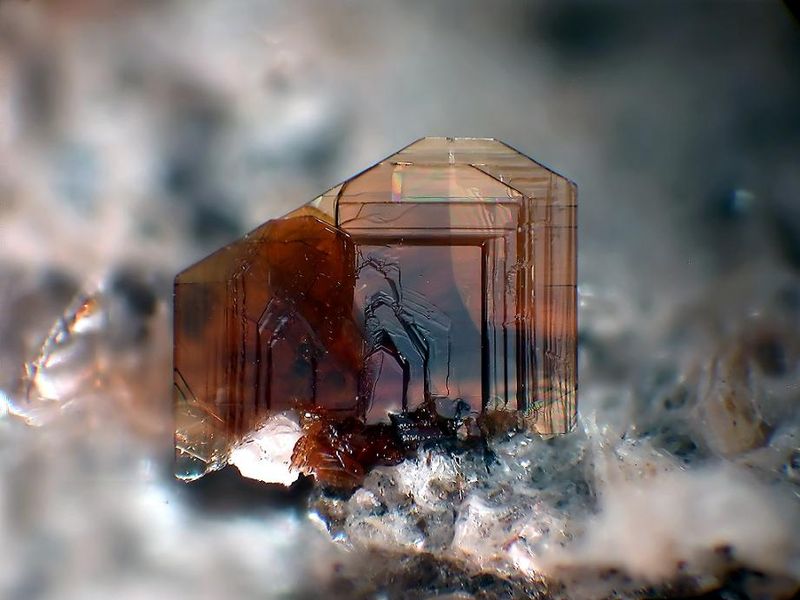
File:Biotite_aggregate_-_Ochtendung,_Eifel,_Germany.jpg · Wikimedia Commons · See Wikimedia Commons
biotite series
Sign in to saveAlso known as lepidomelano, serie de mica biotita, biotite
Biotite is a common group of phyllosilicate minerals within the mica group, with the approximate chemical formula . It is primarily a solid-solution series between the iron-endmember annite, and the magnesium-endmember phlogopite; more aluminous end-members include siderophyllite and eastonite. Biotite was regarded as a mineral species by the International Mineralogical Association until 1998, when its status was changed to a mineral group. The term biotite is still used to describe unanalysed dark micas in the field. Biotite was named by J.F.L. Hausmann in 1847 in honor of the French physicis
The biotite series is a group of common dark mica minerals that vary in composition between iron-rich and magnesium-rich end-members, with intermediate varieties containing more aluminum. It matters because biotite is one of the most frequently encountered minerals in rocks, and understanding its compositional variations helps geologists and mineralogists identify and classify rocks in the field and laboratory.
AI-generated from the Wikipedia summary — may contain errors.
Key facts
- Mineral.name
- Biotite
- Mineral.category
- Phyllosilicate minerals
- Mineral.group
- Mica group, trioctahedral mica group, biotite subgroup
- Mineral.boxbgcolor
- 7b4118
- Mineral.boxtextcolor
- fff
- Mineral.image
- Biotite aggregate - Ochtendung, Eifel, Germany.jpg
- Mineral.imagesize
- 260px
- Mineral.caption
- Thin tabular biotite aggregate(Image width: 2.5 mm)
- Mineral.IMAsymbol
- Bt
- Mineral.system
- Monoclinic
- Mineral.class
- Prismatic (2/m) (same H-M symbol)
- Mineral.symmetry
- C2/m
- Mineral.color
- Dark brown, greenish-brown, blackish-brown, yellow
- Mineral.habit
- Massive to platy
- Mineral.twinning
- Common on the [310], less common on the {001}
- Mineral.cleavage
- Perfect on the {001}
- Mineral.fracture
- Micaceous
- Mineral.tenacity
- Brittle to flexible, elastic
via Wikipedia infobox
Wikidata facts
- Image
- Biotite aggregate - Ochtendung, Eifel, Germany.jpg
Show 8 more facts
- Commons category
- Biotite
- Nickel-Strunz 9th edition (updated 2009)
- 9.EC.20
- streak color
- white
- crystal system
- monoclinic crystal system
- Mohs' hardness
- 2.5
- IMA Mineral Symbol
- Bt
- described by source
- Encyclopædia Britannica 11th edition
- Strunz 8th edition (series ID, updated)
- VIII/E.05b
Sources (6)
via Wikidata · CC0
~9 min read
Encyclopedic overview
8 sectionsContents
- Properties
- Optical properties
- Structure
- Occurrence
- Uses
- References
- Bibliography
- External links
{{Infobox mineral | name = Biotite | category = Phyllosilicate minerals | group = Mica group, trioctahedral mica group, biotite subgroup | boxwidth = | boxbgcolor =#7b4118 | boxtextcolor = #fff | image = Biotite aggregate - Ochtendung, Eifel, Germany.jpg | imagesize = 260px | caption = Thin tabular biotite aggregate(Image width: 2.5 mm) | formula = | IMAsymbol=Bt | system = Monoclinic | class = Prismatic (2/m) (same H-M symbol) | symmetry = C2/m | color = Dark brown, greenish-brown, blackish-brown, yellow | habit = Massive to platy | twinning = Common on the [310], less common on the {001} | cleavage = Perfect on the {001} | fracture = Micaceous | tenacity = Brittle to flexible, elastic | mohs = 2.5–3.0 | luster = Vitreous to pearly | polish = | refractive = nα = 1.565–1.625 nβ = 1.605–1.675 nγ = 1.605–1.675 | opticalprop = Biaxial (-) | birefringence = δ = 0.03–0.07 | dispersion = r r > v weak (Mg rich) | pleochroism = Strong | fluorescence= None | absorption = | streak = White | gravity = 2.7–3.3 | melt = | fusibility = | diagnostic = | solubility = | diaphaneity = Transparent to translucent to opaque | other = | references = |var1=Manganophyllite|var1text=K(Fe,Mg,Mn)3AlSi3O10(OH)2}}
Biotite is a common group of phyllosilicate minerals within the mica group, with the approximate chemical formula . It is primarily a solid-solution series between the iron-endmember annite, and the magnesium-endmember phlogopite; more aluminous end-members include siderophyllite and eastonite. Biotite was regarded as a mineral species by the International Mineralogical Association until 1998, when its status was changed to a mineral group. The term biotite is still used to describe unanalysed dark micas in the field. Biotite was named by J.F.L. Hausmann in 1847 in honor of the French physicist Jean-Baptiste Biot, who performed early research into the many optical properties of mica.
Excerpted from Wikipedia’s “biotite series” article, available under the CC BY-SA 4.0 licence.