Category
page 1Molecular physics

molecule
thumb|Atomic force microscopy (AFM) image of a PTCDA molecule, in which the five six-carbon rings are visible
thumb|A scanning tunneling microscopy image of [[pentacene molecules, which consist of linear chains of five carbon rings]]
thumb|AFM image of 1,5,9-trioxo-13-azatriangulene and its chemical structure

macromolecule
thumb|Chemical structure of a polypeptide macromolecule
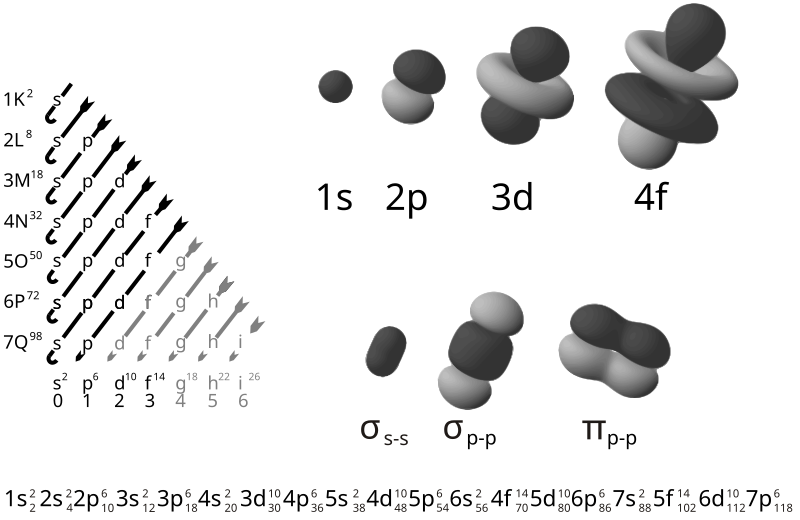
electron configuration
mode of arrangement of electrons in different shells of an atom

ionization
alt=The solar wind moving through the magnetosphere alters the movements of charged particles in the Earth's thermosphere or exosphere, and the resulting ionization of these particles causes them to emit light of varying colour, thus forming auroras near the polar regions.|thumb|201x201px|The solar wind moving through the [[magnetosphere alters the movements of charged particles in the Earth's thermosphere or exosphere, and the resulting ionization of these particles causes them to emit light of varying color, thus forming auroras near the polar regions.]]
Ionization or ionisation is the proce

ionization energy
minimum amount of energy required to remove an electron from an atom or molecule in the gaseous state
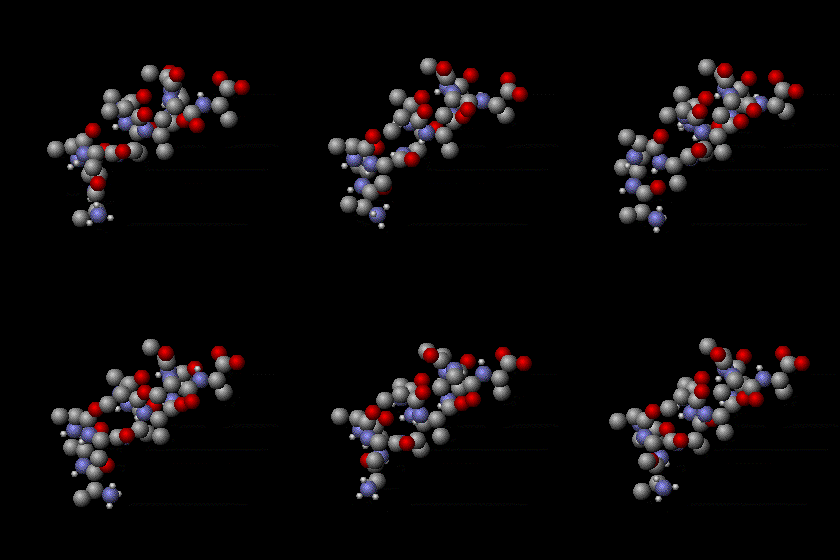
molecular physics
branch of physics

energy level
different states of quantum systems

electron affinity
amount of energy released when an electron is attached to a neutral atom or molecule in the gaseous state to form a negative ion

cohesion
chemical property of like molecules sticking together
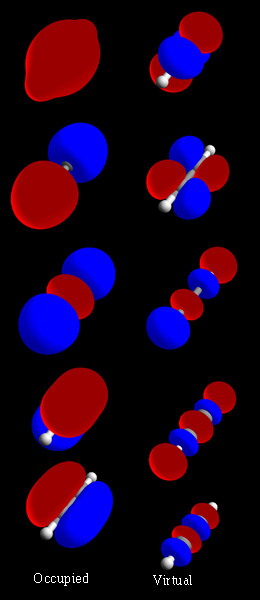
molecular orbital
wave-like behavior of an electron in a molecule

positronium
thumb|200px|right|An electron and [[positron orbiting around their common centre of mass. An s state has zero angular momentum, so orbiting around each other would mean going straight at each other until the pair of particles is either scattered or annihilated, whichever occurs first. This is a bound quantum state known as positronium.]]
electron pair
two electrons that occupy the same orbital but have opposite spins
X-ray fluorescence
emission of characteristic "secondary" X-rays from a material that has been excited by high-energy X-rays or gamma rays
molecular mechanics
use of classical mechanics to model molecular systems
reaction coordinate
abstract coordinate depicting chemical reaction progress
Franck–Condon principle
quantum chemistry rule regarding vibronic transitions
Intramolecular reaction
coordination geometry
geometric arrangement of atoms about a given central atom in a coordination complex
Jablonski diagram
diagram representing the electronic states of a molecule and the transitions between them
Hückel method
scientific theory of molecular orbitals
force field
concept on molecular modeling
Townsend discharge
gas ionisation process where free electrons are accelerated by an electric field, collide with gas molecules, and consequently free additional electrons

microwave spectroscopy
spectroscopy method employing microwaves
positronium hydride
chemical compound
autoionization
Autoionization is a process by which an atom or a molecule in an excited state spontaneously emits one of the outer-shell electrons, thus going from a state with charge to a state with charge , for example from an electrically neutral state to a singly ionized state.
International Academy of Quantum Molecular Science
organization devoted to applying quantum physics to chemistry
di-positronium
Di-positronium, or dipositronium, is an exotic molecule consisting of two atoms of positronium. It was predicted to exist in 1946 by John Archibald Wheeler, and subsequently studied theoretically, but was not observed until 2007 in an experiment performed by David Cassidy and Allen Mills at the University of California, Riverside. The researchers made the positronium molecules by firing intense bursts of positrons into a thin film of porous silicon dioxide. Upon slowing down in the silica, the positrons captured ordinary electrons to form positronium atoms. Within the silica, these were long l
RRKM theory
Microcanonic transition state theory of unimolecular reactions
molecular autoionization
spontaneous, equilibrium ionization of a solvent's molecules
rigid rotor
model of rotating physical systems

Gaussian orbital
Mathematical function
macromolecular docking
computational modeling of molecular interaction
electromagnetically induced transparency
coherent optical nonlinearity which renders a medium transparent within a narrow spectral range around an absorption line
molecular binding
attractive interaction between two molecules
Pariser–Parr–Pople method
calculation method in quantum chemistry
Molecular Hamiltonian
Hamiltonian operator for molecules