Category
page 1Monoclinic minerals

gypsum
Gypsum is a soft sulfate mineral composed of calcium sulfate dihydrate, with the chemical formula . It is widely mined and is used as a fertilizer and as the main constituent in many forms of plaster, drywall and blackboard or sidewalk chalk. Gypsum also crystallizes as translucent crystals of selenite. It forms as an evaporite mineral and as a hydration product of anhydrite. The Mohs scale of mineral hardness defines gypsum as hardness value 2 based on scratch hardness comparison.

feldspar
Feldspar ( ; sometimes spelled felspar) is a group of rock-forming aluminium tectosilicate minerals, also containing other cations such as sodium, calcium, potassium, or barium. The most common members of the feldspar group are the plagioclase (sodium-calcium) feldspars and the alkali (potassium-sodium) feldspars. Feldspars make up about 60% of the Earth's crust and 41% of the Earth's continental crust by weight.

talc
Talc, or talcum, is a clay mineral composed of hydrated magnesium silicate, with the chemical formula . Talc in powdered form, often combined with corn starch, is used as baby powder. This mineral is used as a thickening agent and lubricant. It is an ingredient in ceramics, paints, and roofing material. It is a main ingredient in many cosmetics. It occurs as foliated to fibrous masses, and in an exceptionally rare crystal form. It has a perfect basal cleavage and an uneven flat fracture, and it is foliated with a two-dimensional platy form.

malachite
Malachite () is a copper carbonate hydroxide mineral, with the formula Cu2CO3(OH)2. This opaque, green-banded mineral crystallizes in the monoclinic crystal system, and most often forms botryoidal, fibrous, or stalagmitic masses, in fractures and deep, underground spaces, where the water table and hydrothermal fluids provide the means for chemical precipitation. Individual crystals are rare, but occur as slender to acicular prisms. Pseudomorphs after more tabular or blocky azurite crystals also occur.

chalcedony
Chalcedony ( or ) is a cryptocrystalline form of silica, composed of very fine intergrowths of quartz and moganite. These are both silica minerals, but they differ in that quartz has a trigonal crystal structure, while moganite is monoclinic. Chalcedony's standard chemical structure (based on the chemical composition of quartz) is (silicon dioxide).

azurite
Azurite or Azure spar is a soft, deep-blue copper mineral produced by weathering of copper ore deposits. During the early 19th century, it was also known as chessylite, after the type locality at Chessy near Lyon, France. The mineral, a basic carbonate with the chemical formula Cu3(CO3)2(OH)2, has been known since ancient times, and was mentioned in Pliny the Elder's Natural History under the Greek name (κυανός: "deep blue," root of English cyan) and the Latin name caeruleum. Copper (Cu2+) gives it its deep blue color.

orthoclase
Orthoclase, or orthoclase feldspar (endmember formula KAlSi3O8), is an important tectosilicate mineral which forms igneous rock. The name is from the Ancient Greek for "straight fracture", because its two cleavage planes are at right angles to each other. It is a type of alkali feldspar, also known as potassium feldspar or K-spar. The gem known as moonstone (see below) is largely composed of orthoclase.
biotite series
Biotite is a common group of phyllosilicate minerals within the mica group, with the approximate chemical formula . It is primarily a solid-solution series between the iron-endmember annite, and the magnesium-endmember phlogopite; more aluminous end-members include siderophyllite and eastonite. Biotite was regarded as a mineral species by the International Mineralogical Association until 1998, when its status was changed to a mineral group. The term biotite is still used to describe unanalysed dark micas in the field. Biotite was named by J.F.L. Hausmann in 1847 in honor of the French physicis

muscovite

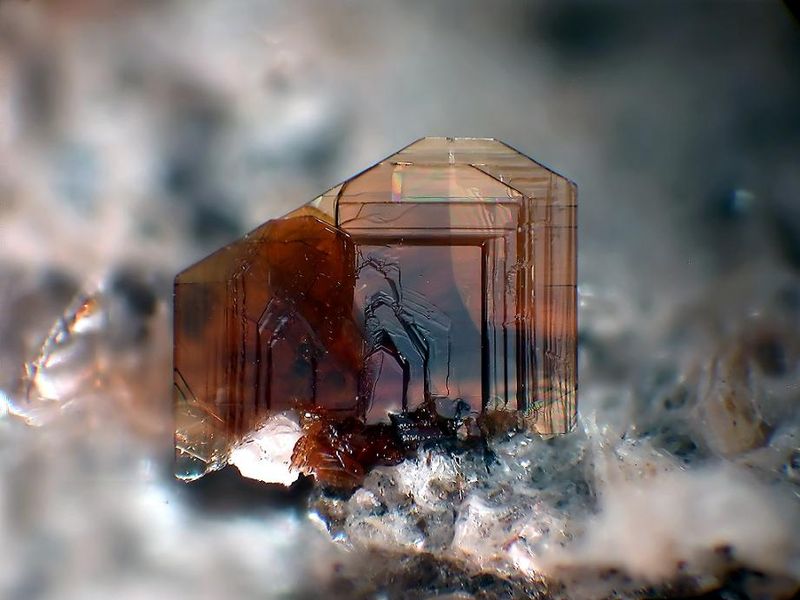
monazite
Monazite is a primarily reddish-brown phosphate mineral that contains rare-earth elements. Due to variability in composition, monazite is considered a group of minerals. The most common species of the group is monazite-(Ce), that is, the cerium-dominant member of the group.

realgar
Realgar ( ), also known as arsenic blende, ruby sulphur or ruby of arsenic, is an arsenic sulfide mineral with the chemical formula . It is a soft mineral occurring in monoclinic crystals, or in granular, compact, or powdery form, often in association with the related mineral, orpiment (). It is orange-red in color, and burns with a bluish flame releasing fumes of arsenic and sulfur. It is trimorphous with pararealgar and bonazziite.

cryolite
Cryolite (Na3AlF6, sodium hexafluoroaluminate) is a rare mineral identified with the once-large deposit at Ivittuut on the southwest coast of Greenland, mined commercially until 1987.

orpiment
Orpiment, also known as yellow arsenic blende, is a deep-colored, orange-yellow arsenic sulfide mineral with formula . It is found in volcanic fumaroles, low-temperature hydrothermal veins, and hot springs and may be formed through sublimation.

actinolite
thumb|upright=0.3|Gem-quality actinolite blade, from Mogok, Burma

wolframite
Wolframite is an iron, manganese, and tungstate mineral with a chemical formula of that is the intermediate mineral between ferberite ( rich) and hübnerite ( rich). Along with scheelite, the wolframite series are the most important tungsten ore minerals. Wolframite is found in quartz veins and pegmatites associated with granitic intrusives. Associated minerals include cassiterite, scheelite, bismuth, quartz, pyrite, galena, sphalerite, and arsenopyrite.

augite
Augite, also known as Augurite, is a common rock-forming pyroxene mineral with formula . The crystals are monoclinic and prismatic. Augite has two prominent cleavages, meeting at angles near 90 degrees.

diopside
Diopside is a monoclinic pyroxene mineral with composition . It forms complete solid solution series with hedenbergite () and augite, and partial solid solutions with orthopyroxene and pigeonite. It forms variably colored, but typically dull green crystals in the monoclinic prismatic class. It has two distinct prismatic cleavages at 87 and 93° typical of the pyroxene series. It has a Mohs hardness of six, a Vickers hardness of 7.7 GPa at a load of 0.98 N, and a specific gravity of 3.25 to 3.55. It is transparent to translucent with indices of refraction of nα=1.663–1.699, nβ=1.671–1.705, and n

montmorillonite
Montmorillonite is a very soft phyllosilicate group of minerals that form when they precipitate from water solution as microscopic crystals, known as clay. It is named after Montmorillon in France. Montmorillonite, a member of the smectite group, is a 2:1 clay, meaning that it has two tetrahedral sheets of silica sandwiching a central octahedral sheet of alumina. The particles are plate-shaped with an average diameter around 1 μm and a thickness of 0.96 nm; magnification of about 25,000 times, using an electron microscope, is required to resolve individual clay particles. Members of this group

arsenopyrite
Arsenopyrite (IMA symbol: Apy) is an iron arsenic sulfide (FeAsS). It is a hard (Mohs 5.5–6) metallic, opaque, steel grey to silver white mineral with a relatively high relative density of 6.1.

vermiculite
Vermiculite is a hydrous phyllosilicate mineral which undergoes significant expansion when heated. Exfoliation occurs when the mineral is heated sufficiently; commercial furnaces can routinely produce this effect. Vermiculite forms by the weathering or hydrothermal alteration of biotite or phlogopite.
Large commercial vermiculite mines exist in the United States, Russia, South Africa, China, and Brazil.

epidote
Epidote is a calcium aluminium iron sorosilicate mineral.
titanite
thumb|150px|Titanite crystal model

jadeite
Jadeite is a pyroxene mineral with composition NaAlSi2O6. It is hard (Mohs hardness of about 6.5 to 7.0), very tough, and dense, with a specific gravity of about 3.4. It is found in a wide range of colors, but is most often found in shades of green or white. Jadeite is formed only in the subduction zones of continental margins, where rock undergoes metamorphism at high pressure but relatively low temperature.
chlorite group
group of phyllosilicate minerals
lepidolite
Lepidolite is the common name for a lilac-gray or rose-colored series of minerals in the mica group. The mineralogical name for this series is the polylithionite-trilithionite series. Lepidolite has a chemical formula of . It is the most abundant lithium-bearing mineral and is a secondary source of this metal. It is also the major source of the alkali metal rubidium, which substitutes (as in all minerals) for potassium.
spodumene
Spodumene is a pyroxene mineral consisting of lithium aluminium inosilicate, LiAl(SiO3)2, and is a commercially important source of lithium. It occurs as colorless to yellowish, purplish, or lilac kunzite (see below), or alternatively yellowish-green or emerald-green hiddenite; it takes the form of prismatic crystals, often of great size. Single crystals of in size are reported from the Black Hills of South Dakota, United States.

hornblende
Hornblende is a complex inosilicate series of minerals. It is not a recognized mineral in its own right, but the name is used as a general or field term, to refer to a dark amphibole. Hornblende minerals are common in igneous and metamorphic rocks.
-sulfide-unit-cell-3D-balls.png)
pyrrhotite
Pyrrhotite (pyrrhos in Greek meaning "flame-coloured") is an iron sulfide mineral with the formula Fe(1−x)S (x = 0 to 0.125). It is an iron-deficient nonstoichiometric variant of FeS, the mineral known as troilite.
Pyrrhotite is also called magnetic pyrite, because the color is similar to pyrite and it is weakly magnetic. The magnetism decreases as the iron content increases, and troilite is non-magnetic. Pyrrhotite is generally tabular and brassy/bronze in color with a metallic luster. The mineral occurs with mafic igneous rocks like norites, and may form from pyrite during metamorp

chalcocite
Chalcocite (), copper(I) sulfide (Cu2S), is an important copper ore mineral. It is opaque and dark gray to black, with a metallic luster. It has a hardness of 2.5–3 on the Mohs scale. It is a sulfide with a monoclinic crystal system.

natron
Natron is a naturally occurring mixture of sodium carbonate decahydrate (Na2CO3·10H2O, a kind of soda ash) and around 17% sodium bicarbonate (also called baking soda, NaHCO3) along with small quantities of sodium chloride and sodium sulfate. Natron is white to colourless when pure, varying to gray or yellow with impurities. Natron deposits are sometimes found in saline lake beds which arose in arid environments. Throughout history natron has had many practical applications that continue today in the wide range of modern uses of its constituent mineral components.

gibbsite
thumb|right|Ball-and-stick model of the part of the [[crystal structure of gibbsite]]
Gibbsite, Al(OH)3, is one of the mineral forms of aluminium hydroxide. It is often designated as γ-Al(OH)3 (but sometimes as α-Al(OH)3). It is also sometimes called hydrargillite (or hydrargyllite).
acanthite
Acanthite is a form of silver sulfide with the chemical formula Ag2S. It crystallizes in the monoclinic system and is the stable form of silver sulfide below . Argentite is the stable form above that temperature. As argentite cools below that temperature its cubic form is distorted to the monoclinic form of acanthite. Below 173 °C acanthite forms directly. Acanthite is the only stable form in normal air temperature.
glauconite
Glauconite is an iron potassium phyllosilicate (mica group) mineral of characteristic green color which is very friable and has very low weathering resistance.
carnotite
thumb|Carnotite from the Happy Jack Mine, Moab, Utah

vivianite
thumb|alt=text|Vivianite from South Dakota, US
thumb|alt=text|Vivianite and childrenite from the [[Siglo XX mine (tin mine in Bolivia)]]
thumb|alt=text|Vivianite from Bavaria (Germany)
thumb|alt=text|Vivianite and albite from Brazil

aegirine
Aegirine is a mineral. It is a member of the clinopyroxene group of inosilicate minerals. Acmite is a fibrous green-colored variety of aegirine, with the name also used as a synonym. It was first described in 1821, in Kongsberg, Norway.

manganite
Manganite is a mineral composed of manganese oxide-hydroxide, MnO(OH), crystallizing in the monoclinic system (pseudo-orthorhombic). Crystals of manganite are prismatic and deeply striated parallel to their length; they are often grouped together in bundles. The color is dark steel-grey to iron-black, and the luster brilliant and submetallic. The streak is dark reddish brown. The hardness is 4, and the specific gravity is 4.3. There is a perfect cleavage parallel to the brachypinacoid, and less-perfect cleavage parallel to the prism faces. Twinned crystals are not infrequent.

tremolite
Tremolite is a member of the amphibole group of silicate minerals with composition Ca2(Mg5.0-4.5Fe2+0.0-0.5)Si8O22(OH)2. Tremolite forms by metamorphism of sediments rich in dolomite and quartz, and occurs in two distinct forms, crystals and fibers. Tremolite forms a series with actinolite and ferro-actinolite. Pure magnesium tremolite is creamy-white, but the color grades to dark green with increasing iron content. It has a hardness on Mohs scale of 5 to 6. Nephrite, one of the two minerals known as the gemstone jade, is a green crystalline variety of tremolite.

crocoite
Crocoite is a mineral consisting of lead chromate, PbCrO4, and crystallizing in the monoclinic crystal system. It is identical in composition with the artificial product chrome yellow used as a paint pigment.

chrysotile
Chrysotile (/ˈkrɪsəˌtʌɪl/, /ˈkrɪsəˌtaɪl/, or /ˈkrɪsətɪl/) or white asbestos is the most commonly encountered form of asbestos, accounting for approximately 95% of the asbestos in the United States and a similar proportion in other countries. It is a soft, fibrous silicate mineral in the serpentine subgroup of phyllosilicates; as such, it is distinct from other asbestiform minerals in the amphibole group. Its idealized chemical formula is Mg(SiO)(OH). The material has physical properties which make it desirable for inclusion in building materials, but poses serious health risks when dispersed i

staurolite
Staurolite is a reddish brown to black, mostly opaque, nesosilicate mineral with a white streak. It crystallizes in the monoclinic crystal system, has a Mohs hardness of 7 to 7.5 and the chemical formula: Fe2+2Al9O6(SiO4)4(O,OH)2. Magnesium, zinc and manganese substitute in the iron site and trivalent iron can substitute for aluminium.
gadolinite
Gadolinite, sometimes known as ytterbite, is a silicate mineral consisting principally of the silicates of cerium, lanthanum, neodymium, yttrium, beryllium, and iron with the formula . It is called gadolinite-(Ce) or gadolinite-(Y), depending on the prominent composing element (Y if yttrium predominates, and Ce if cerium). It may contain 35.5% yttria sub-group rare earths, 2.2% ceria earths, as much as to 11.6% BeO, and traces of thorium. It is found in Sweden, Norway, and the US (Texas and Colorado).
allanite group
Allanite (also called orthite) is a sorosilicate group of minerals within the broader epidote group that contain a significant amount of rare-earth elements. The mineral occurs mainly in metamorphosed clay-rich sediments and felsic igneous rocks. It has the general formula A2M3Si3O12[OH], where the A sites can contain large cations such as Ca2+, Sr2+, and rare-earth elements, and the M sites admit Al3+, Fe3+, Mn3+, Fe2+, or Mg2+ among others. However, a large amount of additional elements, including Th, U, Be, Zr, P, Ba, Cr and others may be present in the mineral. The International Mineralogi
sanidine
Sanidine is the high temperature form of potassium feldspar with a general formula K(AlSi3O8). Sanidine is found most typically in felsic volcanic rocks such as obsidian, rhyolite and trachyte. Sanidine crystallizes in the monoclinic crystal system. Orthoclase is a monoclinic polymorph stable at lower temperatures. At yet lower temperatures, microcline, a triclinic polymorph of potassium feldspar, is stable.

glaucophane
Glaucophane is a mineral and a mineral group belonging to the sodic amphibole supergroup of the double chain inosilicates, with the chemical formula Na2(Mg3Al2)Si8O22(OH)2.

illite
thumb|Structure of illite mica – USGS

phlogopite
Phlogopite is a yellow, greenish, or reddish-brown member of the mica family of phyllosilicates. It is also known as magnesium mica.
palygorskite
Palygorskite or attapulgite is a magnesium aluminium phyllosilicate with the chemical formula ) that occurs in a type of clay soil common to the Southeastern United States. It is one of the types of fuller's earth. Some smaller deposits of this mineral can be found in Mexico, where its use is tied to the manufacture of Maya blue in pre-Columbian times.

petalite
Petalite, also known as castorite, is a lithium aluminum phyllosilicate mineral LiAlSi4O10, crystallizing in the monoclinic system. Petalite occurs as colorless, pink, grey, yellow, yellow grey, to white tabular crystals and columnar masses. It occurs in lithium-bearing pegmatites with spodumene, lepidolite, and tourmaline. Petalite is an important ore of lithium, and is converted to spodumene and quartz by heating to ~500 °C and under 3 kbar of pressure in the presence of a dense hydrous alkali borosilicate fluid with a minor carbonate component. Petalite (and secondary spodumene fo
%20-%20Bou%20Azzer%2C%20Atlas%2C%20Maroko.jpg)
erythrite
thumb|Erythrite (cobalt flower) - Bou Azzer, Atlas Mountains, Morocco.
Erythrite, also known as red cobalt, previously cobalt ochre is a secondary hydrated cobalt arsenate mineral with the formula . Erythrite and annabergite, chemical formula , or nickel arsenate form a complete series with the general formula .
thumb|left|Erythrite crystals
psilomelane
Psilomelane is a group name for hard black manganese oxides including hollandite and romanechite. Psilomelane consists of hydrous manganese oxide with variable amounts of barium and potassium. Psilomelane is erroneously, and uncommonly, known as black hematite, despite not being related to true hematite, which is an iron oxide.

hedenbergite
Hedenbergite, CaFeSi2O6 (), is the iron-rich end member of the pyroxene group having a monoclinic crystal system. The mineral is extremely rarely found as a pure substance, and usually has to be synthesized in a lab. It was named in 1819 after M.A. Ludwig Hedenberg, who was the first to define hedenbergite as a mineral. Contact metamorphic rocks high in iron are the primary geologic setting for hedenbergite. This mineral is unique because it can be found in chondrites and skarns (calc–silicate metamorphic rocks). As a member of the pyroxene family, it has generated considerable interest due to
brochantite
Brochantite is a sulfate mineral, one of a number of cupric sulfates. Its chemical formula is Cu4SO4(OH)6. Formed in arid climates or in rapidly oxidizing copper sulfide deposits, it was named by Armand Lévy for his fellow Frenchman, geologist and mineralogist A. J. M. Brochant de Villiers.
jamesonite
Jamesonite (also axotomous antimony glance, domingite, comuccite, pfaffite, grey antimony or feather ore) is a sulphosalt mineral, a lead, iron, antimony sulphide with formula Pb4FeSb6S14. With the addition of manganese it forms a series with benavidesite. It is a dark grey metallic mineral which forms acicular prismatic monoclinic crystals. It is soft with a Mohs hardness of 2.5 and has a specific gravity of 5.5 – 5.6. It is one of the few sulphide minerals to form fibrous or needle like crystals. It can also form large prismatic crystals similar to stibnite with which it can be associated. I

kainite
Kainite ( or ) (KMg(SO4)Cl·3H2O) is an evaporite mineral in the class of "Sulfates (selenates, etc.) with additional anions, with H2O" according to the Nickel–Strunz classification. It is a hydrated potassium-magnesium sulfate-chloride, naturally occurring in irregular granular masses or as crystalline coatings in cavities or fissures. This mineral is dull and soft, and is colored white, yellowish, grey, reddish, or blue to violet. Its name is derived from Greek [kainos] ("(hitherto) unknown"), as it was the first mineral discovered that contained both sulfate and chloride as anions. Kainite f
pyrophyllite
Pyrophyllite is a phyllosilicate mineral composed of aluminium silicate hydroxide: Al2Si4O10(OH)2. It occurs in two forms (habits): crystalline folia and compact masses; distinct crystals are not known.
stilbite
Stilbite is the name of a series of tectosilicate minerals of the zeolite group. Prior to 1997, stilbite was recognized as a mineral species, but a reclassification in 1997 by the International Mineralogical Association changed it to a series name, with the mineral species being named:
aurichalcite
Aurichalcite is a carbonate mineral, usually found as a secondary mineral in copper and zinc deposits. Its chemical formula is . The zinc to copper ratio is about 5:4. Copper (Cu2+) gives aurichalcite its green-blue colors.

halloysite
Halloysite is an aluminosilicate clay mineral with the empirical formula Al2Si2O5(OH)4. Its main constituents are oxygen (55.78%), silicon (21.76%), aluminium (20.90%), and hydrogen (1.56%). It is a member of the kaolinite group. Halloysite typically forms by hydrothermal alteration of alumino-silicate minerals. It can occur intermixed with dickite, kaolinite, montmorillonite and other clay minerals. X-ray diffraction studies are required for positive identification. It was first described in 1826, and subsequently named after, the Belgian geologist Omalius d'Halloy.

euclase
Euclase is a beryllium aluminium hydroxide silicate mineral (BeAlSiO4(OH)). It crystallizes in the monoclinic crystal system and is typically massive to fibrous as well as in slender prismatic crystals. It is related to beryl (Be3Al2Si6O18) and other beryllium minerals. It is a product of the decomposition of beryl in pegmatites. Euclase occurs mostly in association with minerals like: quartz, muscovite, fluorite, albite, rutile, schorl and calcite.
thumb|left|Euclase, 3.0 x 1.6 x 1.6 cm. Lost Hope Mine, Mwami, Zimbabwe|Mwami, [[Mashonaland West Province, Zimbabwe|252x252px]]
Euclase crystals