Category
page 1Monopoly (economics)

copyright
A copyright is a type of intellectual property that gives its owner the exclusive legal right to copy, distribute, adapt, display, and perform a creative work, usually for a limited time. The creative work may be in a literary, artistic, educational, or musical form. Copyright is intended to protect the original expression of an idea in the form of a creative work, but not the idea itself. A copyright is subjected to limitations based on public interest considerations, such as the fair use doctrine in the United States and fair dealing doctrine in the United Kingdom.

monopoly
A monopoly (from Greek and ) is a market in which one person or company is the only supplier of a particular good or service. A monopoly is characterized by a lack of economic competition to produce a particular thing, a lack of viable substitute goods, and the possibility of a high monopoly price well above the seller's marginal cost that leads to a high monopoly profit. The verb monopolise or monopolize refers to the process by which a company gains the ability to raise prices or exclude competitors. In economics, a monopoly is a single seller. In law, a monopoly is a business entity that ha
.jpg)
patent
thumb|A patent issued by the United States Patent and Trademark Office|U.S. Patent and Trademark Office

privatization
Privatization (rendered privatisation in British English) can mean several different things, most commonly referring to transitioning something from the public sector into the private sector. It is also sometimes used as a synonym for deregulation when a heavily regulated private company or industry becomes less regulated. Government functions and services may also be privatised (which may also be known as "franchising" or "out-sourcing"); in this case, private entities are tasked with the implementation of government programs or performance of government services that had previously been the

monopsony
In economics, a monopsony is a market structure in which a single buyer substantially controls the market as the major purchaser of goods and services offered by many would-be sellers. The microeconomic theory of monopsony assumes a single entity to have market power over all sellers as the only purchaser of a good or service. This is a similar power to that of a monopolist, which can influence the price for its buyers in a monopoly, where multiple buyers have only one seller of a good or service available to purchase from.
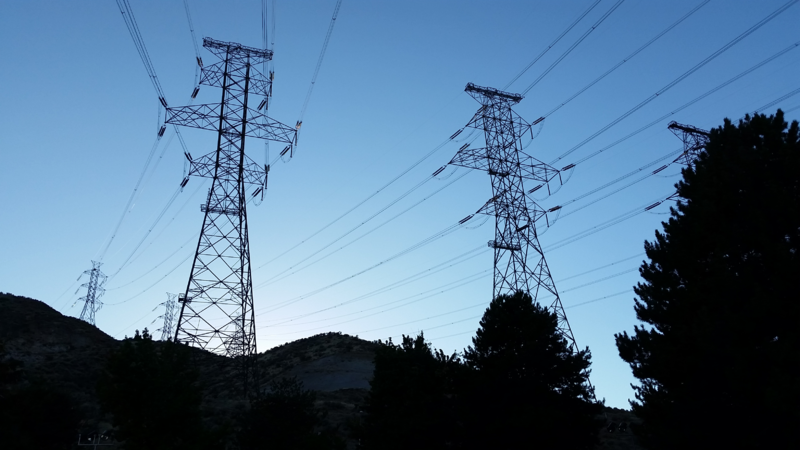
electric power transmission
bulk movement of electrical energy from a generating site to an electrical substation
trust
anti-competitive large grouping of business interests; a large corporation, corporate group, or trade association that holds a dominant position in its sector of activity
price discrimination
pricing strategy of offering similar products at different prices according to buyers' willingness to pay
network effect
a phenomenon by which the value or utility a user derives from a good or service
%206%20-%20Flickr%20-%20gruntzooki.jpg)
enshittification
Enshittification, also known as platform decay, is a process in which two-sided online products and services decline in quality over time. Initially, vendors create high-quality offerings to attract users, then they degrade those offerings to better serve business customers, and finally degrade their services to both users and business customers to maximize short-term profits for shareholders.
natural monopoly
type of monopoly where the average costs are always decreasing throughout the market demand
Sherman Antitrust Act
1890 U.S. anti-monopoly law
public utility
organization that maintains the infrastructure for a public service
barrier to entry
economic obstacles to market participation
government monopoly
government control of an industry or economic sector
Herfindahl index
measure of the size of firms in relation to the industry and an indicator of the amount of competition among them
state monopoly capitalism
Marxist theory
predatory pricing
Undercutting to eliminate competition
regulatory economics
economics of regulation, in the sense of the application of law by government
bilateral monopoly
market structure consisting of both a monopoly (a single seller) and a monopsony (a single buyer)
economy of scope
efficiencies formed by variety of products or services offered
Motion Picture Patents Company
Monopolistic organization of the American film industry (1908–1918)

X-inefficiency
X-inefficiency is a concept used in economics to describe instances where firms go through internal inefficiency resulting in higher production costs than required for a given output. This inefficiency can result from various factors, such as outdated technology, inefficient production processes, poor management, and lack of competition, and it results in lower profits for the inefficient firm(s) and higher prices for consumers. The concept of X-inefficiency was introduced by Harvey Leibenstein.
thumb|320x320px|The difference between the potential and actual cost is known as X-Inefficiency. In
contestable market
market served by a small number of firms that are nevertheless characterized by competitive equilibrium (and therefore provides desirable welfare outcomes) because of the existence of potential short-term entrants
competition regulator
government bodies enforcing fair competition
market dominance
term in competition regulation and anti-monopolistic law
Ramsey problem
problem of setting prices by a public monopoly

zero-rating
thumb|Portuguese company MEO (Portugal)|MEO gives zero-rated access to their own service "MEO cloud". Even though it does not provide unlimited mobile data, it offers packages to give zero-rated access to other applications and services. Contrary to popular belief it does not prevent the usage of those applications while using the regular unused data, but instead offers packages where applications and services within the package are not counted towards the data consumed.
market concentration
function of the number of firms and their respective shares of the total production in a market
municipalization
thumb|upright=1.35|Primary barriers to municipalization
Municipalization is the transfer of private entities, assets, service providers, or corporations to public ownership by a municipality, including (but not limited to) a city, county, or public utility district ownership. The transfer may be from private ownership (usually by purchase) or from other levels of government. It is the opposite of privatization and is different from nationalization. The term municipalization largely refers to the transfer of ownership of utilities from Investor Owned Utilities (IOUs) to public ownership, and op
practice of law
acting as a lawyer
monopoly profit
inflated level of profit due to the monopolistic practices of an enterprise
switching barriers
economic & psychological costs of switching from one alternative to another
coercive monopoly
legally closed monopoly
barriers to exit
obstacles in the path of a firm which wants to leave a given market or industrial sector
copyright term
copyright
energy liberalization
liberalization of energy markets
Special 301 Report
annual US report on trade barriers
private finance initiative
United Kingdom government procurement policy
Coase conjecture
Economic principle
monopolies of knowledge
Power through control of communications
Statute of Monopolies
United Kingdom legislation
price-cap regulation
form of market regulation
monopolization
In United States antitrust law, monopolization is illegal monopoly behavior. The main categories of prohibited behavior include exclusive dealing, price discrimination, refusing to supply an essential facility, product tying and predatory pricing. Monopolization is a federal crime under Section 2 of the Sherman Antitrust Act of 1890. It has a specific legal meaning, which is parallel to the "abuse" of a dominant position in EU competition law, under TFEU article 102. It is also illegal in Australia under the Competition and Consumer Act 2010 (CCA). Section 2 of the Sherman Act states that any