Category
page 1Monotypic ant genera

Sri Lankan relict ant
species of ant

Megaponera
Megaponera analis is the sole species of the genus Megaponera. They are a strictly termite-eating (termitophagous) ponerine ant species widely distributed in Sub-Saharan Africa and most commonly known for their column-like raiding formation when attacking termite feeding sites. Their sophisticated raiding behaviour gave them the common name Matabele ant after the Matabele tribe, fierce warriors who overwhelmed various other tribes during the 1800s. With some individuals reaching up to in length, M. analis is one of the world's largest ants.

Anillidris bruchi
Anillidris is a genus of ants which only contains the species Anillidris bruchi. The genus is known only from a few collections in Brazil and Argentina. For a time Anillidris was synonymous with genus Linepithema, but was revived from synonymy by Shattuck (1992).
left|thumb|
Myrcidris epicharis
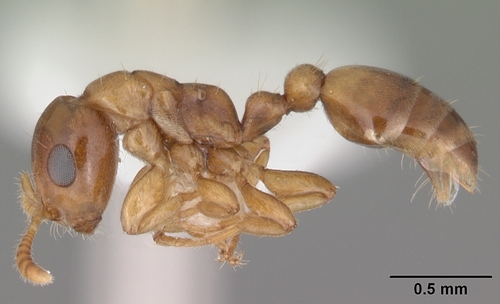
Myrcidris is a genus of ants in the subfamily Pseudomyrmecinae containing a single species, Myrcidris epicharis. The genus is known only from a few localities north of Manaus, Brazil.

Adlerzia froggatti
Adlerzia is a genus of ant in the subfamily Myrmicinae containing the single species Adlerzia froggatti.

Gigantiops destructor
Gigantiops is a South American genus of jumping ants in the subfamily Formicinae. The genus contains the single species Gigantiops destructor, which is also the sole member of the tribe Gigantiopini. They have the largest eyes among all ants, are known for their ability to jump, and have the highest number of chromosomes of any member of the subfamily Formicinae (2n=78).
Opamyrma hungvuong
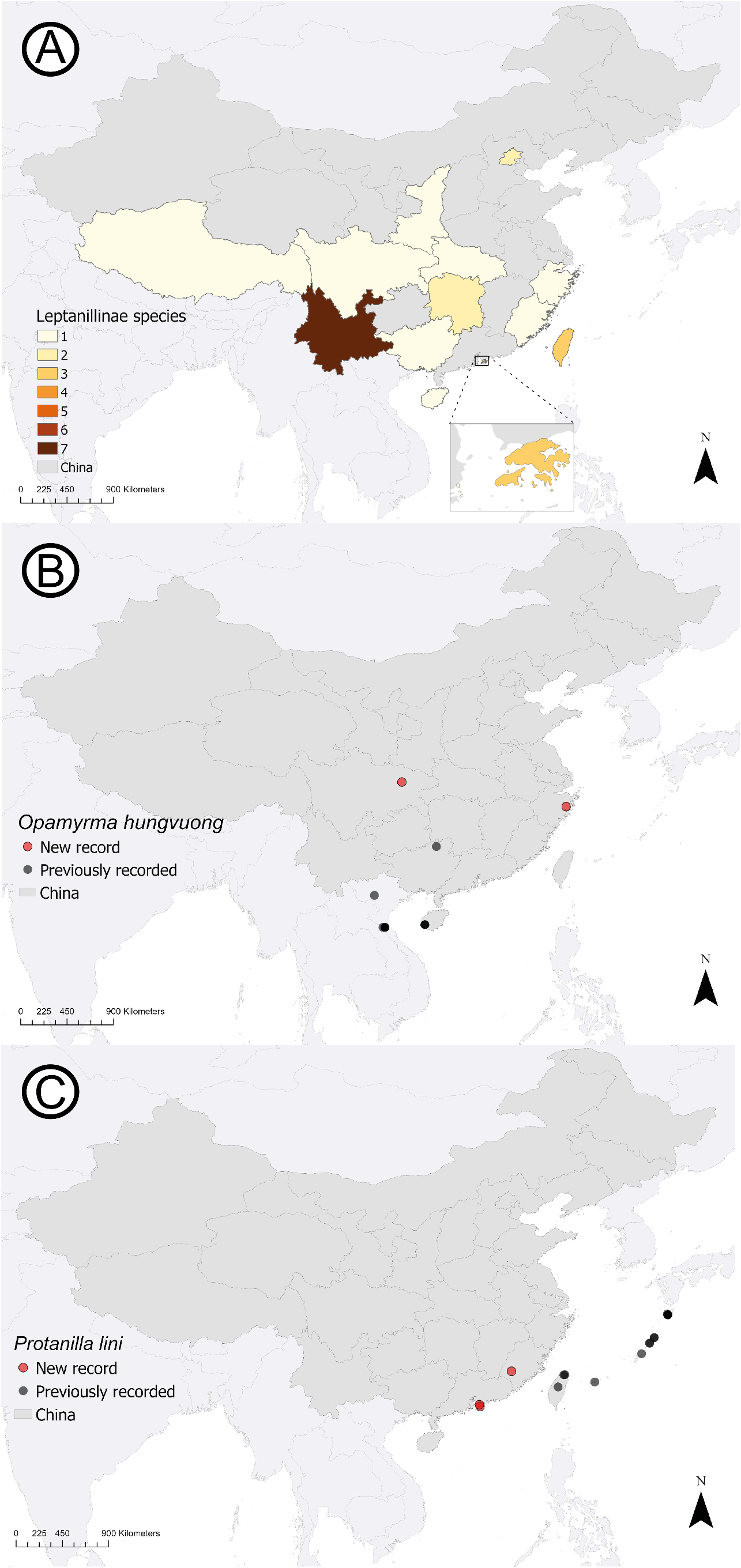
Opamyrma hungvuong is a species of ant found in central Vietnam, first described in 2008. It is the only species in the genus Opamyrma. While originally classified in the subfamily Amblyoponinae, it is presently considered to belong to the subfamily Leptanillinae.

Dacatria templaris
Dacatria is a genus of ants in the subfamily Myrmicinae. It contains the single species Dacatria templaris, first described from South Korea. The genus is known only from South Korea, Vietnam and China.
Pseudoatta
Pseudoatta is a genus of ant in the subfamily Myrmicinae. It contains the single species Pseudoatta argentina, native to Argentina.

Liomyrmex
Liomyrmex is a monotypic genus of ant in the subfamily Myrmicinae; the only species is Liomyrmex gestroi. This genus is known to inhabit Southeast Asia (including Papua New Guinea), South Asia, and parts of Southern China. Individuals in this genus are blind and are known to live among termites in their chambers, but it is relatively unknown as to the purpose of such a relationship.

Santschiella kohli
Santschiella is an Afrotropical genus of ants in the subfamily Formicinae. It contains the single species Santschiella kohli, described by Forel in 1916 from the Democratic Republic of the Congo. The genus is known only from workers, measuring about 3 mm in length and with large eyes. Forel (1917) placed Santschiella in its own tribe, Santschiellini, where it remained until Bolton (2003) moved it to Gesomyrmecini.

Vicinopone conciliatrix
Vicinopone is a monotypic Afrotropical genus of arboreal ants in the subfamily Dorylinae. Vicinopone conciliatrix, the only species in the genus, was first described as Simopone conciliatrix by Brown in 1975 and was transferred to its own genus by Bolton & Fisher in 2012. V. conciliatrix appears to be quite widely distributed but rare. Its rarity is more likely apparent than real because it nests and forages in trees, rarely if ever coming down to the ground.
Ankylomyrma
Ankylomyrma, from Ancient Greek ἀγκύλος (ankúlos), meaning "curved", and μύρμηξ (múrmēx), meaning "ant", is a genus of large arboreal ants in the subfamily Agroecomyrmecinae. It contains the single species Ankylomyrma coronacantha, the sole member of the tribe Ankylomyrmini. The genus is known from Africa. Nothing is known about their biology. The genus was moved from the subfamily Myrmicinae to Agroecomyrmecinae in 2014.

Diaphoromyrma sofiae
Diaphoromyrma (from Greek diaphoros, "different"/"remarkable", + myrmekos, "ant") is a genus of ants in the subfamily Myrmicinae. It contains the single species Diaphoromyrma sofiae, known only from workers from the type locality in Bahia, Brazil. The genus is apparently close to Allomerus and Diplomorium in the Solenopsidini, but its tribal attribution remains uncertain.
Feroponera ferox
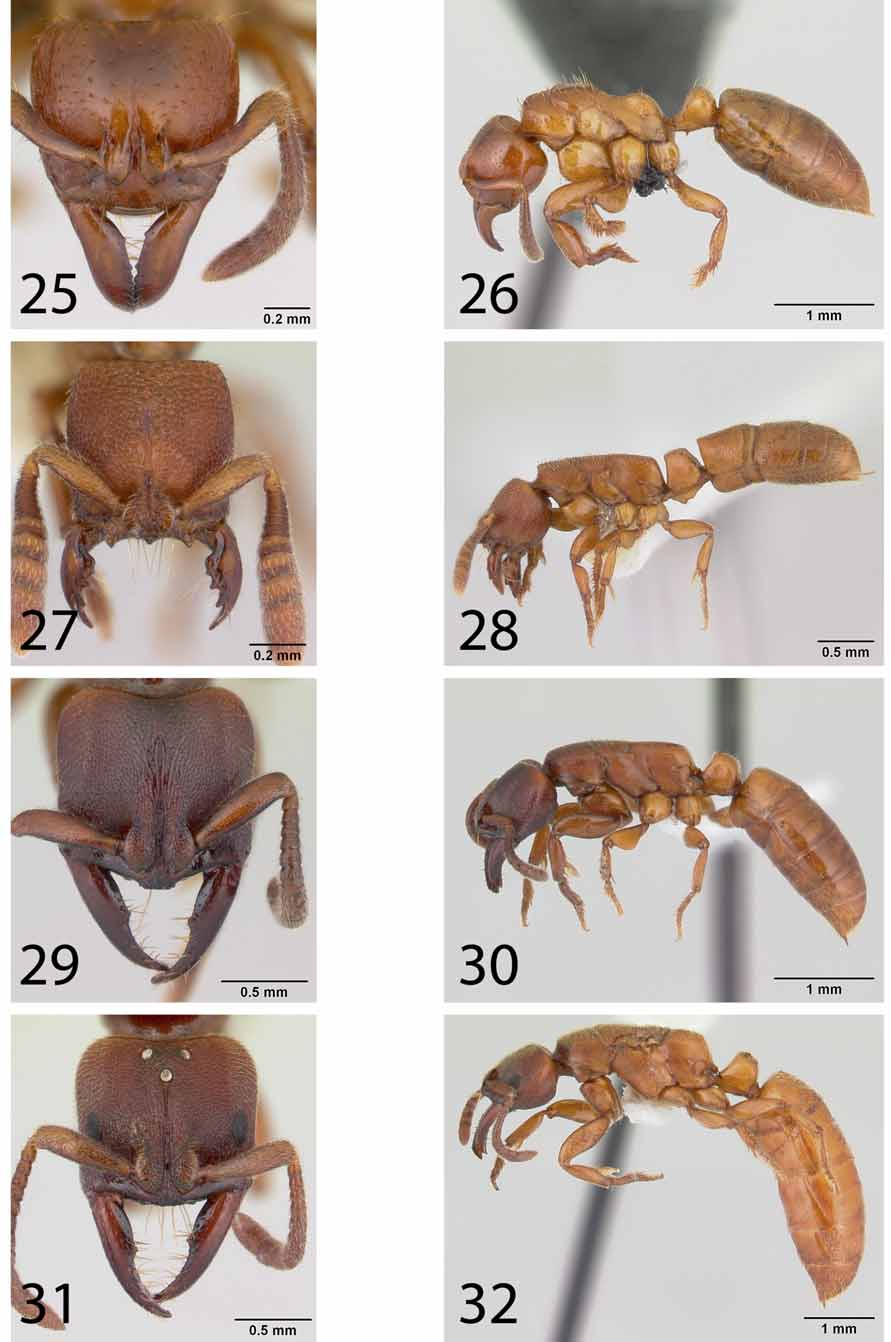
Feroponera is a monotypic Afrotropical genus of ants in the subfamily Ponerinae containing the single species Feroponera ferox. The genus is known only from a few specimens collected from an unoccupied termitary in Cameroon.
Proatta
Proatta is a Southeast Asian genus of myrmicine ants containing the single species Proatta butteli known from the Malay Peninsula, Borneo and Sumatra.
Machomyrma
genus of insects
Buniapone
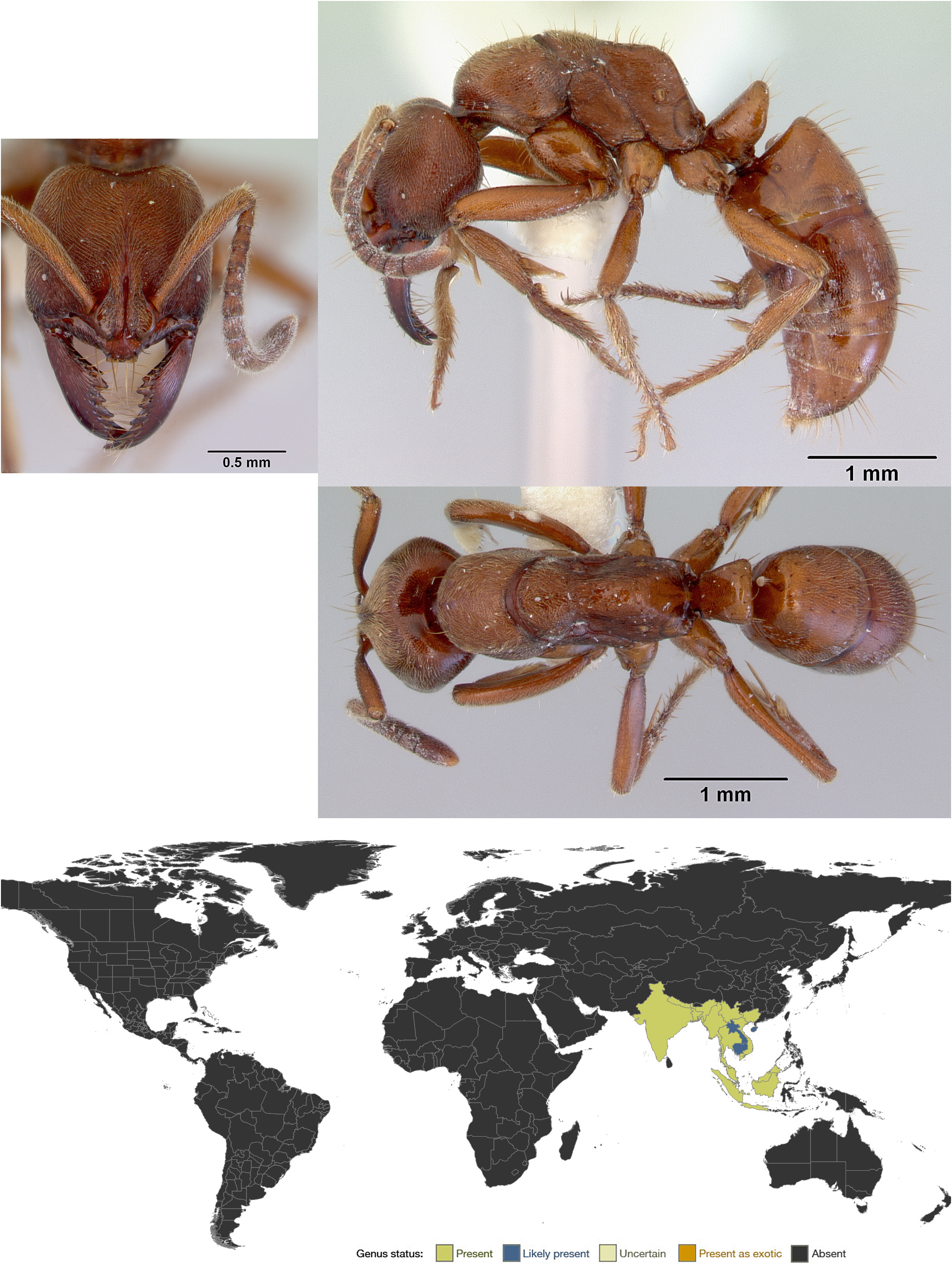
Buniapone is a monotypic genus of ants in the subfamily Ponerinae. Buniapone amblyops, the single described species, is found in Southern and Southeast Asia.
Promyopias silvestrii
Promyopias is an Afrotropical genus of ant in the subfamily Ponerinae containing the single species Promyopias silvestrii. The rare genus has previously been regarded as a separate genus, as a subgenus and as a provisional synonymy, but was reinstated at genus-rank in 2008.
Paltothyreus
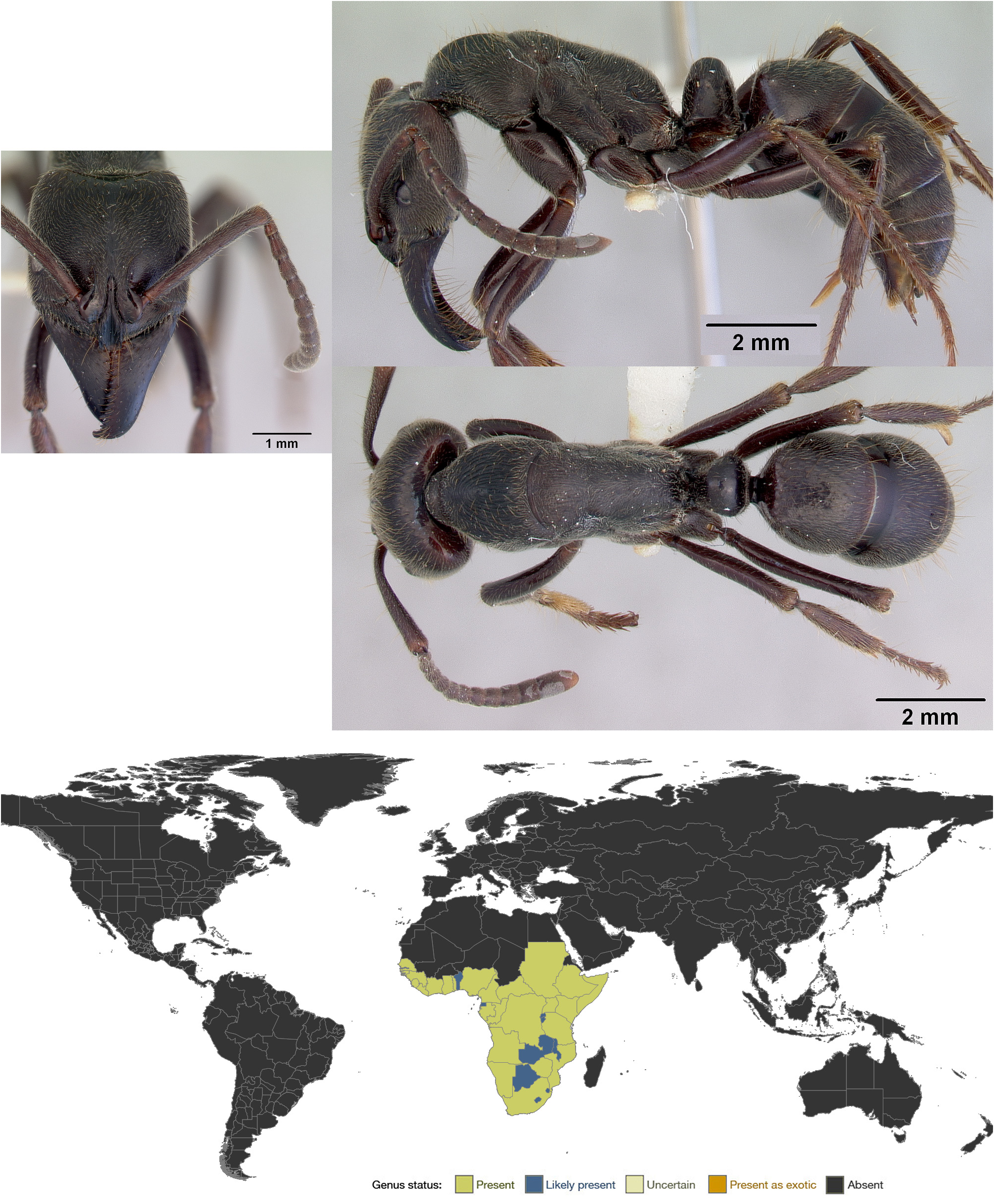
Paltothyreus (also known as African stink ant) is a monotypic genus of ants in the subfamily Ponerinae. Paltothyreus tarsatus, the single described species, is widely distributed in Sub-Saharan Africa. Workers are very large in size (17–20 mm); queens are similar to workers, but larger (23 mm) and winged.

Cyatta abscondita
Cyatta is a genus of ants in the subfamily Myrmicinae containing the single species Cyatta abscondita. It is considered the most recent ancestor of all fungus-farming ants and a living fossil.
Tatuidris
Tatuidris, or armadillo ant, is a rare genus of ants consisting of a single species, Tatuidris tatusia. The ants are small in size and inhabit the leaf litter of Neotropical forests in Central and South America, from Mexico to Brazil. Workers are ferruginous-colored to dark red and present a distinctive morphology, consisting of a shield-like head with a broad vertex, ventrally-turned heavy mandibles which do not overlap at full closure, and unique among ants – an antenna socket apparatus sitting upside-down. Little is known about the biology of the ants, but they are likely nocturnal and
Iberoformica
Iberoformica is a small genus of ants in the subfamily Formicinae.