Category
page 1Monotypic decapod genera

Thenus orientalis
Thenus orientalis is a species of slipper lobster from the Indian and Pacific oceans.
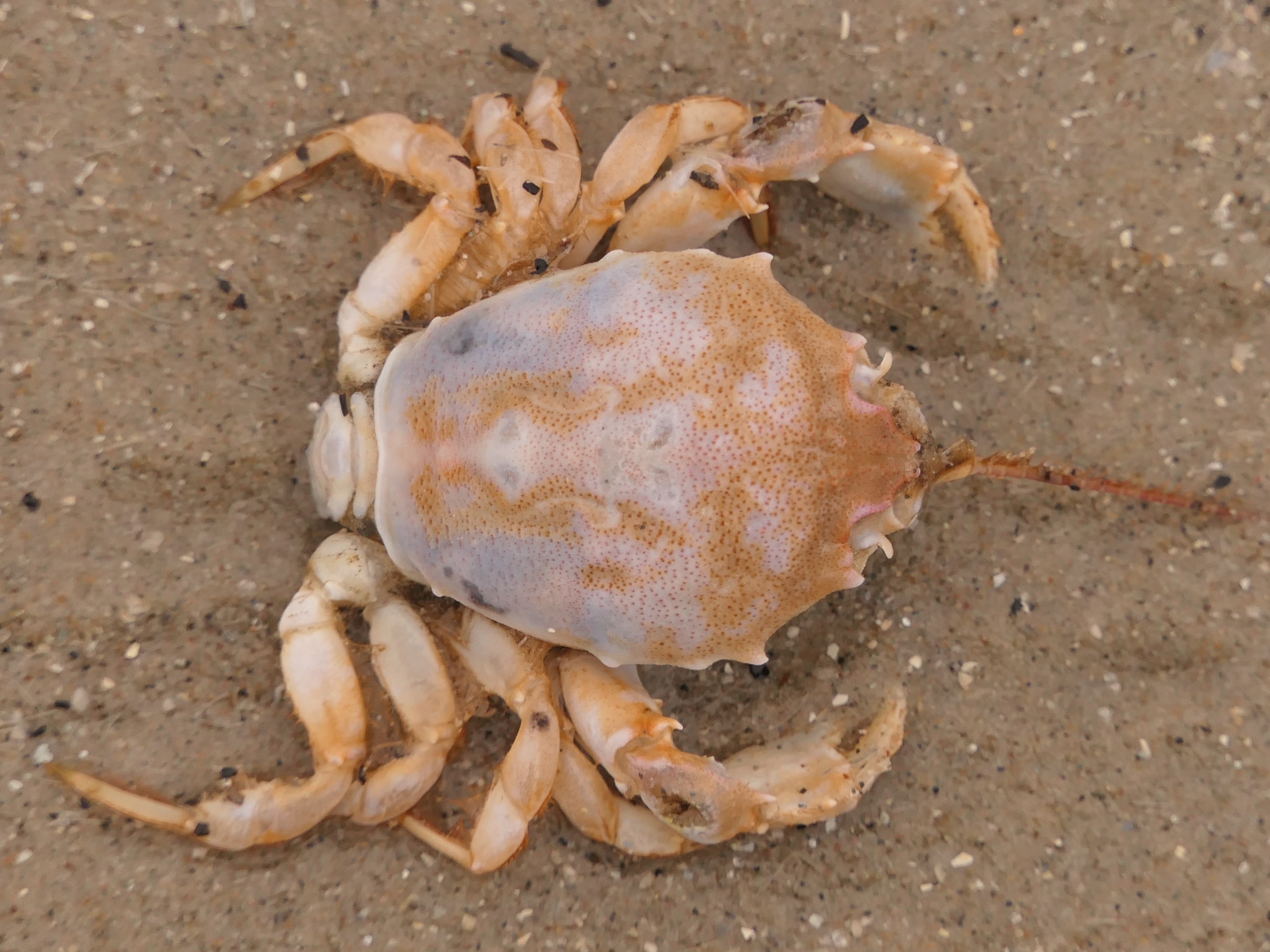
Corystes cassivelaunus
Corystes cassivelaunus, the masked crab, helmet crab or sand crab, is a burrowing crab of the North Atlantic and North Sea from Portugal to Norway, which also occurs in the Mediterranean Sea. It may grow up to long (carapace length). The name "masked crab" derives from the patterns on the carapace which resemble a human face (a case of pareidolia), in a similar manner to heikegani. It is the only species in the genus Corystes.
%20Nigiri.jpg)
Marsupenaeus
Marsupenaeus is a monotypic genus of prawn. It contains a single species, Marsupenaeus japonicus, known as the kuruma shrimp, kuruma prawn, or Japanese tiger prawn. It occurs naturally in bays and seas of the Indo-West Pacific, but has also reached the Mediterranean Sea as a Lessepsian migrant. It is one of the largest species of prawns, and is accordingly one of the most economically important species in the family.

Sagmariasus verreauxi
Sagmariasus verreauxi is a species of spiny lobster that lives around northern New Zealand, the Kermadec Islands the Chatham Islands and Australia from Queensland to Tasmania. It is probably the longest decapod crustacean in the world, alongside the American lobster Homarus americanus, growing to lengths of up to .

Pirimela denticulata
Pirimela is a genus of crab containing a single species, Pirimela denticulata.
Seychellum
Seychellum alluaudi is a species of freshwater crab endemic to the Seychelles, and the only true freshwater crab in that country. It lives in rainforest streams on the archipelago's granitic high islands. Although it may be abundant, little is known about its biology. If its habitat were to decline in quality, S. alluaudi might become endangered, but it is currently listed as Vulnerable on the IUCN Red List.
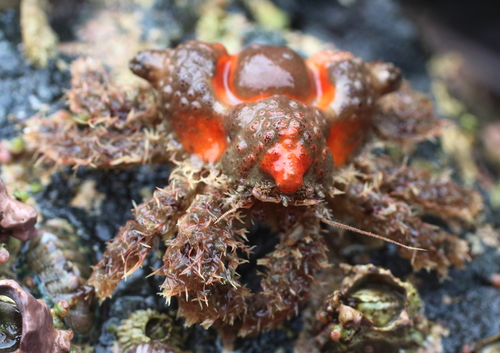
Rhinolithodes wosnessenskii
Rhinolithodes wosnessenskii, also called the rhinoceros crab, is a species of king crab, the only species in the genus Rhinolithodes. The species is named after Ilya Gavrilovich Voznesenski. It is found at depths of in the north-east Pacific Ocean from Kodiak, Alaska to Crescent City, California.

Heterozius rotundifrons
Heterozius rotundifrons, or big hand crab, is a species of crab of the family Belliidae, endemic to New Zealand. The carapace width is up to .

Chasmagnathus convexus
Chasmagnathus convexus is a common mud-flat crab of the family Varunidae, which is endemic to East Asia. In Japan, this crab is commonly called hamagani. This crab has two forms that differ in color; one is olive green and the other is purple. Differences in diet are believed to be responsible for the color variation between the two forms. C. convexus is large, relative to related crabs, and can reach wide across its carapace. It is predominantly nocturnal.
Hymenocera
Hymenocera picta, commonly known as the harlequin shrimp, is a species of saltwater shrimp found at coral reefs in the tropical Indian and Pacific Oceans. It is usually considered the only species in the genus Hymenocera, but some split it into two species: H. picta from the central and east Pacific, where the spots are deep pinkish-purple with a yellow edge, and H. elegans from the Indian Ocean and west Pacific, where the spots are more brownish and have a blue edge. They reach about in length, live in pairs, and feed exclusively on starfish, including crown-of-thorns starfish. They do seem t

Placetron wosnessenskii
Placetron wosnessenskii, common name the scaled crab, is a species of king crab found in most waters off North America's west coast. It is the only species in the genus Placetron.
Camposcia retusa
Camposcia retusa, known commonly as the velcro crab, spider decorator crab, or harlequin crab, is a species of marine crustacea in the family Inachidae. It is known for attaching living sponges and corals to itself, which camouflage it. It is the only species in the genus Camposcia.

Oedignathus inermis
Oedignathus inermis, commonly known as the granular claw crab, paxillose crab, or tuberculate nestling lithode crab, is a species of king crab in the subfamily Hapalogastrinae. It is found off the Pacific coasts of the United States and Canada, from California to the Chukchi Sea. It is also distributed in the Russian Far East and disjunctly around the coasts of Japan. It is the only species in the genus Oedignathus, from Ancient Greek οἰδάω (oidáō), meaning "to swell", and γνάθος (gnáthos), meaning "jaw".

Bellia picta
Bellia picta is a species of crab that lives around the coasts of South America, and the only species in the genus Bellia. On the Atlantic coast, it is found in Rio Grande do Sul, Brazil, while on the Pacific coast, it is found off Peru and Chile. It probably lives in burrows and is a filter feeder.
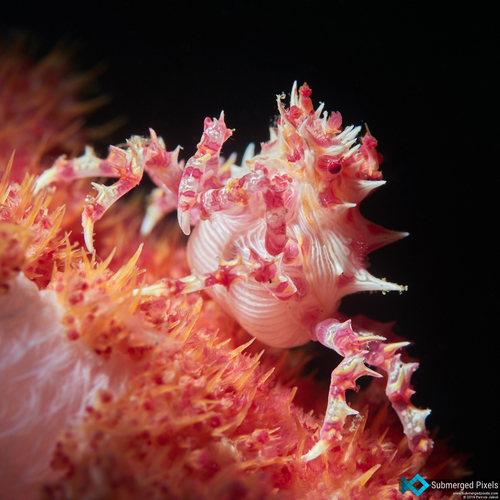
Hoplophrys oatesii
Hoplophrys is a monotypic genus of crab in the family Epialtidae. It contains the single species Hoplophrys oatesii, also known as the candy crab, '''Oates's soft coral crab, commensal soft coral crab and Dendronephthya crab'''.
Shinkaia
Shinkaia crosnieri is a species of squat lobster in a monotypic genus in the family Munidopsidae. S. crosnieri lives in deep-sea hydrothermal vent ecosystems, living off of the chemosynthetic activity of certain bacteria living on its setae.
Cyanagraea
Cyanagraea praedator is a species of crab that lives on hydrothermal vents, and the only species in the genus Cyanagraea.

Troglocambarus maclanei
Troglocambarus is a monotypic genus of troglobitic crayfish, endemic to Florida. Troglocambarus maclanei is found underground in Hernando, Marion, Alachua, Columbia, Gilchrist and Suwanee counties, and is named after Mr. William A. McLane who first collected it. It is commonly called the North Florida Spider Cave crayfish.
Palibythus
Palibythus magnificus, sometimes called the musical furry lobster, is a species of furry lobster found in Polynesia. It is generally included in the family Palinuridae, although it has also been separated from that family with the genus Palinurellus to form the family Synaxidae in the past. The species is known in Samoan as '', a name which also covers the deep-water shrimp Heterocarpus laevigatus''.

Leptograpsus variegatus
Leptograpsus variegatus, known as the purple rock crab, is a marine large-eyed crab of the family Grapsidae, found in southern subtropical Indo-Pacific Oceans. It grows to around shell width. It is the only species in the genus Leptograpsus.
Glyptolithodes
Glyptolithodes cristatipes, also known as the Peruvian centolla, is a species of king crab, and the only species in the genus Glyptolithodes. The species was briefly placed in the related genus Rhinolithodes after its initial description, but was soon moved to its own genus.
Calappula
Calappula saussurei is a species of crab in the family Calappidae, the only species in the genus Calappula.
Thymops
Thymops birsteini, the Patagonian lobsterette, is a species of lobster found around the coasts of South America, particularly the South Atlantic. It belongs to the monotypic genus Thymops.
Socotra pseudocardisoma
species of crustacean
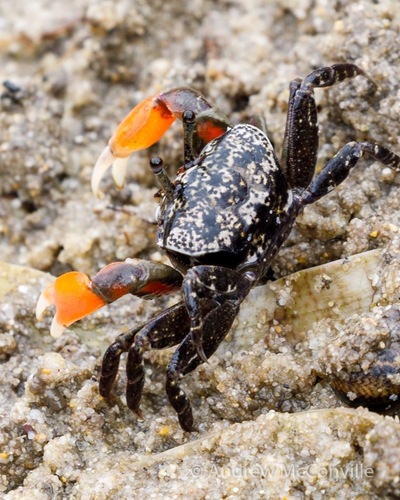
Heloecius
Heloecius cordiformis is a species of semiterrestrial crab found in mangrove swamps and mudflats along the east coast of Australia. Adults are around wide, with males being larger and having larger and more conspicuously coloured claws. The males wave their claws to communicate with other crabs, giving them their common name of semaphore crab. They can breathe both in air and under water, and feed at low tide on detritus in the sediment. H. cordiformis is the only species in the genus Heloecius and the family Heloeciidae.
Orithyia
genus of crabs
Macroregonia
Macroregonia is a genus of crabs containing only a single species, Macroregonia macrochiera. It is found from the coast around Pacific Ocean at depths of .

Samastacus
Samastacus is a genus of southern crayfish in the family Parastacidae. It has a single species, Samastacus spinifrons.
Austropenaeus
Austropenaeus is a monotypic genus of deepwater prawn. Its only species is Austropenaeus nitidus which is native to the deep water surrounding South Africa.
Aristaeopsis
Aristaeopsis is a monotypic genus of deepwater prawn. Its only species Aristaeopsis edwardsiana, commonly known as Carabineros shrimp or cardinal prawn, is the target of commercial fisheries. The scientific name honours Henri Milne-Edwards.
Conleyus defodio
Conleyus defodio is a species of crab, the only species in the genus Conleyus and the family Conleyidae. It lives in rubble beds in Guam, and is named after the collector Harry T. Conley.
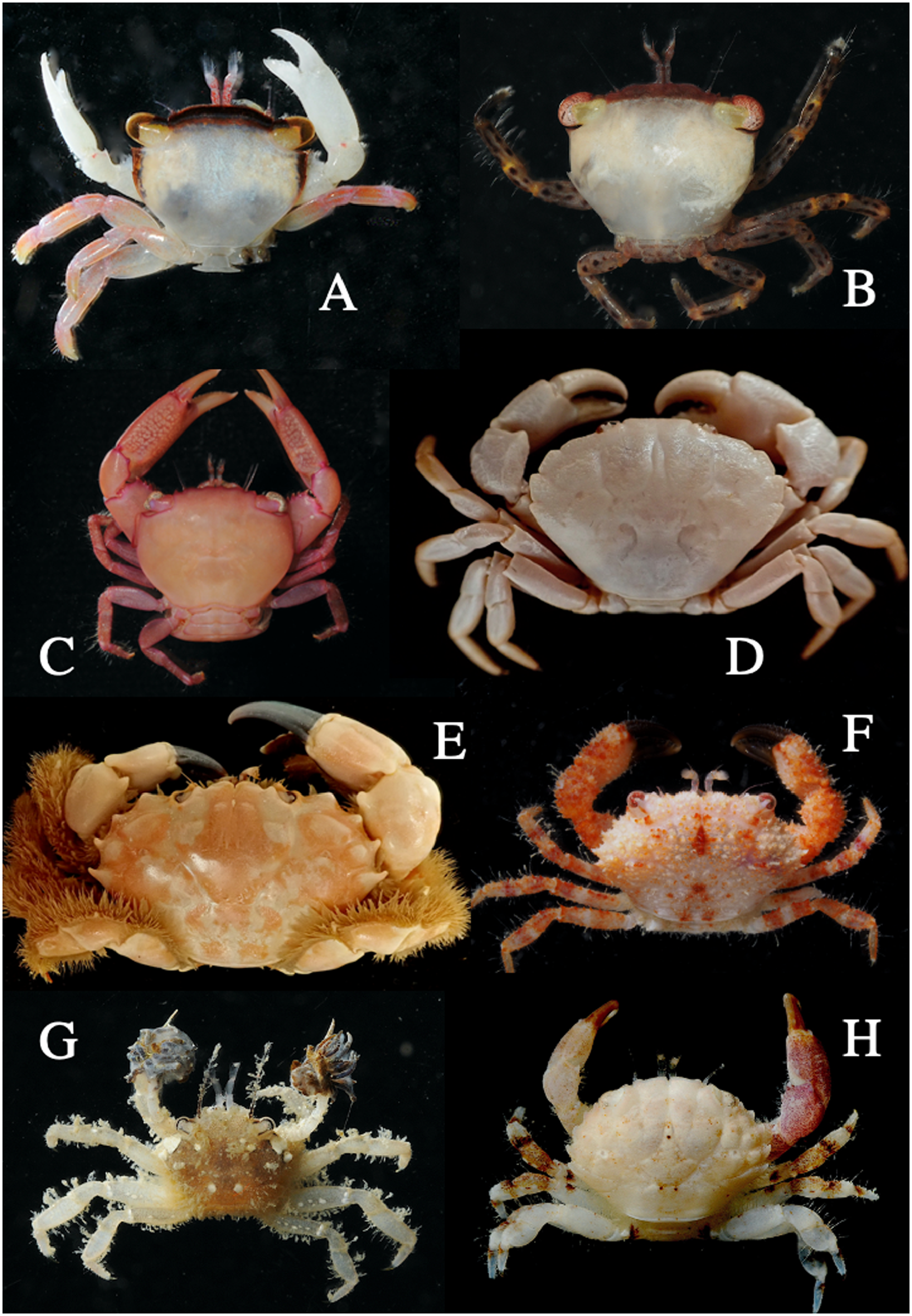
Garthiella aberrans
Garthiella aberrans is a species of crabs in the family Xanthidae, the only species in the genus Garthiella.
Amphionides
Amphionides reynaudii is a species of caridean shrimp, whose identity and position in the crustacean system remained enigmatic for a long time. It is a small (less than one inch long) planktonic crustacean found throughout the world's tropical oceans, which until 2015 was considered the sole representative of the order Amphionidacea, due to unusual morphological features. Molecular data however confirm it as a member of the caridean family Pandalidae, and the confusion of morphology is because only larval phases have so far been studied.
Cyrtocarcinus
Cyrtocarcinus truncatus is a species of crab in the family Xanthidae that lives in the waters around Hawaii. It was described in 1906 by Mary J. Rathbun as Harrovia truncata, based on a single immature male specimen caught near Kauai. Masatsune Takeda transferred the species to his new genus Glyptocarcinus in 1979, and Peter Ng and Diana Chia erected a new genus, Cyrtocarcinus, for this species alone, in 1994.
Guinotia
Neoglyphea
Neoglyphea inopinata is a species of glypheoid lobster, a group thought long extinct before Neoglyphea was discovered. It is a lobster-like animal, up to around in length, although without claws. It is only known from 17 specimens, caught at two sites – one at the entrance to Manila Bay in the Philippines, and one in the Timor Sea, north of Australia. Due to the small number of specimens available, little is known about the species, but it appears to live up to five years, with a short larval phase. A second species, previously included in Neoglyphea, is now placed in a separate genus, Laurent
Maiopsis
Maiopsis, also known as the Panamic spider crab or Ecuadorian king crab, is a large deep-water spider crab genus. It contains a single species, Maiopsis panamensis. It is found in the Gulf of California, from Peru to Ecuador and the Galapagos.
Cancrocaeca
Cancrocaeca xenomorpha is a species of troglobitic (cave-dwelling) freshwater crab from Sulawesi, the only species in the monotypic genus Cancrocaeca. It has been described as the world's "most highly cave-adapted species of crab".

Antrocarcinus petrosus
Antrocarcinus petrosus is a species of crab in the family Xanthidae, the only species in the genus Antrocarcinus.