Category
page 1Moons with a prograde orbit

Moon
The Moon is the only natural satellite of Earth. It orbits around Earth at an average distance of , a distance roughly 30 times the width of Earth. It completes an orbit (lunar month) in relation to Earth and the Sun (synodically) every 29.5 days. The Moon and Earth are bound by gravitational attraction, which is stronger on the sides facing each other. The resulting tidal forces are the main driver of Earth's tides, and have pulled the Moon to always face Earth with the same near side. This tidal locking effectively synchronizes the Moon's rotation period (lunar day) to its orbital period (lu

Titan
largest moon of Saturn

Phobos
natural satellite of Mars

Europa
Galilean moon of Jupiter

Io
innermost of the 4 Galilean moons of Jupiter

Deimos
moon of Mars

Ganymede
Galilean moon of Jupiter

Callisto
second largest Galilean moon of Jupiter and third largest in the solar system

Charon
largest natural satellite of Pluto

Enceladus
Enceladus is the sixth-largest moon of Saturn and the 18th largest in the Solar System. It is about in diameter, about a tenth of that of Saturn's largest moon, Titan. It is covered by clean, freshly deposited snow hundreds of meters thick, making it one of the most reflective bodies of the Solar System. Consequently, its surface temperature at noon reaches only , far colder than a light-absorbing body would be. Despite its small size, Enceladus has a wide variety of surface features, ranging from old, heavily cratered regions to young, tectonically deformed terrain.

Oberon
moon of Uranus

Titania
largest moon of Uranus
Mimas
Mimas is the seventh-largest natural satellite of Saturn. With a mean diameter of , Mimas is the smallest astronomical body known to be roughly rounded in shape due to its own gravity. Mimas's low density, 1.15 g/cm3, indicates that it is composed mostly of water ice with only a small amount of rock, and study of Mimas's motion suggests that it may have a liquid ocean beneath its surface ice. The surface of Mimas is heavily cratered and shows little signs of recent geological activity. A notable feature of Mimas's surface is Herschel, one of the largest craters relative to the size of the
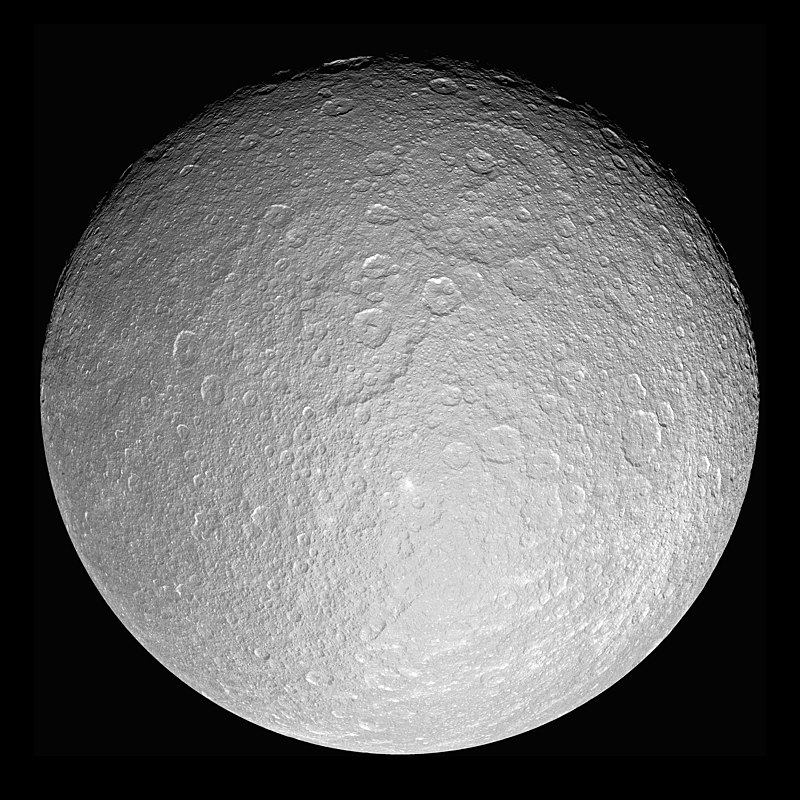
Rhea
moon of Saturn

Dione
moon of Saturn
.svg)
Umbriel
Umbriel () is the third-largest moon of Uranus. It was discovered on October 24, 1851, by William Lassell at the same time as neighboring moon Ariel. It was named after a character in Alexander Pope's 1712 poem The Rape of the Lock. Umbriel consists mainly of ice with a substantial fraction of rock, and may be differentiated into a rocky core and an icy mantle. The surface is the darkest among Uranian moons and appears to have been shaped primarily by impacts, However, the presence of canyons suggests early internal processes. The moon may have undergone an early endogenically driven resurfaci

Miranda
smallest of the large moons of Uranus

Iapetus
moon of Saturn
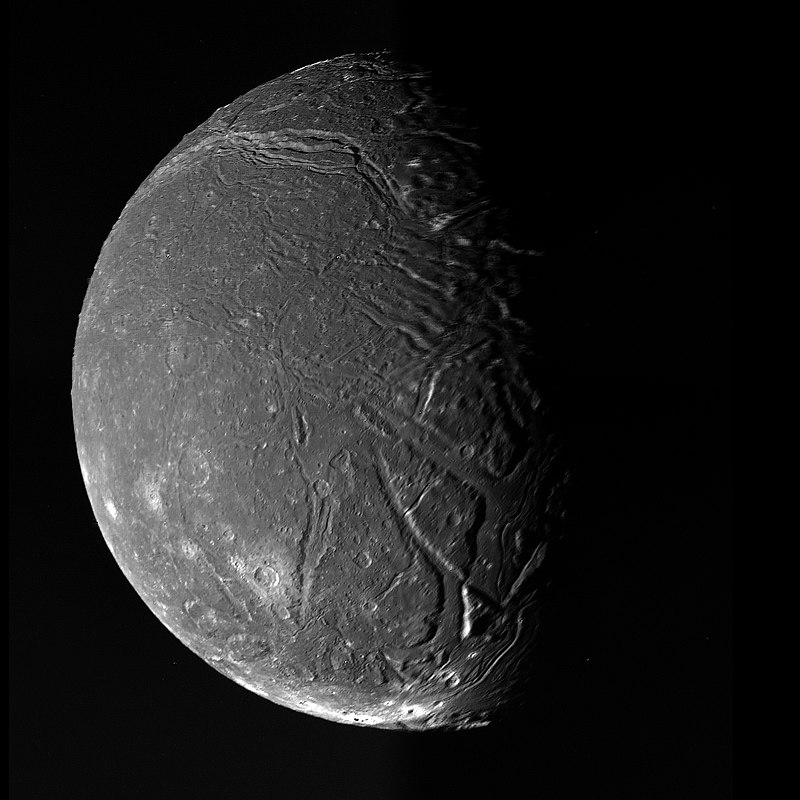
Ariel
fourth-largest moon of Uranus
Metis
moon of Jupiter
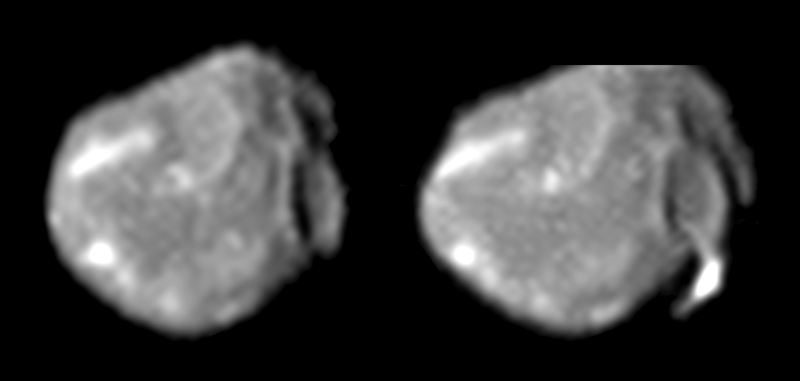
Amalthea
moon of Jupiter

Tethys
moon of Saturn
Adrastea
moon of Jupiter

Thebe
moon of Jupiter

Proteus
moon of Neptune
Nereid
large moon of Neptune

Hyperion
moon of Saturn

Nix
natural satellite of the dwarf planet Pluto

Galilean moons
four largest moons of Jupiter

Hydra
outermost known natural satellite of Pluto

Himalia
moon of Jupiter

Leda
moon of Jupiter
Galatea
moon of Neptune

Themisto
moon of Jupiter

Pan
moon of Saturn

Elara
moon of Jupiter
Styx
small natural satellite of the dwarf planet Pluto

Naiad
moon of Neptune

Atlas
moon of Saturn

Pandora
Saturn XVII, officially named after Pandora from Greek mythology

Ophelia
moon of Uranus

Thalassa
moon of Neptune

Prometheus
moon of Saturn

Despina
moon of Neptune

Epimetheus
moon of Saturn

Helene
moon of Saturn

Lysithea
moon of Jupiter
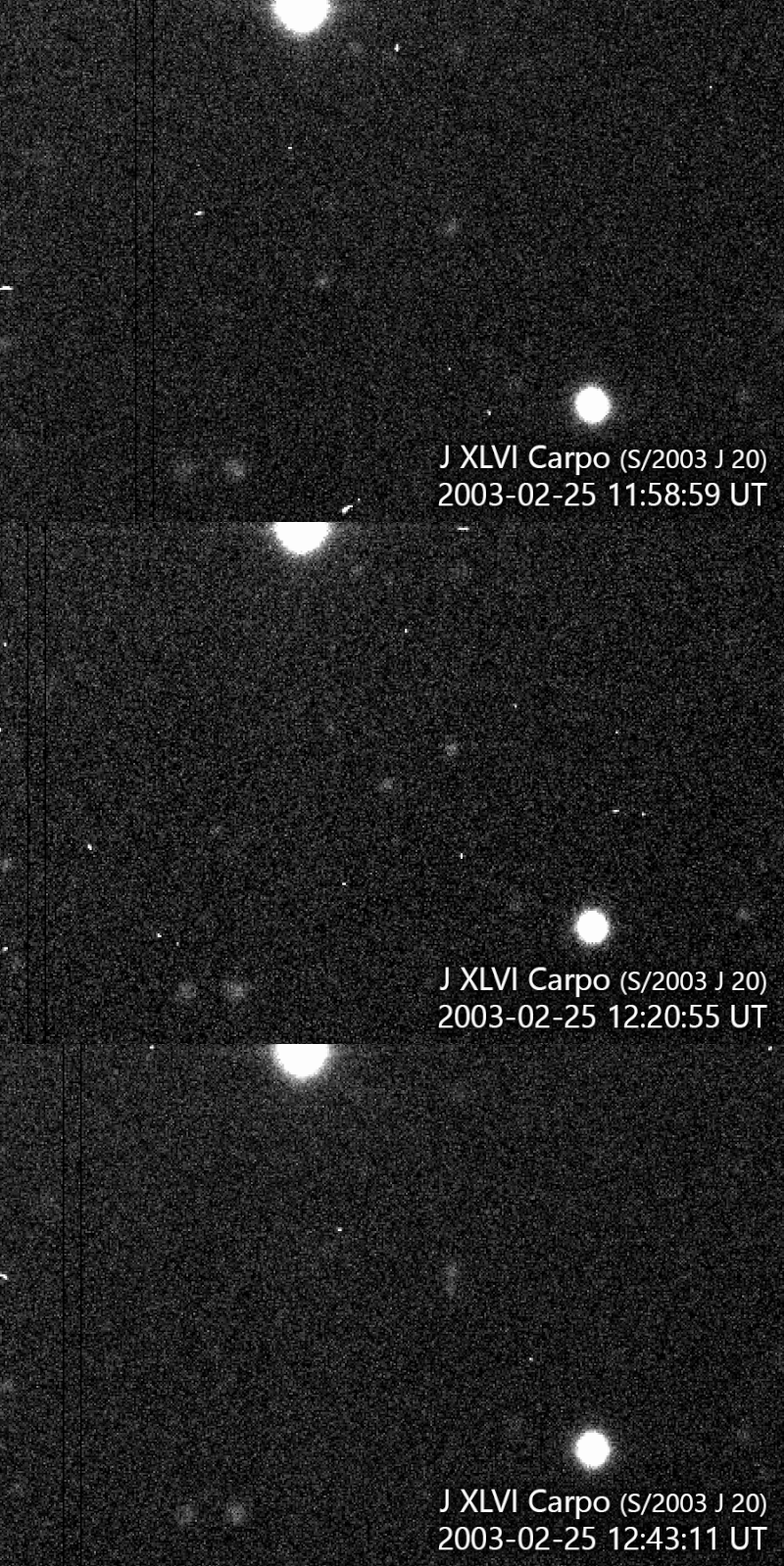
Carpo
moon of Jupiter

Puck
moon of Uranus

Rosalind
moon of Uranus

Daphnis
moon of Saturn

Janus
moon of Saturn
Cordelia
moon of Uranus

Portia
moon of Uranus

Calypso
moon of Saturn
Belinda
moon of Uranus

Juliet
moon of Uranus

Dia
moon of Jupiter

Desdemona
moon of Uranus

Cressida
moon of Uranus