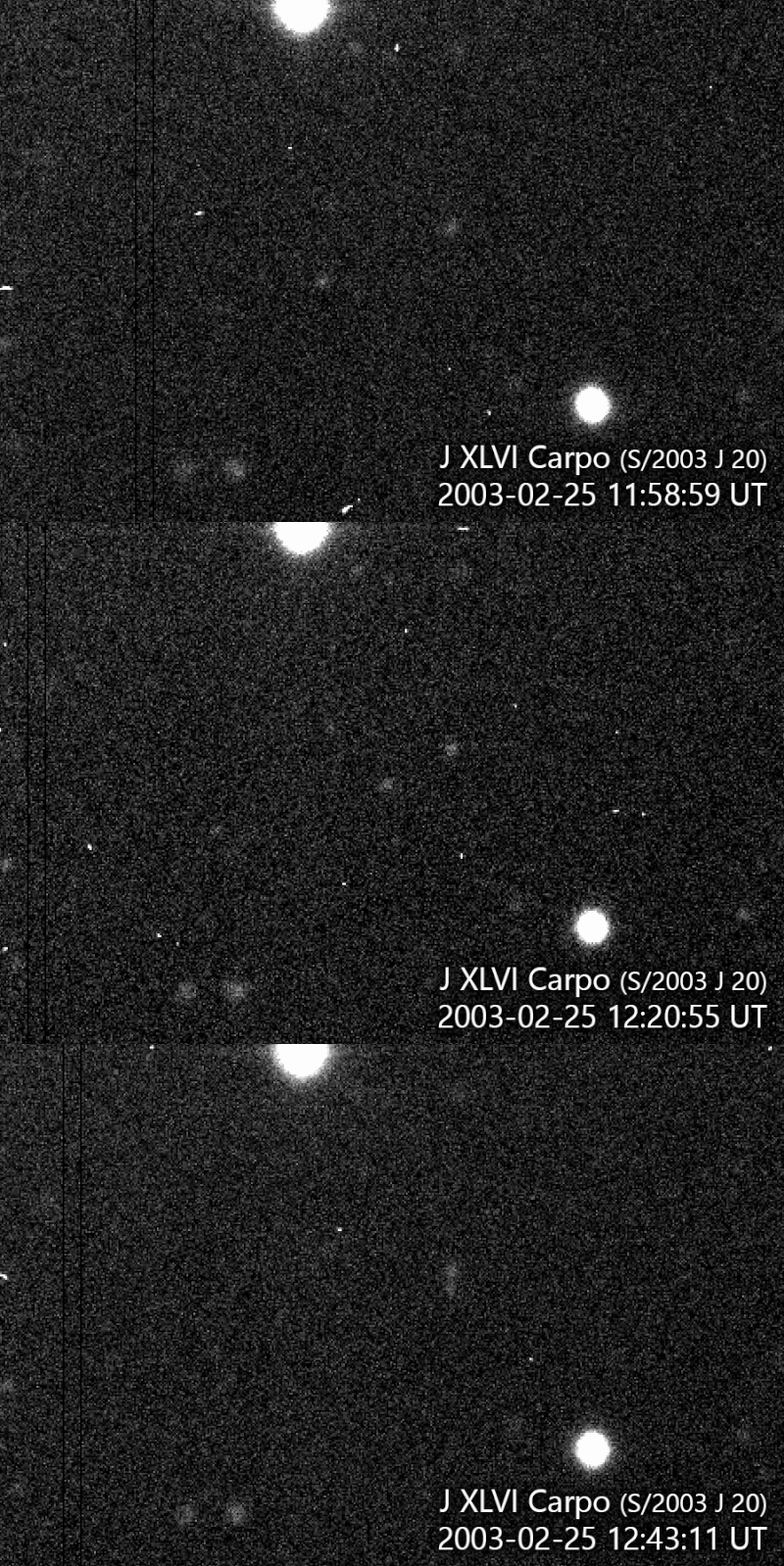
File:Carpo_CFHT_2003-02-25_annotated.gif · Wikimedia Commons · See Wikimedia Commons
Carpo is a small moon that orbits Jupiter, discovered relatively recently through modern astronomical observations. It matters because studying Jupiter's moons helps scientists understand the formation and evolution of the Jupiter system and our solar system as a whole.
AI-generated from the Wikipedia summary — may contain errors.
Wikidata facts
- Instance of
- irregular moon
- Named after
- Carpo
- Parent body
- Jupiter
- Radius
- 1.5
- Mass
- 45
- Orbital period
- 456.1
- Image
- Carpo CFHT 2003-02-25 annotated.gif
Show 9 more facts
- time of discovery or invention
- 2003-02-09
- provisional designation
- S/2003 J 20
- discoverer or inventor
- John J. Kavelaars
- orbital eccentricity
- 0.4316
- albedo
- 0.04
- semi-major axis of an orbit
- 17144888
- apparent magnitude
- 23.0
- orbital inclination
- 51.4
- Commons category
- Carpo (moon)
via Wikidata · CC0
~2 min read
Encyclopedic overview
Carpo /ˈkɑːrpoʊ/, also Jupiter XLVI, is a small outer natural satellite of Jupiter. It was discovered by a team of astronomers from the University of Hawaiʻi led by Scott S. Sheppard in 2003, and was provisionally designated as S/2003 J 20 until it received its name in early 2005. It was named in March 2005 after Carpo, one of the Horae, and a daughter of Zeus (Jupiter).
Carpo has a diameter of about 3 km (1.9 mi) for an absolute magnitude of 16.2. Like all irregular moons of Jupiter, Carpo's orbit is highly variable over time due to gravitational perturbations by the Sun and other planets. On average, Carpo's orbit has a semi-major axis of 17.0 million km (10.6 million mi), a high eccentricity of 0.42, and a very high inclination of 54° with respect to the ecliptic.
Excerpted from Wikipedia’s “Carpo” article, available under the CC BY-SA 4.0 licence.
Gallery (3)
Available in 60 languages
- Español
- Français
- Deutsch
- 中文
- 日本語
- Русский
- Português
- Italiano
- العربية
- Afrikaans
- Albanian
- Armenian
- Bahasa Indonesia
- Bangla
- Belarusian
- Breton
- Bulgarian
- Burmese
Show 41 more
- Catalan
- cdo
- Corsican
- Croatian
- Czech
- Danish
- Esperanto
- Finnish
- Galician
- Georgian
- Greek
- Hebrew
- Hungarian
- Komi
- Latin
- Latvian
- Lithuanian
- Low German
- Luxembourgish
- Macedonian
- Nederlands
- Norwegian
- Norwegian Nynorsk
- Polski
- Romanian
- Serbian
- Serbian (Latin)
- simple
- Slovak
- Slovenian
- Svenska
- Tatar
- Tiếng Việt
- Türkçe
- Ukrainian
- Waray
- Wu Chinese
- zh_min_nan
- zh_yue
- فارسی
- 한국어
via Wikidata sitelinks · CC0