Category
page 1Muroidea

Muridae
The Muridae, or murids, are either the largest or second-largest family of rodents and of mammals, containing approximately 870 species, including many species of mice, rats, and gerbils found naturally throughout Eurasia, Africa, and Australia.

Muroidea
The Muroidea are a large superfamily of rodents, including mice, rats, voles, hamsters, lemmings, gerbils, and many other relatives. Although the Muroidea originated in Eurasia, they occupy a vast variety of habitats on every continent except Antarctica. Some authorities have placed all members of this group into a single family, Muridae, due to difficulties in determining how the subfamilies are related to one another. Many of the families within the Muroidea superfamily have more variations between the families than between the different clades. A possible explanation for the variations in r

Spalacidae
The Spalacidae, or spalacids, are a family of rodents in the large and complex superfamily Muroidea. They are native to eastern Asia, the Horn of Africa, the Middle East, and southeastern Europe. It includes the blind mole-rats, bamboo rats, mole-rats, and zokors. This family represents the oldest split (excluding perhaps the Platacanthomyidae) in the muroid superfamily, and comprises animals adapted to a subterranean way of life. These rodents were thought to have evolved adaptations to living underground independently until recent phylogenetic studies demonstrated they form a monophyletic gr

Mouse-like hamster
genus of mammals
Platacanthomyidae
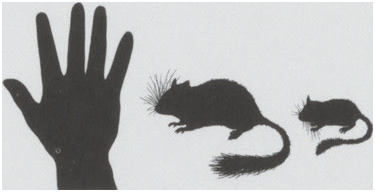
The rodent family Platacanthomyidae, or Oriental dormice, includes the spiny dormice and the Chinese pygmy dormice. In spite of their appearance, these animals are not true dormice, but are part of the large and complex superfamily Muroidea. The platacanthomyids can be distinguished from the true dormice, because they have no premolars, giving them three cheek teeth, like their relatives, the Muroidea.