Category
page 1NASA space probes
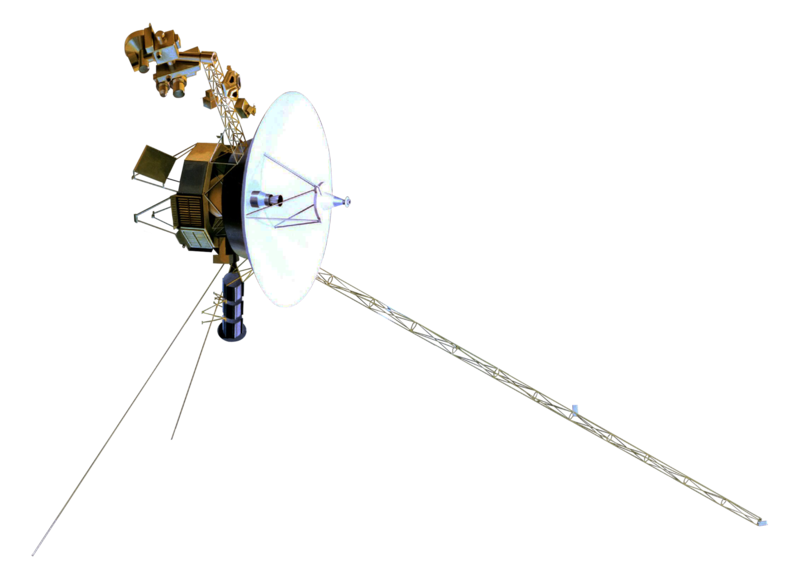
Voyager 1
space probe launched by NASA to study the outer Solar System, furthest spacecraft from Earth

New Horizons
NASA probe that visited Pluto and Kuiper belt object 486958 Arrokoth
Voyager 2
space probe launched by NASA to study the outer Solar System, second furthest spacecraft from Earth after Voyager 1

Cassini−Huygens
Cassini–Huygens ( ), commonly called Cassini, was a space-research mission by NASA, the European Space Agency (ESA), and the Italian Space Agency (ASI) to send a space probe to study the planet Saturn and its system, including its rings and natural satellites. The Flagship-class robotic spacecraft comprised both NASA's Cassini space probe and ESA's Huygens lander, which landed on Saturn's largest moon, Titan. Cassini was the fourth space probe to visit Saturn and the first to enter its orbit, where it stayed from 2004 to 2017. The two craft took their names from the astronomers Giovanni Cassin

Kepler Space Telescope
defunct NASA space telescope

Phoenix
robotic spacecraft on a space exploration mission on Mars under the Mars Scout Program

Juno
NASA spacecraft orbiting the planet Jupiter

Perseverance
American robotic rover exploring Jezero Crater on Mars

Galileo mission
NASA program to send an orbiter to the Jupiter system

Dawn
NASA space probe exploring Vesta and Ceres
MESSENGER
MESSENGER was a NASA robotic space probe that orbited the planet Mercury between 2011 and 2015, studying Mercury's chemical composition, geology, and magnetic field. The name is a backronym for Mercury Surface, Space Environment, Geochemistry, and Ranging, and a reference to the messenger god Mercury from Roman mythology.

InSight
The Interior Exploration using Seismic Investigations, Geodesy and Heat Transport (InSight) mission was a robotic lander designed to study the deep interior of the planet Mars. It was manufactured by Lockheed Martin Space, was managed by NASA's Jet Propulsion Laboratory (JPL), and two of its three scientific instruments were built by European agencies. InSight confirmed "marsquakes" on the planet and thus a still active interior.

Curiosity
American robotic rover exploring Gale Crater on Mars

Mars Reconnaissance Orbiter
NASA space probe in orbit of Mars

Ingenuity
decommissioned NASA rotorcraft on the Mars 2020 mission

Parker Solar Probe
NASA robotic space probe to probe the outer corona of the Sun
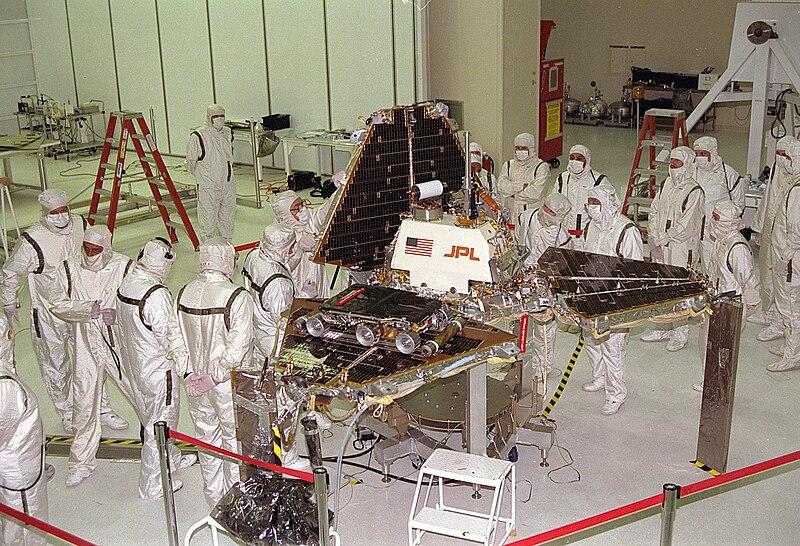
Mars Pathfinder
Mars lander

Mars Science Laboratory
Mars mission by NASA, with rover named "Curiosity"
.jpg)
MAVEN
MAVEN is a NASA spacecraft orbiting Mars to study the loss of its atmospheric gases to space, providing insight into the history of the planet's climate and water. The name is an acronym for "Mars Atmosphere and Volatile Evolution" while the word maven also denotes "a person who has special knowledge or experience; an expert".
.jpg)
OSIRIS-REx
thumb|OSIRIS-REx in Launch Configuration

2001 Mars Odyssey
2001 NASA orbiter studying the geology and hydrology of Mars

Mars 2020
Mars mission by NASA, with rover named "Perseverance" and helicopter named "Ingenuity"
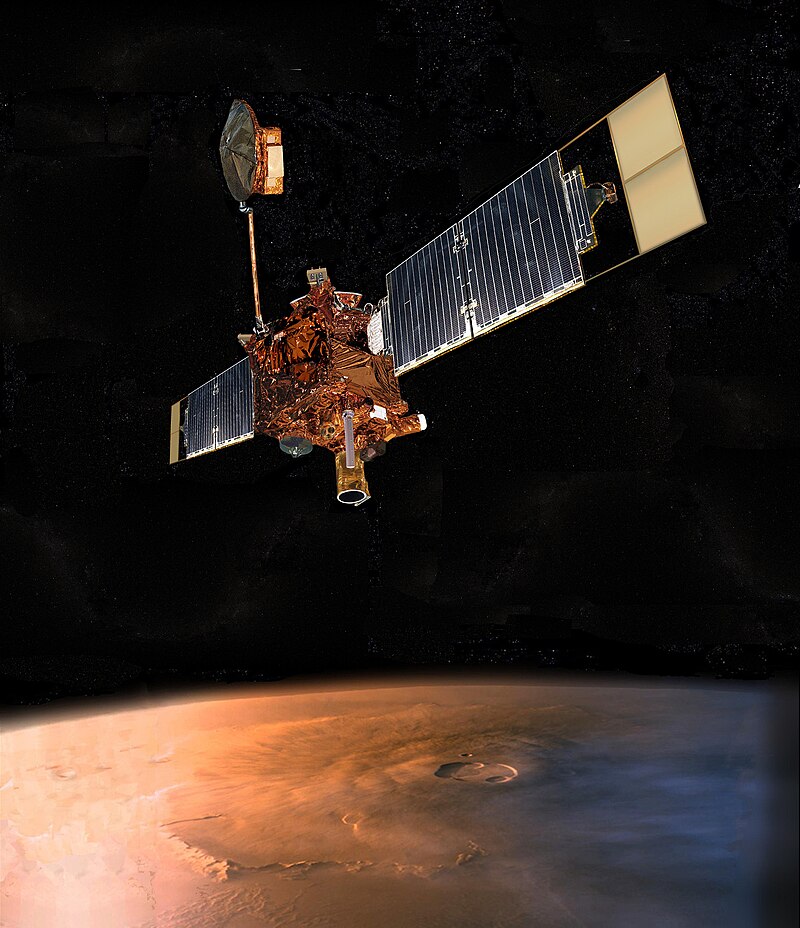
Mars Global Surveyor
US spacecraft developed by NASA's Jet Propulsion Laboratory

Double Asteroid Redirection Test
first mission in NASA's Solar System Exploration program; impact of asteroid Dimorphos in 65803 Didymos system

Wilkinson Microwave Anisotropy Probe
NASA Cosmic Microwave Background probe launched in 2001

Mars Exploration Rover
robotic space mission from NASA involving two Mars rovers, Spirit and Opportunity exploring the planet Mars
Ulysses
NASA robotic space probe that studied the Sun

Stardust
space probe launched by NASA in 1999

Mars Observer
space probe

Mars Polar Lander
robotic spacecraft lander launched by NASA on January 3, 1999

NEAR Shoemaker
1996 robotic space probe that landed on asteroid 433 Eros in 2001
Deep Impact
NASA space probe launched in 2005 to study comet Tempel 1
Mars Climate Orbiter
robotic space probe launched by NASA on December 11, 1998
Wide-field Infrared Survey Explorer
decommissioned American infrared space telescope
Lucy
thirteenth mission of the Discovery program; multiple-flyby reconnaissance of five Jupiter trojans

Europa Clipper
NASA space mission en route to Jupiter and Europa
Deep Space 1
spacecraft

Lunar Atmosphere and Dust Environment Explorer
The Lunar Atmosphere and Dust Environment Explorer (LADEE; ) was a NASA lunar exploration and technology demonstration mission. It was launched on a Minotaur V rocket from the Mid-Atlantic Regional Spaceport on September 7, 2013. During its seven-month mission, LADEE orbited the Moon's equator, using its instruments to study the lunar exosphere and dust in the Moon's vicinity. Instruments included a dust detector, neutral mass spectrometer, and ultraviolet-visible spectrometer, as well as a technology demonstration consisting of a laser communications terminal. The mission ended on April 18, 2

LCROSS
The Lunar Crater Observation and Sensing Satellite (LCROSS) was a robotic spacecraft operated by NASA. The mission was conceived as a low-cost means of determining the nature of hydrogen detected at the polar regions of the Moon. Launched immediately after discovery of lunar water by Chandrayaan-1, the main LCROSS mission objective was to further explore the presence of water in the form of ice in a permanently shadowed crater near a lunar polar region. It was successful in confirming water in the southern lunar crater Cabeus.
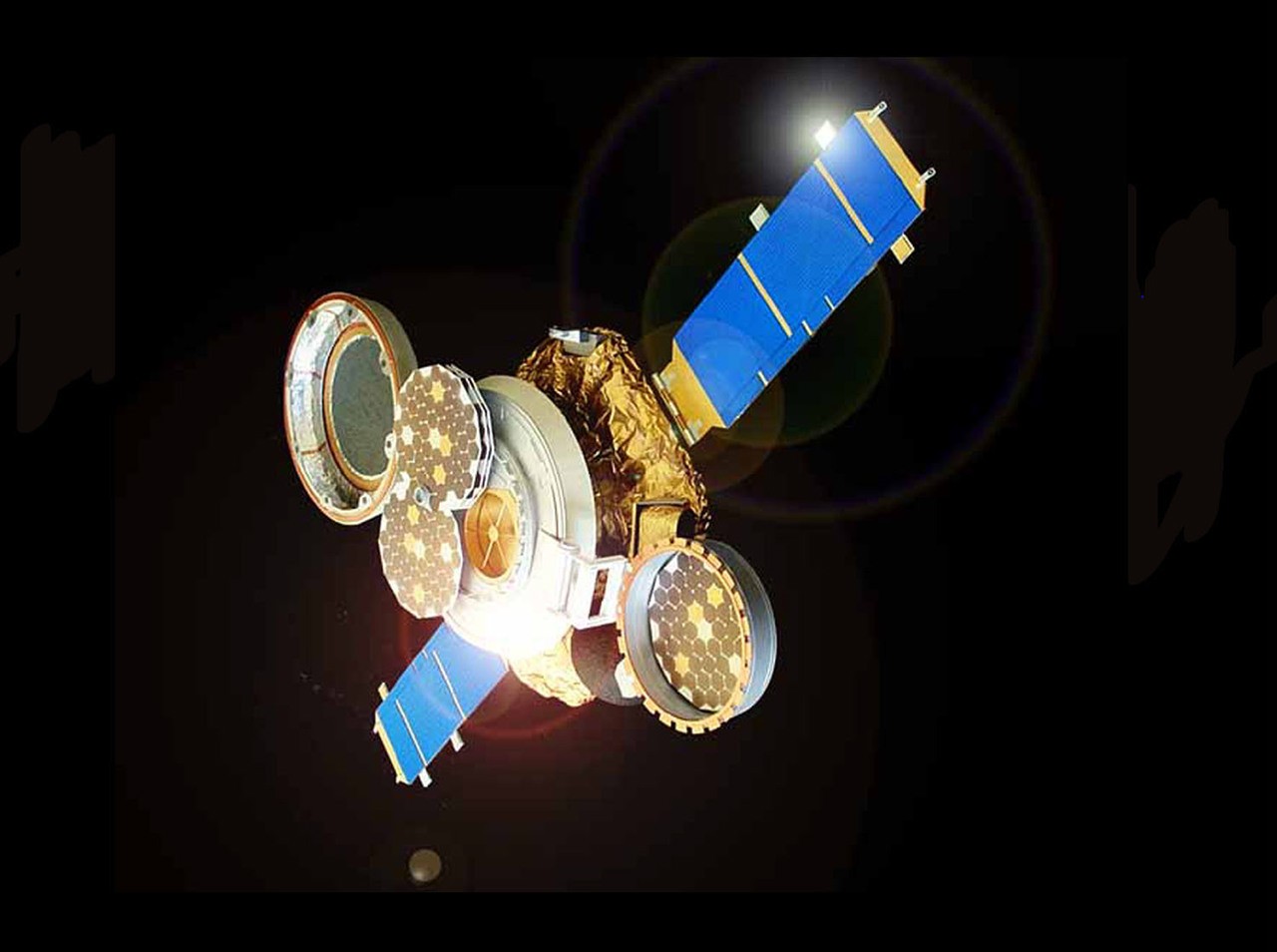
Genesis
NASA sample return probe
Lunar Prospector
NASA mission designed for a low polar orbit investigation of the Moon
Psyche
NASA spacecraft en route to metallic asteroid 16 Psyche
Clementine
American lunar orbiter

THEMIS
Time History of Events and Macroscale Interactions during Substorms (THEMIS) mission began in February 2007 as a constellation of five NASA satellites (THEMIS-A through THEMIS-E) to study energy releases from Earth's magnetosphere known as substorms, magnetic phenomena that intensify auroras near Earth's poles. The name of the mission is an acronym alluding to the Titan Themis.

Gravity Recovery and Interior Laboratory
thumb|right|MoonKAM shot
The Gravity Recovery and Interior Laboratory (GRAIL) was an American lunar science mission in NASA's Discovery Program which used high-quality gravitational field mapping of the Moon to determine its interior structure. The two small spacecraft, GRAIL A (Ebb) and GRAIL B (Flow), were launched on 10 September 2011 aboard a single launch vehicle: the most-powerful configuration of a Delta II, the 7920H-10. GRAIL A separated from the rocket about nine minutes after launch, GRAIL B followed about eight minutes later. They arrived at their orbits around the Moon 25 hours ap
Deep Space 2
twin Mars impact probes
International Ultraviolet Explorer
astronomical observatory satellite
Advanced Composition Explorer
NASA scientific satellite
Helios Program
pair of solar probes operated by NASA and DLR
International Cometary Explorer
American magnetospheric research satellite

CONTOUR
The Comet Nucleus Tour (CONTOUR) was a NASA Discovery-class space probe that failed shortly after its July 2002 launch. It was the only Discovery mission to fail.
Van Allen Probes
NASA space mission in the Van Allen radiation belts

CAPSTONE
CAPSTONE (Cislunar Autonomous Positioning System Technology Operations and Navigation Experiment) is a lunar orbiter that is testing and verifying the calculated orbital stability planned for the now canceled Lunar Gateway space station. The spacecraft is a 12-unit CubeSat that is also testing a navigation system that is measuring its position relative to NASA's Lunar Reconnaissance Orbiter (LRO) without relying on ground stations. It was launched on 28 June 2022, arrived in lunar orbit on 14 November 2022, and was scheduled to orbit for six months. On 18 May 2023, it completed its primary mis
Explorer 35
space probe
Mars Cube One
Mars flyby mission
.jpg)
EscaPADE
Escape and Plasma Acceleration and Dynamics Explorers (ESCAPADE) is a spacecraft mission to Mars consisting of two spacecraft known as Blue and Gold, which launched in November 2025. The mission is designed to demonstrate low-cost planetary space exploration. The twin spacecraft will study Mars' magnetosphere and how solar wind contributed to the loss of most of the planet's atmosphere over Solar System history. The mission is led by UC Berkeley's Space Sciences Laboratory with Dr. Robert Lillis as Principal Investigator. It is part of NASA's SIMPLEx program.
Lunar Flashlight
NASA small satellite which was planned to orbit the Moon
NEO Surveyor
proposed space-based infrared telescope designed to survey the Solar System for potentially hazardous asteroids
Near-Earth Asteroid Scout
planned solar sail spacecraft
LunIR
LunIR (Lunar InfraRed Imaging, formerly known as SkyFire) is a nanosatellite spacecraft launched to the Moon collecting surface spectroscopy and thermography. It was launched as a secondary payload on the Artemis 1 mission on 16 November 2022.