
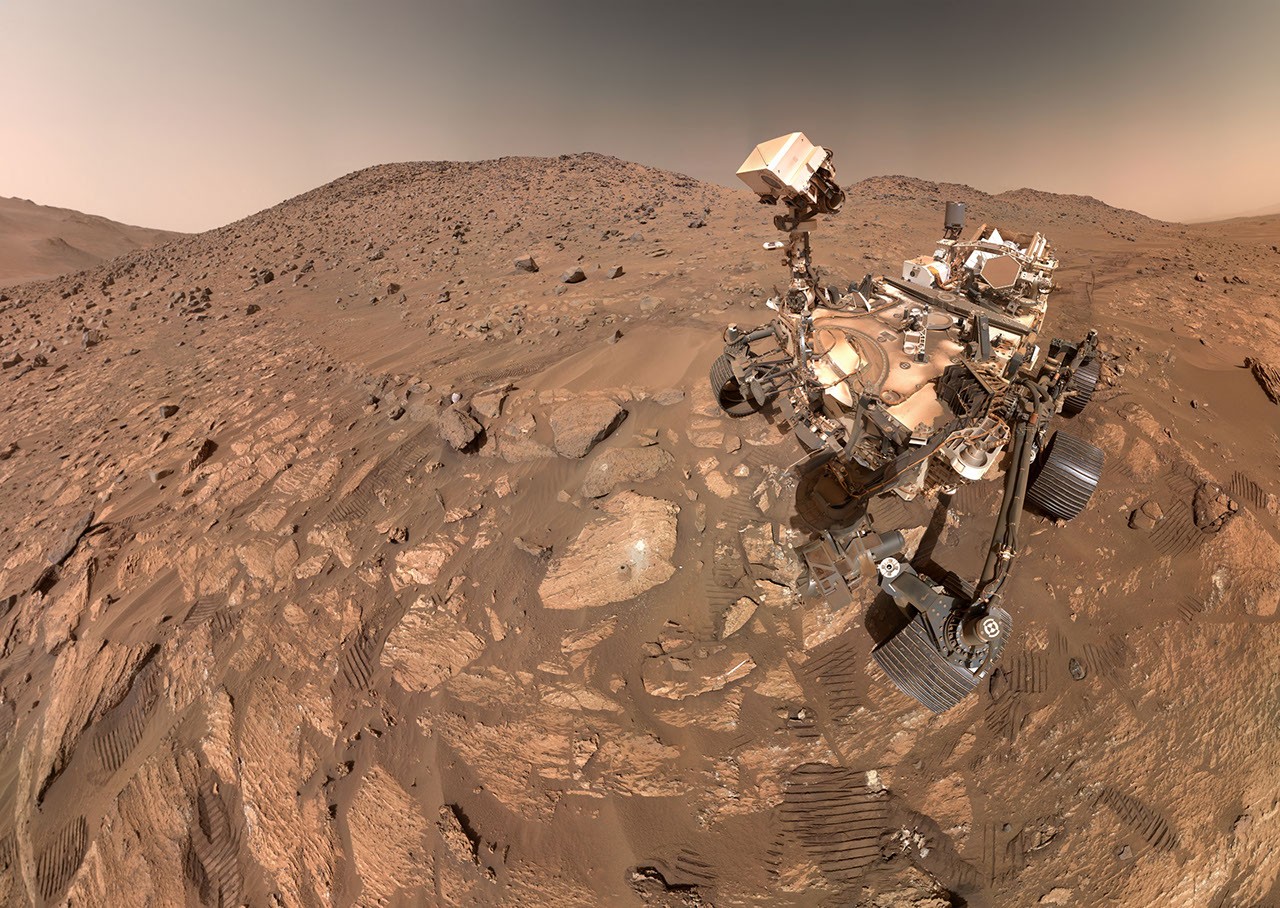
File:Perseverance-Selfie-at-Rochette-Horizontal-V2.gif · Wikimedia Commons · See Wikimedia Commons
Perseverance
Sign in to saveAlso known as Percy, Perseverance rover, Mars rover Perseverance
American robotic rover exploring Jezero Crater on Mars
Perseverance is a robotic rover sent by the United States to explore Jezero Crater on Mars. It matters because it searches for signs of ancient microbial life and gathers information about Mars' geology and climate to help prepare for future human exploration.
AI-generated from the Wikipedia summary — may contain errors.
Official website
Mars 2020: Perseverance Rover - NASA Science
NASA’s Mars Perseverance rover seeks signs of ancient life and collects samples of rock and regolith for possible Earth return.
mars.nasa.gov →Part of NASA's Mars Science Laboratory mission, at the time of launch Curiosity was the largest and most capable rover ever sent to Mars. Part of NASA's Mars Science Laboratory mission, Curiosity, was the largest and most capable rover ever sent to Mars when it launched in 2011. Curiosity set out to answer the question: Did Mars ever have the right environmental conditions to support small life forms called microbes? Early in its mission, Curiosity's scientific tools found chemical and mineral evidence of past habitable environments on Mars. It continues to explore the rock record from a time when Mars could have been home to microbial life. This graphic shows the long-chain organic molecules decane, undecane, and dodecane. These are the largest organic molecules discovered on Mars to date. They were detected in a drilled rock sample called “Cumberland” that was analyzed by the Sample Analysis at Mars lab inside the belly of NASA’s Curiosity rover. The rover, whose selfie is on the right side of the image, has been exploring Gale Crater since 2012. An image of the Cumberland drill hole is faintly visible in the background of the molecule chains. NASA's Curiosity Mars rover has collected 42 powderized rock samples with the drill on the end of its robotic arm. This grid shows all 42 holes made by the drill when collecting the samples. The Curiosity rover has taught us a lot about the history of Mars and its potential to support life. Take a tour of its landing site, Gale Crater. Credit NASA/JPL-Caltech Curiosity is seeking evidence of organics, the chemical building blocks of life. View raw images sent back by Curiosity from its explorations on Mars. Read updates provided by self-selected Mars Science Laboratory mission team members who love to share what Curiosity is doing with the public. Drag your mouse or move your phone to explore this 360-degree panorama provided by NASA’s Curiosity Mars rover. NASA’s Curiosity Mars rover used LED lights on the end of its robotic arm to create this rare nighttime view of the Red Planet’s surface on Dec. 6, 2025, the 4,740th Martian day, or sol, of the rover’s mission. The LED lights are part of the Mars Hand Lens Imager, or MAHLI, a camera on the end of Curiosity’s robotic arm. The image was captured by the Mast Camera, or Mastcam, on the rover’s mast, or “head.” Credits: NASA/JPL-Caltech/MSSS NASA’s Mars Perseverance rover seeks signs of ancient life and collects samples of rock and regolith for possible Earth return. Mars is the only planet we know of inhabited entirely by robots. Learn more about the Mars Missions. Mars is the fourth planet from the Sun, and the seventh largest. It’s the only planet we know of inhabited…
Read more on their site →Excerpt from the official site · 40,000 chars · not written by Vinony
Wikidata facts
- Instance of
- Mars rover
- Part of
- Mars 2020
- Operator
- NASA
- Country of origin
- United States
- Follows
- Curiosity
- Based on
- Curiosity
- Location
- Jezero
- Mass
- 1026
- Manufacturer
- Jet Propulsion Laboratory
- Official website
- www.jpl.nasa.gov/missions/mars-2020-perseverance-rover
- Image
- PIA23499-Mars2020Rover-FirstTestDrive-20191217a.jpg
- Height
- 2.2
- Width
- 2.7
- Length
- 3.0
- Has use
- exploration of Mars
Show 9 more facts
- location of landing
- Jezero
- UTC date of spacecraft landing
- 2021-02-18
- UTC date of spacecraft launch
- 2020-07-30
- Commons category
- Perseverance rover
- start point
- Cape Canaveral Space Launch Complex 41
- launch contractor
- United Launch Alliance
- social media followers
- 2832378
- located on astronomical body
- Mars
Sources (10)
via Wikidata · CC0
~30 min read
Encyclopedic overview
Perseverance is a NASA rover that has been exploring Mars since February 18, 2021, as part of the Mars 2020 mission. Built and managed by the Jet Propulsion Laboratory, it was launched on July 30, 2020, from Cape Canaveral aboard an Atlas V rocket and landed in Jezero Crater, a site chosen for its ancient river delta that may preserve evidence of past microbial life.
The rover's main goals are to search for signs of ancient life, study the planet's geology and climate, and collect rock and regolith samples for possible return to Earth by a future mission. Perseverance also tests technologies intended to support later human exploration, including an experiment that successfully produced oxygen from the thin carbon-dioxide atmosphere.
Excerpted from Wikipedia’s “Perseverance” article, available under the CC BY-SA 4.0 licence.
Gallery (13)
On the map
2 mapped locations
Available in 63 languages
- Español
- Français
- Deutsch
- 中文
- 日本語
- Русский
- Português
- Italiano
- العربية
- हिन्दी
- Afrikaans
- Aragonese
- Bahasa Indonesia
- Bangla
- Basque
- Bosnian
- Catalan
- Central Kurdish
Show 44 more
- Croatian
- Czech
- Danish
- Egyptian Arabic
- Estonian
- Filipino
- Finnish
- Galician
- Greek
- Hebrew
- Hungarian
- hyw
- Ido
- Kazakh
- Kurdish
- Latvian
- Malay
- Malayalam
- Nederlands
- Norwegian
- Polski
- Romanian
- Serbian
- Serbian (Latin)
- simple
- Sinhala
- Slovak
- Slovenian
- Svenska
- Swahili
- Tamil
- Tiếng Việt
- Türkçe
- Ukrainian
- Urdu
- Welsh
- Western Panjabi
- Wu Chinese
- Yakut
- zh_min_nan
- zh_yue
- فارسی
- ไทย
- 한국어
via Wikidata sitelinks · CC0