Category
page 1Neoplatonists

Augustine of Hippo
Christian theologian, philosopher, and saint (354–430)

Plotinus
Plotinus (; , Plōtînos; – 270 CE) was a Hellenistic Greek philosopher, born and raised in Roman Egypt. Plotinus is regarded by modern scholarship as the founder of Neoplatonism.

Farabi
thumbnail|200px|Postage stamp of the USSR, issued on the 1100th anniversary of the birth of Al-Farabi (1975)
Abu Nasr Muhammad al-Farabi (; – 14 December 950–12 January 951), known in the Latin West as Alpharabius, was an early Islamic philosopher and music theorist. He has been designated as "Father of Islamic Neoplatonism", and the "Founder of Islamic Political Philosophy".

Julian
last Pagan Roman emperor, reigned 361 to 363

Boethius
Anicius Manlius Severinus Boethius, commonly known simply as Boethius (; Latin: Boetius; 480–524 AD), was a Roman senator, consul, magister officiorum, polymath, historian, and philosopher of the Early Middle Ages. He was a central figure in the translation of the Greek classics into Latin, a precursor to the Scholastic movement, and, along with Cassiodorus, one of the two leading Christian scholars of the 6th century. The local cult of Boethius in the Diocese of Pavia was sanctioned by the Sacred Congregation of Rites in 1883, confirming the diocese's custom of honouring him on the 23 October

John of Damascus
Christian monk, priest, hymnographer and apologist (675/6-749)

Bonaventure
Bonaventure ( ; ; ; born Giovanni di Fidanza; 1221 – 15 July 1274) was an Italian Catholic Franciscan bishop, cardinal, scholastic theologian and philosopher.

Giovanni Pico della Mirandola
Italian Renaissance philosopher (1463–1494)

Marsilio Ficino
Italian philosopher and Catholic priest (1433–1499)

Porphyry
3rd-century Greek Neoplatonist philosopher

Johannes Scotus Eriugena
Irish Catholic philosopher and theologian (c. 800 – c. 877)
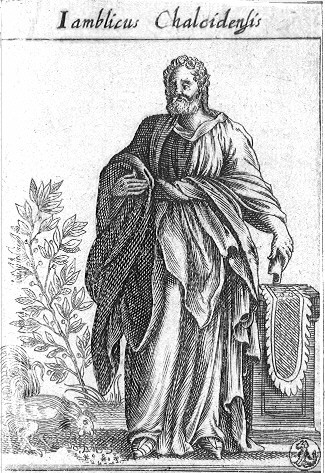
Iamblichus
Iamblichus ( ; ; ; ) was a Syrian Arab Neoplatonist philosopher who determined a direction later taken by Neoplatonism. Iamblichus was also the biographer of the Greek mystic, philosopher, and mathematician Pythagoras. In addition to his philosophical contributions, his is important for the study of the sophists because it preserved about ten pages of an otherwise unknown sophist known as the Anonymus Iamblichi.

Pseudo-Dionysius the Areopagite
Greek philosopher

Macrobius
Macrobius Ambrosius Theodosius, usually referred to as Macrobius (fl. AD 400), was a Roman provincial who lived during the early fifth century, during late antiquity, the period of time corresponding to the Later Roman Empire, and when Latin was as widespread as Greek among the elite. He is primarily known for his writings, which include the widely copied and read Commentarii in Somnium Scipionis ("Commentary on the Dream of Scipio") about Somnium Scipionis, which was one of the most important sources for Neoplatonism in the Latin West during the Middle Ages; the Saturnalia, a compendium of an

Gemistus Pletho
15th-century Byzantine Greek philosopher

Martianus Capella
Latin prose writer of Late Antiquity

Peter the Iberian
Georgian saint
Roman Ingarden
Polish philosopher (1893–1970)
Nikolay Lossky
Russian philosopher (1870–1965)
Aleksei Losev
Russian philosopher and philologist (1893-1988)
Amelius
Amelius Gentilianus (; ), was a Neoplatonist philosopher and writer of the second half of the 3rd century.
Gaius Marius Victorinus
Roman philosopher, theologian and writer
Sosipatra
Sosipatra () was a Greek Neoplatonist philosopher and mystic who lived in Ephesus and Pergamon in the first half of the 4th century AF. The story of her life is told in Eunapius' Lives of the Sophists.
Maximus of Ephesus
Neoplatonist philosopher
John Italus
Byzantine philosopher (11th century)
Remigius of Auxerre
French philosopher and theologian
Pseudo-Aristotle
Pseudo-Aristotle is a general cognomen for authors of philosophical or medical treatises who attributed their works to the Greek philosopher Aristotle, or whose work was later attributed to him by others. Such falsely attributed works are known as pseudepigrapha. The term Corpus Aristotelicum covers both the authentic and spurious works of Aristotle.
Aedesius
Aedesius (, died shortly before 355 AD) was a Neoplatonist philosopher and mystic. He was born into a wealthy Cappadocian family, but he moved to Syria, where he was apprenticed to Iamblichos. None of his writings have survived, but there is an extant biography by Eunapius, a Greek sophist and historian of the 4th century who wrote a collection of biographies titled Lives of the Sophists. Aedesius's philosophical doctrine was a mixture between Platonism and eclecticism and, according to Eunapius, he differed from Iamblichus on certain points connected with theurgy and magic.
Ioane Petritsi
Georgian philosopher
Dexippus (philosopher)
Greek philosopher
Sopater of Apamea
Neoplatonist philosopher
Isaac the Blind
French writer and rabbi (c. 1160–1235)
Thomas Taylor
English translator and Neoplatonist (1758-1835)
Chrysanthius
Chrysanthius of Sardis () was a Greek philosopher of the 4th century AD who studied at the school of Iamblichus.
Eusebius of Myndus
ancient Greek philosopher

Eustathius of Cappadocia
Roman philosopher and diplomat
Asclepius of Tralles
Byzantine philosopher
Priscus of Epirus
Roman philosopher
Salutius
Saturninius Secundus Salutius ( 355–367) was a Roman official and Neoplatonist author. A native of Gaul, he had a successful career as a provincial governor and officer at the imperial court, becoming a close friend and adviser of the Emperor Julian. Salutius was well versed in Greek philosophy and rhetoric, and had a reputation for competence and incorruptibility in office. He authored a Neoplatonic religious treatise titled On the Gods and the Cosmos, in support of Julian's pagan reaction against Christianity.
Messius Phoebus Severus
Roman consul in 470
Theodorus of Asine
Roman philosopher
Abu Ya'qub al-Sijistani
10th century Persian Ismaili missionary and Neo-Platonic philosopher
Dioscorus of Aphrodito
Egyptian poet, lawyer, civic administrator
Muhammad al-Nasafi
10th-century Isma'ili theologian
Francesco Cattani da Diacceto
Florentine philosopher
Yohanan Alemanno
philosopher

Isaac ibn Latif
Jewish philosopher
Mardonio
goth-Roman rhetorician, philosopher and educator
Nymphidianus of Smyrna
Greek philosopher
Cornelius Labeo
3rd century Roman theologian and antiquarian