Category
page 1New media

Internet

mobile phone
portable device to make telephone calls using a radio link

blog
A blog (a truncation of "weblog") is an informational website consisting of discrete, often informal diary-style text entries also known as posts. Posts are typically displayed in reverse chronological order so that the most recent post appears first, at the top of the web page. In the 2000s, blogs were often the work of a single individual, occasionally of a small group, and often covered a single subject or topic. In the 2010s, multi-author blogs (MABs) emerged, featuring the writing of multiple authors, sometimes professionally edited. MABs from newspapers, other media outlets, universities

electronic music
music that mainly employs electronic musical instruments, digital instruments and circuitry-based music technology

ebook
thumb|Reading an e-book (A Dance with Dragons) on a third-generation Kindle
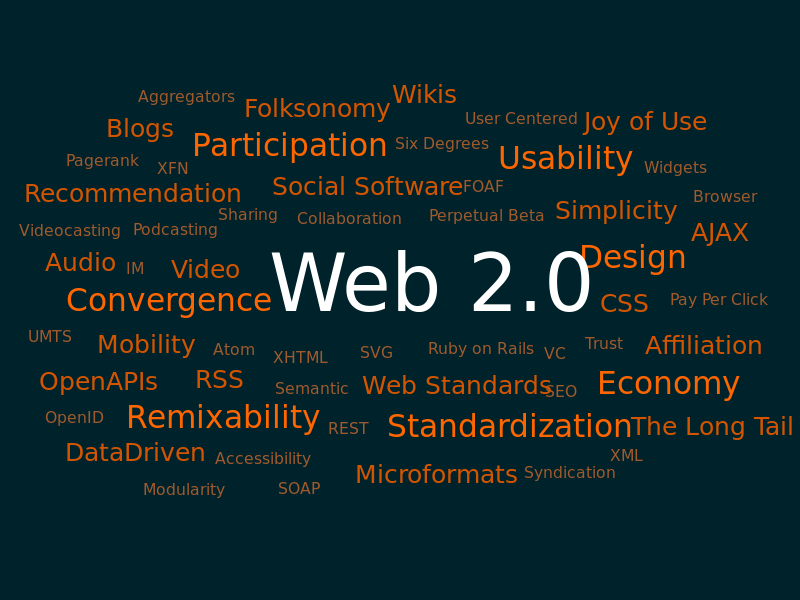
Web 2.0
World Wide Web sites that use technology beyond the static pages of earlier Web sites
new media
forms of media native to computers, computational, relying on computers for redistribution; e.g. telephones, computers, virtual worlds, website games, human-computer interface, computer animation, interactive computer installations

webcomic
Webcomics (also known as online comics or Internet comics) are comics published on the internet, such as on a website or a mobile app. While many webcomics are published exclusively online, others are also published in magazines, newspapers, or comic books.
Webcomics can be compared to self-published print comics in that anyone with an Internet connection can publish their own webcomic. Readership levels vary widely; many are read only by the creator's immediate friends and family, while some of the most widely read have audiences of well over one million readers. Webcomics range from traditio

Internet television
distribution of television content via the public Internet

web series
video serial broadcast on the Internet
user-generated content
online content created by users
original net animation
anime released directly online
digital journalism
an occupation for journalists publishing content digitally
live streaming
broadcasting content live via the Internet
anime music video
fan-made music video consisting of clips from Japanese anime
Internet pornography
pornography that is accessible over the Internet

Adobe Animate
interactive multimedia content authoring app
mainstream media
mass news media that influence many people
online streamer
person who streams activities on their computer to a live online audience
generative art
form of art that is created through the use of autonomous systems, often involving algorithms, random processes, or computational techniques to generate artworks
interactive art
art that involves the spectator
electronic literature
literary genre consisting of works of literature that originate within digital environments and require digital computation
immersion
perception of being physically present in a non-physical world
digital painting
type of art
interactive media
digital media which make use of moving images, animations, videos and audio
HTML video
HTML element
glitch art
practice of using digital or analog errors for aesthetic purposes
Friedrich Kittler
literary scholar and media theorist (1943–2011)
Old media
mass media institutions that dominated prior to the Information Age

deplatforming
thumb|A bust of MIT president Francis Amasa Walker separated from its pedestal at the [[MIT Museum]]
Deplatforming, also known as no-platforming, is a boycott on an individual or group by removing the platforms used to share their information or ideas. The term is commonly associated with social media.
open publishing
online publishing model
postdigital
Postdigital, in artistic practice, is a term that describes works of art and theory that are more concerned with being human than with being digital, similar to the concept of "undigital" introduced in 1995, where technology and society advances beyond digital limitations to achieve a totally fluid multimediated reality that is free from artefacts of digital computation (quantization noise, pixelation, etc.). The postdigital is concerned with our rapidly changed and changing relationships with digital technologies and art forms.
free ad-supported streaming television
category of streaming television services, akin to linear or cable television
personal website
web page created by an individual to contain content of a personal nature
radio art
aural art form made with sound
history of computer animation
aspect of history
collaborative fiction
form of writing
Video Toaster
analog video hardware and software editing suite
metamedia
The term metamedia, coined by Alan Kay and Adele Goldberg, refers to new relationships between form and content in the development of new technologies and new media.
Zettabyte Era
period of human and computer science history
The Dodo
media group and website
Tandy Video Information System
multimedia device
RNW media
public multimedia non-governmental organisation based in the Netherlands
Cultural technology
South Korean marketing system
discoverability
Discoverability is the degree to which something, especially a piece of content or information, can be found in a search of a file, database, or other information system. Discoverability is a concern in library and information science, many aspects of digital media, software and web development, and in marketing, since products and services cannot be used if people cannot find it or do not understand what it can be used for.