Category
page 1Nile Delta

Cairo
Cairo is the capital and largest city of Egypt and the Cairo Governorate. It is home to more than 9.8 million people. It is also part of the largest urban agglomeration in Africa, the Arab world, and the Middle East. The Greater Cairo metropolitan area is one of the largest in the world by population with over 22 million people. Areas of what would become Cairo were inhabited from pre-dynastic and early-dynastic ancient Egypt c. 6000 years ago, as the Giza pyramid complex and the ancient cities of Memphis and Heliopolis are today within the city.

papyrus
thumb|220px|Papyrus (P. British Museum|BM EA 10591 [[recto column IX, beginning of lines 13–17)]]

Port Said
city in northeastern Egypt
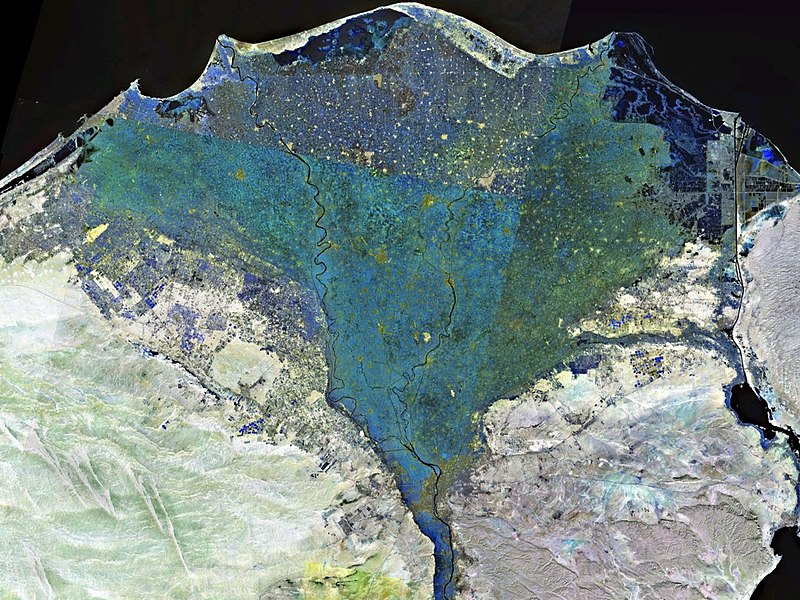
Nile Delta
delta formed in Northern Egypt where the Nile River drains into the Mediterranean Sea

Lower Egypt
northernmost region of Egypt

Damietta
Damietta ('''' ) is a port city and the capital of the Damietta Governorate in Egypt. It is located at the Damietta branch, an eastern distributary of the Nile Delta, from the Mediterranean Sea, and about north of Cairo. The city was a Catholic bishopric and is a multiple titular see. Damietta is also a member of the UNESCO Global Network of Learning Cities.

Cyperus papyrus
species of aquatic flowering plant
.jpg)
Tanta
Tanta is a city in Egypt. It had a population of 530,000 in 2024, making it the seventh most populous city in Egypt. The city is located between Cairo and Alexandria: north of Cairo and southeast of Alexandria. The capital of Gharbia Governorate, Tanta is a center for the cotton-ginning industry.

Zagazig
Zagazig (, ) is a city in Egypt. Situated in the eastern part of the Nile delta, it is the capital of the governorate of Sharqia. It is located on the Muweis Canal and is a hub of the corn and cotton trade. The city contains the Museum of Tal Basta Antiquities, including archaeological exhibits.

Heliopolis
city of ancient Egypt

Neith
thumb|Neith wearing the Deshret|Red Crown of Lower Egypt.

Hyksos
The Hyksos (; Egyptian ḥqꜣ(w)-ḫꜣswt, Egyptological pronunciation: heqau khasut, "ruler(s) of foreign lands"), in modern Egyptology, are the kings of the Fifteenth Dynasty of Egypt (fl. c. 1650–1550 BC). Their seat of power was the city of Avaris in the Nile Delta, from where they ruled over Lower Egypt and Middle Egypt up to Cusae.

Gharbia Governorate
Egyptian governorate

Monufia Governorate
Egyptian governorate

Damietta Governorate
Egyptian governorate

Kafr el-Sheikh Governorate
Egyptian governorate

Qalyubia Governorate
Egyptian governorate

Sais
village in Gharbia Governorate, Egypt

Battle of the Nile
1798 naval battle during the French invasion of Egypt

Tanis
thumb|Map of ancient Lower Egypt showing Tanis
Tanis ( ; ; ) or San al-Hagar (; ; ; or or ; ) is the Greek name for ancient Egyptian ḏꜥn.t, an important archaeological site in the northeastern Nile Delta of Egypt, and the location of a city of the same name. Tanis was the capital of the Egyptian Kingdom in its 21st and 22nd Dynasties. It is located on the Tanitic branch of the Nile, which has long since silted up.
Twenty-first Dynasty of Egypt
ancient Egyptian dynasty

Twenty-second Dynasty of Egypt
ancient Egyptian dynasty
Bubastis
thumb|Map of ancient Lower Egypt showing Bubastis

Twenty-sixth Dynasty of Egypt
Egyptian dynasty of the Late Period (664-525 BCE)
Belbis
Bilbeis ( ; Bohairic ') is an ancient fortress city on the eastern edge of the southern Nile Delta in Egypt, the site of the ancient city and former bishopric of Phelbes''' and a Latin Catholic titular see. It is located 20 km from the city of 10th of Ramadan and roughly 50 km from the city of Cairo.

Amyrtaeus
Amyrtaeus of Sais ( , a Hellenization of the original Egyptian name Amenirdisu) is the only pharaoh of the Twenty-eighth Dynasty of Egypt and is thought to be related to the royal family of the Twenty-sixth Dynasty (664–525 BC). He ended the first Persian occupation of Egypt (i.e. the Twenty-seventh Dynasty: 525–404 BC) and reigned from 404 BC to 399 BC. Amyrtaeus' successful insurrection inaugurated Egypt's last significant phase of independence under native sovereigns, which lasted for about 60 years until the Persians conquered the country again.

Avaris
thumb|An official wearing the "mushroom-headed" hairstyle also seen in contemporary paintings of Western Asiatic foreigners, from Avaris, the capital of the Hyksos. Dated to 1802–1640 BC. Staatliche Sammlung für Ägyptische Kunst.

Uraeus
thumb|right|drawing of a Uraeus
thumb|Statuette of a uraeus, between 722 and 332 BC. Late Period of ancient Egypt|Late Period. [[Museo Egizio Turin.]]
thumb|Mask of Tutankhamun's mummy featuring a uraeus, from the Eighteenth Dynasty. The [[cobra image of Wadjet with the vulture image of Nekhbet represent the unification of Lower and Upper Egypt.]]
Pi-Ramesses
Pi-Ramesses (; Ancient Egyptian: , meaning "House of Ramesses") was the new capital built by the Nineteenth Dynasty Pharaoh Ramesses II (1279–1213 BC) at Qantir, near the old site of Avaris. The city had served as a summer palace under Seti I (c. 1290–1279 BC), and may have been founded by Ramesses I (c. 1292–1290 BC) while he served under Horemheb.

Naucratis
Naucratis or Naukratis (; , "Naval Command"; Egyptian: , , ; ) was a city and trading-post in ancient Egypt, located on the Canopic (western-most) branch of the Nile river, south-east of the Mediterranean Sea and the city of Alexandria. Naucratis was the first and, for much of its early history, the only permanent Greek settlement in Egypt, serving as a symbiotic nexus for the interchange of Greek and Egyptian art and culture.
Pelusium
thumb|Map of ancient Lower Egypt showing Pelusium
Greater Cairo
metropolitan area in Egypt
Land of Goshen
land assigned by Pharaoh to the children of Israel when they came to sojourn in Egypt
Canopus
ancient Egyptian town
.svg)
Buto
Buto (, , Butu), Bouto, Butus (, Boutos) or Butosus was a city that the Ancient Egyptians called Per-Wadjet. It was located 95 km east of Alexandria in the Nile Delta of Egypt. What in classical times the Greeks called Buto, stood about midway between the Taly (Bolbitine) and Thermuthiac (Sebennytic) branches of the Nile, a few kilometers north of the east-west Butic River and on the southern shore of the Butic Lake (, Boutikē limnē).
Bakenranef
Bakenranef, known by the ancient Greeks as Bocchoris (Ancient Greek: , ; Latin: ) or Bochchoris (, ; Latin: ) was briefly a king of the 24th Dynasty of Egypt. Based at Sais in the western Delta, he ruled Lower Egypt from c. 725 to 720 BC. Though the Ptolemaic period Egyptian historian Manetho considers him the sole member of the 24th Dynasty, modern scholars include his father Tefnakht in that dynasty. Although Sextus Julius Africanus quotes Manetho as stating that "Bocchoris" ruled for six years, some modern scholars again differ and assign him a shorter reign of only five years, based on evi
Helwan
former governorate of Egypt
Samannud
Samannud ( ) is a city (markaz) located in Gharbia Governorate, Egypt. Known in classical antiquity as Sebennytos (), Samannud is a historic city that has been inhabited since the Ancient Egyptian period. As of 2019, the population of the markaz of Samannud was estimated to be 410,388, with 83,417 people living in urban areas and 326,971 in rural areas.
Aaru
thumb|Depiction of Aaru within a work of Art of ancient Egypt|ancient Egyptian art, from Dayr al-Madīnah

Mendes
Mendes (, gen.: ), the Greek name of the ancient Egyptian city of Djedet, also known in ancient Egypt as Per-Banebdjedet ("The Domain of the Ram Lord of Djedet") and Anpet, is known today as Tell El-Ruba ().
Lake Mariout
brackish lake in northern Egypt
365 Crete earthquake
earthquake which occurred on 21 July 365 AD in the Eastern Mediterranean, with an assumed epicentre near Crete
Leontopolis
Leontopolis was an ancient Egyptian city located in the Nile Delta, Lower Egypt. It served as a provincial capital and Metropolitan Archbishopric. The archaeological site and settlement are known today as Kafr Al Muqdam.
Hatmehit
Hatmehit or Hatmehyt () was an Ancient Egyptian goddess associated with the city in the Nile Delta known as Djedet () or Mendes ().
Lake Manzala
lake in Egypt
Merimde culture
archaeological culture
Wadj-wer
Wadj-wer, also spelled Uatch-ur is an Egyptian god of fertility and the personification of the Mediterranean Sea, whose name means the "great green". He also symbolizes the richness of the waters of the Nile Delta.
Canal of the Pharaohs
Forerunner of the Suez Canal
Lake Burullus
lake in Kafr el-Sheikh Governorate, Egypt
Decree of Canopus
decree
Ash
ancient Egyptian god
Lake Timsah
lake in Egypt

Meshwesh
The Meshwesh (often abbreviated in ancient Egyptian as Ma) was an ancient Libyan tribe, of Berber origin.
Battle of the Delta
battle between Egypt under Ramses III and the Sea Peoples

Letopolis
thumb|Standard of the Letopolite nome (Egypt)|nome
thumb|Five faience ushabti of Ankh-hapi, a priest in Letopolis during the Ptolemaic dynasty. The Archaeological Civic Museum (MCA) of Bologna|Bologna, Museo Civico Archeologico
Letopolis (Greek: Λητοῦς Πόλις) was an ancient Egyptian city, the capital of the second nome of Lower Egypt. Its Egyptian name was Khem 𓋊𓐍𓐝𓂜𓊖𓉐 (ḫm), and the modern site of its remains is known as Ausim (, from ). The city was a center of worship of the deity Khenty-irty or Khenti-kheti, a form of the god Horus. The site and its deity are mentioned in texts from as

Xois
village and archaeological site in Egypt
Inaros II
5th century BC Egyptian ruler
Fort Julien
fort in Egypt on the Nile
Abusir
village in Alexandria Governorate, Egypt
Tinnis
Tennis or Tinnīs (, ) was a medieval city in Egypt which no longer exists. It was most prosperous from the 9th century to the 11th century until its abandonment. It was located at 31°12′N 32°14′E, on an island in Lake Manzala, southwest of Port Said.