Category
page 1Nitrogen cycle

ammonia

amino acid
organic compound containing both amino and acidic functional groups, important in biology

Fabaceae
Fabaceae or Leguminosae, commonly known as the legume, pea, or bean family, is a large and agriculturally important family of flowering plants. It includes trees, shrubs, and perennial or annual herbaceous plants, which are easily recognized by their fruit (legume) and their compound, stipulate leaves. The family is widely distributed, and is the third-largest land plant family in number of species, behind only the Orchidaceae and Asteraceae, with about 765 genera and nearly 20,000 known species.

urea
Urea, also called carbamide (because it is a diamide of carbonic acid), is an organic compound with chemical formula . This amide has two amino groups (−) joined by a carbonyl functional group (−C(=O)−). It is thus the simplest amide of carbamic acid.

nitrate
Nitrate is a polyatomic ion with the chemical formula . Salts containing this ion are called nitrates. Nitrates are common components of fertilizers and explosives. Almost all inorganic nitrates are soluble in water. An example of an insoluble (inorganic) nitrate is bismuth oxynitrate.

ammonium nitrate
chemical compound
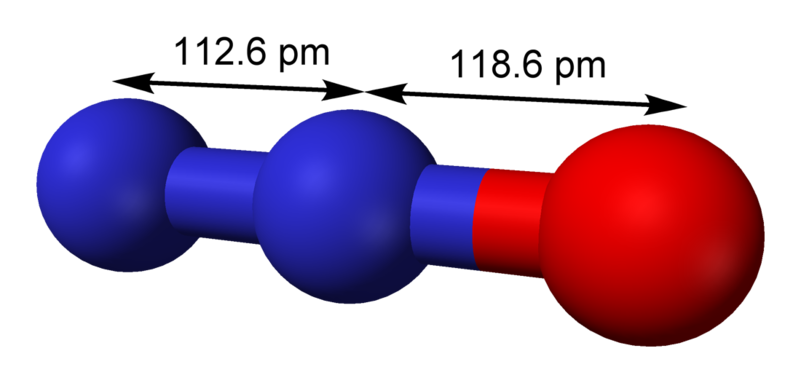
nitrous oxide
chemical compound

guano
300px|thumb|The nest of the Peruvian booby is made of almost pure guano.
thumb|Human-made Bird Island (Namibia)|Guano Island near [[Walvis Bay in Namibia]]
Guano (Spanish from ) is the accumulated excrement of seabirds or bats. Guano is a highly effective fertiliser due to the high content of nitrogen, phosphate, and potassium, all key nutrients essential for plant growth. Guano was also, to a lesser extent, sought for the production of gunpowder and other explosive materials.

uric acid
end product of nucleic acid degradation

nitrogen cycle
biogeochemical cycle by which nitrogen is converted into various chemical forms

nitric oxide
chemical compound

nitrite
The nitrite ion has the chemical formula . Nitrite (mostly sodium nitrite) is widely used throughout chemical and pharmaceutical industries. The nitrite anion is a pervasive intermediate in the nitrogen cycle in nature. The name nitrite also refers to organic compounds having the –ONO group, which are esters of nitrous acid.

nitrogen fixation
process which converts nitrogen from the air into compounds such as ammonia

nitrous acid
chemical compound
essential amino acid
amino acid that cannot be synthesized de novo by the organism

Martinus Wilhelm Beijerinck
Dutch microbiologist (1851–1931)

urea cycle
cycle of biochemical reactions producing urea

nitrification
right|thumb|300px|Nitrogen cycle
Sergei Winogradsky
Ukrainian microbiologist (1856-1953)
denitrification
thumb|320px|Nitrogen cycle.

cyanamide
Cyanamide is an organic compound with the formula CN2H2. This white solid is widely used in agriculture and the production of pharmaceuticals and other organic compounds. It is also used as an alcohol-deterrent drug. One isomer of the molecule features a nitrile group attached to an amino group. Derivatives of this compound are also referred to as cyanamides, the most common being calcium cyanamide (CaCN2).

nitrosamine
thumb|150px|Structure of the nitrosamino group
proteinogenic amino acid
amino acid that is incorporated biosynthetically into proteins during translation

nitrogenase
Nitrogenases are enzymes () that are produced by certain bacteria, such as cyanobacteria (blue-green bacteria) and rhizobacteria. These enzymes are responsible for the reduction of nitrogen (N2) to ammonia (NH3). Nitrogenases are the only family of enzymes known to catalyze this reaction, which is a step in the process of nitrogen fixation. Nitrogen fixation is required for all forms of life, with nitrogen being essential for the biosynthesis of molecules (nucleotides, amino acids) that create plants, animals and other organisms. They are encoded by the Nif genes or homologs. They are related
root nodule
plant part
Nitrifying bacteria
chemolithotrophic organism(s)

heterocyst
thumb|upright=1.7|

leghemoglobin
thumb|upright=1.35|Leghemoglobin A from a soybean (PDB: 1BIN)
glucogenic amino acid
amino acids that can be converted into glucose through gluconeogenesis

anammox
thumb|220px|A bioreactor containing the anammox bacterium Kuenenia stuttgartiensis

diazotrophy
Diazotrophs are organisms capable of nitrogen fixation, i.e. converting the relatively inert diatomic nitrogen (N2) in Earth's atmosphere into bioavailable compound forms such as ammonia. Diazotrophs are typically microorganisms such as bacteria and archaea, with examples being rhizobia and Frankia and Azospirillum. All diazotrophs contain iron-molybdenum or iron-vanadium nitrogenase systems, and two of the most studied systems are those of Klebsiella pneumoniae and Azotobacter vinelandii due to their genetic tractability and their fast growth.

Rhizobia
thumb|right|Root nodules, each containing billions of Rhizobiaceae bacteria
Ketogenic amino acid
type of amino acid
blood urea nitrogen
urea nitrogen in blood
nitrosation
process of converting organic compounds into nitroso derivatives
plants nitrogen deficiency
nutrient deficiency
human impact on the nitrogen cycle
environmental impact of agricultural and industrial nitrogen
denitrifying bacteria
bacteria using nitrate and nitrite as a terminal electron acceptor
actinorhizal plant
plants hosting N-fixing Frankia symbioants in nodules
nitrogen assimilation
Assimilate nitrogen from inorganic nitrogen
sodium phenylbutyrate
chemical compound
urea ammonium nitrate
UAN is a solution of urea and ammonium nitrate in water used as a fertilizer. The combination of urea and ammonium nitrate has an extremely low critical relative humidity (18% at 30 °C) and can therefore only be used in liquid fertilizers. The most commonly used grade of these fertilizer solutions is UAN 32.0.0 (32%N) known as UN32 or UN-32, which consists of 45% ammonium nitrate, 35% urea and only 20% water. Other grades are UAN 28, UAN 30 and UAN 18.
The solutions are quite corrosive towards mild steel (up to per year on C1010 steel) and are therefore generally equipped with a corrosion inhi
Biological functions of nitric oxide
Functions of nitric oxide in organisms
Non-protein nitrogen
Nitrogenous compounds found in living systems
CULTAN Fertilization
type of injection fertilization