Category
page 1Northern constellations
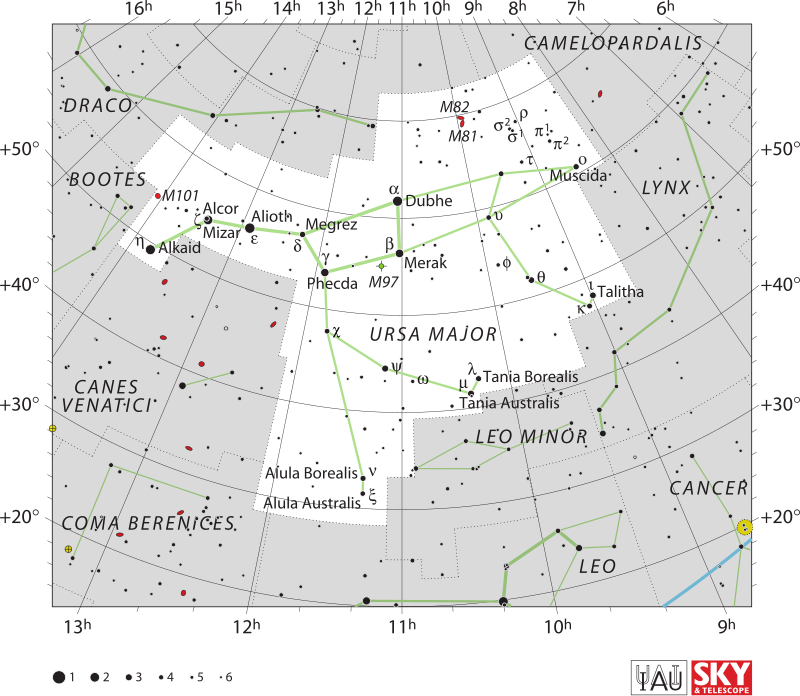
Ursa Major
constellation visible throughout the year in most of the northern hemisphere

Gemini
zodiac constellation in the northern hemisphere

Ursa Minor
constellation in the northern celestial hemisphere, containing the northern celestial pole

Cancer
zodiac constellation in the northern celestial hemisphere

Aries
zodiac constellation in the northern celestial hemisphere

Andromeda
constellation in the northern celestial hemisphere

Cygnus
constellation

Auriga
Auriga is a constellation in the northern celestial hemisphere. It is one of the 88 modern constellations; it was among the 48 constellations listed by the 2nd-century astronomer Ptolemy. Its name is Latin for '(the) charioteer', associating it with various mythological beings, including Erichthonius and Myrtilus. Auriga is most prominent during winter evenings in the northern Hemisphere, as are five other constellations that have stars in the Winter Hexagon asterism. Because of its northern declination, Auriga is only visible in its entirety as far south as −34°; for observers farther south i

Lyra
, from ; pronounced: ) is a small constellation. It is one of the 48 listed by the 2nd century astronomer Ptolemy, and is one of the modern 88 constellations recognized by the International Astronomical Union. Lyra was often represented on star maps as a vulture or an eagle carrying a lyre, and hence is sometimes referred to as Vultur Cadens or Aquila Cadens ("Falling Vulture" or "Falling Eagle"), respectively. Beginning at the north, Lyra is bordered by Draco, Hercules, Vulpecula, and Cygnus. Lyra is nearly overhead in temperate northern latitudes shortly after midnight at the start of summer

Perseus
constellation in the northern celestial hemisphere

Boötes
Boötes ( ) is a constellation in the northern sky, located between 0° and +60° declination, and 13 and 16 hours of right ascension on the celestial sphere. The name comes from , which comes from 'herdsman' or 'plowman' (literally, 'ox-driver'; from boûs 'cow').

Draco
constellation in the northern celestial hemisphere

Cassiopeia
constellation in the northern celestial hemisphere

Pegasus
constellation in the northern celestial hemisphere

Hercules
constellation in the northern celestial hemisphere

Corona Borealis
constellation in the northern celestial hemisphere

Coma Berenices
constellation in the northern celestial hemisphere
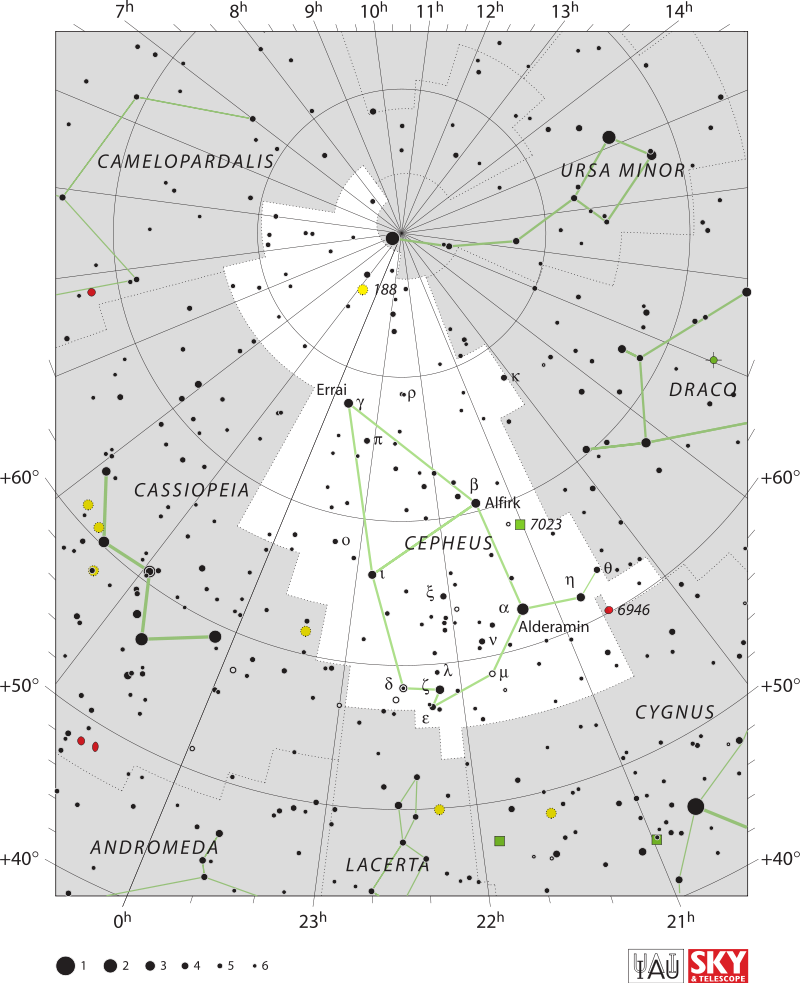
Cepheus
constellation in the northern celestial hemisphere

Equuleus
Equuleus is a faint constellation located just north of the celestial equator. Its name is Latin for "little horse", a foal. It was one of the 48 constellations listed by the 2nd century astronomer Ptolemy, and remains one of the 88 modern constellations. It is the second smallest of the modern constellations (after Crux), spanning only 72 square degrees. It is also very faint, having no stars brighter than the fourth magnitude.

Delphinus
Delphinus is a small constellation in the Northern Celestial Hemisphere, close to the celestial equator. Its name is the Latin version for the Greek word for dolphin (). It is one of the 48 constellations listed by the 2nd-century astronomer Ptolemy, and remains one of the 88 modern constellations recognized by the International Astronomical Union. It is one of the smaller constellations, ranked 69th in size. Delphinus' five brightest stars form a distinctive asterism symbolizing a dolphin with four stars representing the body and one the tail. It is bordered (clockwise from north) by Vulpecul

Triangulum
Triangulum is a small constellation in the northern sky. Its name is Latin for "triangle", derived from its three brightest stars, which form a long and narrow triangle. Known to the ancient Babylonians and Greeks, Triangulum was one of the 48 constellations listed by the 2nd century astronomer Ptolemy. The celestial cartographers Johann Bayer and John Flamsteed catalogued the constellation's stars, giving six of them Bayer designations.

Canes Venatici
constellation in the northern celestial hemisphere

Vulpecula
Vulpecula () is a faint constellation in the Northern Sky. Its name is Latin for "little fox", although it is commonly called simply the Fox. It was identified in the 17th century, and is located in the middle of the Summer Triangle (an asterism consisting of the bright stars Deneb, Vega, and Altair).

Lacerta
Lacerta is one of the 88 modern constellations defined by the International Astronomical Union. Its name is Latin for lizard. A small, faint constellation, it was defined in 1687 by the astronomer Johannes Hevelius. Its brightest stars form a "W" shape similar to that of Cassiopeia, and it is thus sometimes referred to as 'Little Cassiopeia'. It is located between Cygnus, Cassiopeia and Andromeda on the northern celestial sphere. The northern part lies on the Milky Way.

Camelopardalis
Camelopardalis is a large but faint constellation of the Northern Sky representing a giraffe. The constellation was introduced in 1612 or 1613 by Petrus Plancius. Some older astronomy books give Camelopardalus or Camelopardus as alternative forms of the name, but the version recognized by the International Astronomical Union matches the genitive form, seen suffixed to most of its brighter stars.
Sagitta
Sagitta is a dim but distinctive constellation in the northern sky. Its name is Latin for 'arrow', not to be confused with the significantly larger constellation Sagittarius 'the archer'. It was included among the 48 constellations listed by the 2nd-century astronomer Ptolemy, and it remains one of the 88 modern constellations defined by the International Astronomical Union. Although it dates to antiquity, Sagitta has no star brighter than 3rd magnitude and has the third-smallest area of any constellation.
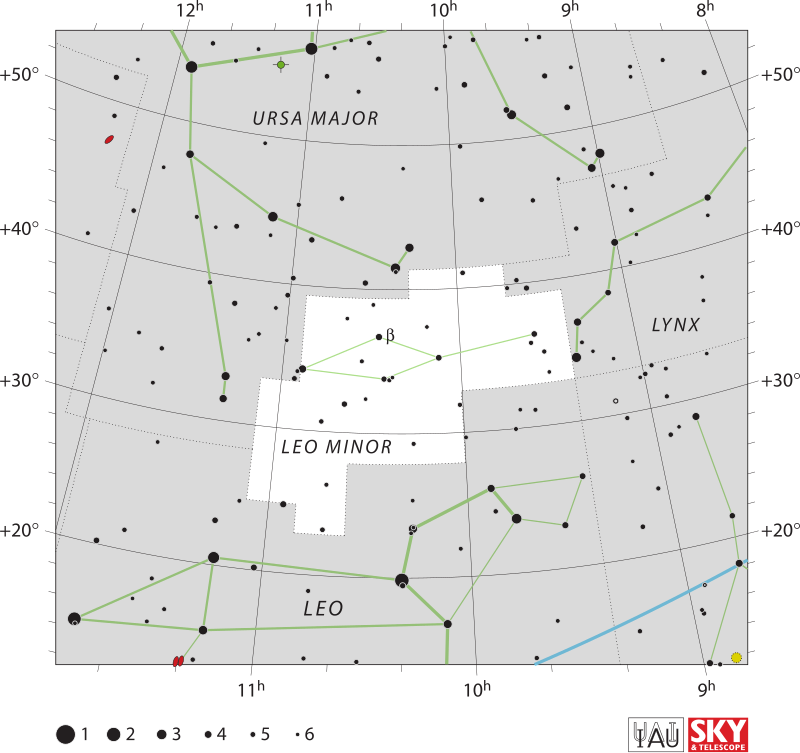
Leo Minor
constellation in the northern celestial hemisphere

Lynx
constellation in the northern celestial hemisphere