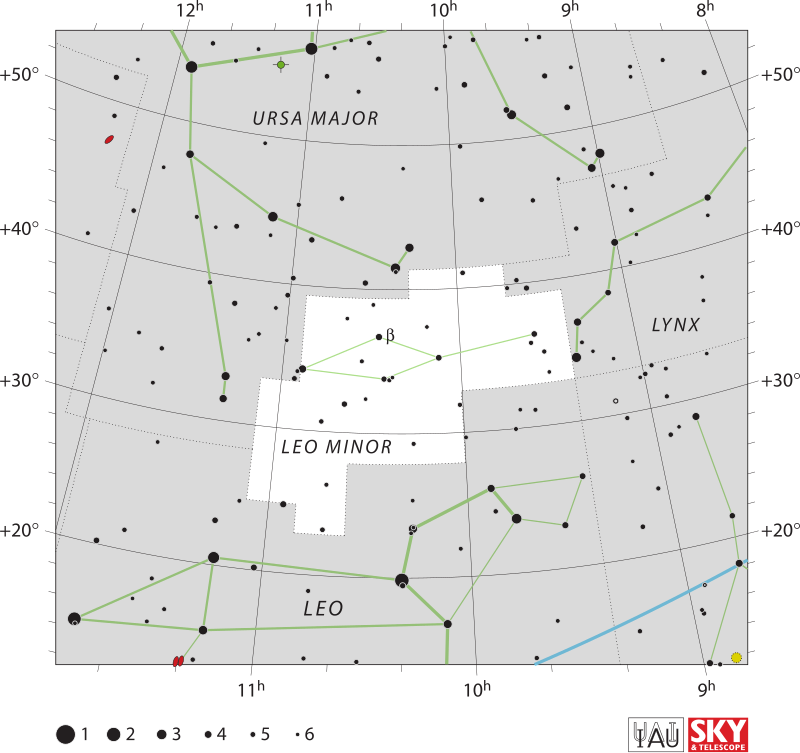
File:Leo_Minor_IAU.svg · Wikimedia Commons · See Wikimedia Commons
Leo Minor
Sign in to saveAlso known as the smaller lion, LMi, Leonis Minoris
constellation in the northern celestial hemisphere
Leo Minor is a small constellation located in the northern sky that is best visible during spring nights in the Northern Hemisphere. While it contains no particularly bright stars, it is one of the recognized constellations in astronomy and sits near the larger and more famous constellation Leo.
AI-generated from the Wikipedia summary — may contain errors.
Wikidata facts
- Instance of
- constellation
- Official name
- Leo Minor
- Area
- 232
- Shares border with
- Cancer
- Image
- LeoMinorCC.jpg
Show 9 more facts
- short name
- LMi
- discoverer or inventor
- Johannes Hevelius
- time of discovery or invention
- 1687-00-00
- maintained by WikiProject
- WikiProject Astronomy
- on focus list of Wikimedia project
- Wikipedia:Vital articles/Level/4
- native label
- Mały Lew
- Commons category
- Leo Minor
- topic's main category
- Category:Leo Minor
- Commons gallery
- Leo Minor
via Wikidata · CC0
~22 min read
Encyclopedic overview
Leo Minor is a small and faint constellation in the northern celestial hemisphere. Its name is Latin for "the smaller lion", in contrast to Leo, the larger lion. It lies between the larger and more recognizable Ursa Major to the north and Leo to the south. Leo Minor was not regarded as a separate constellation by classical astronomers; it was designated by Johannes Hevelius in 1687.
There are 37 stars brighter than apparent magnitude 6.5 in the constellation; three are brighter than magnitude 4.5. 46 Leonis Minoris, an orange giant of magnitude 3.8, is located some 95 light-years from Earth. At magnitude 4.4, Beta Leonis Minoris is the second-brightest star and the only one in the constellation with a Bayer designation. It is a binary star, the brighter component of which is an orange giant and the fainter a yellow-white main sequence star. The third-brightest star is 21 Leonis Minoris, a rapidly rotating white main-sequence star of average magnitude 4.5. The constellation also includes two stars with planetary systems, two pairs of interacting galaxies, and Hanny's Voorwerp, a unique deep-sky object.
Excerpted from Wikipedia’s “Leo Minor” article, available under the CC BY-SA 4.0 licence.
Gallery (4)
Available in 82 languages
- Español
- Français
- Deutsch
- 中文
- 日本語
- Русский
- Português
- Italiano
- العربية
- Afrikaans
- Armenian
- Asturian
- Azerbaijani
- Bahasa Indonesia
- Bashkir
- Basque
- be_x_old
- Belarusian
Show 63 more
- Bosnian
- Breton
- Bulgarian
- Burmese
- Catalan
- cdo
- Cornish
- Corsican
- Croatian
- Czech
- Danish
- Egyptian Arabic
- Esperanto
- Estonian
- Finnish
- Galician
- Georgian
- Greek
- Hakka Chinese
- Hebrew
- Hungarian
- Icelandic
- Irish
- Javanese
- Kazakh
- Kurdish
- Latin
- Latvian
- Lithuanian
- Luxembourgish
- Macedonian
- Malay
- Malayalam
- Manx
- Nederlands
- Northern Frisian
- Norwegian
- Norwegian Nynorsk
- olo
- Polski
- Romanian
- Serbian
- Serbian (Latin)
- simple
- Slovak
- Slovenian
- Svenska
- Swahili
- Tiếng Việt
- Türkçe
- Ukrainian
- Urdu
- Uzbek
- Waray
- Welsh
- Wu Chinese
- Yakut
- Zaza
- zh_min_nan
- zh_yue
- فارسی
- ไทย
- 한국어
via Wikidata sitelinks · CC0