Category
page 1Nuclear physics

atomic number
number of protons found in the nucleus of an atom

copernicium
Copernicium is a synthetic chemical element; it has symbol Cn and atomic number 112. Its known isotopes are extremely radioactive, and have only been created in a laboratory. The most stable known isotope, copernicium-285, has a half-life of approximately 30 seconds. Copernicium was first created in February 1996 by the GSI Helmholtz Centre for Heavy Ion Research near Darmstadt, Germany. It was named after the astronomer Nicolaus Copernicus on his 537th anniversary.

atomic nucleus
core of the atom; composed of bound nucleons (protons and neutrons)

isotope
thumb|300px|The three naturally occurring isotopes of hydrogen. The fact that each nuclide has 1 proton makes them all isotopes of [[hydrogen: the identity of the isotope is given by the number of protons and neutrons. From left to right, the isotopes are protium (H) with 0 neutrons, deuterium (H) with 1 neutron, and tritium (H) with 2 neutrons.]]

nuclear fission
nuclear reaction splitting an atom into multiple parts

strong interaction
force binding particles within the atomic nucleus

nuclear physics
field of physics that deals with the structure and behavior of atomic nuclei

nuclear fusion
nuclear reaction in which atomic nuclei combine

gamma ray
electromagnetic radiation of high frequency and high energy

hadron
thumb|upright=1.5|A hadron is a Composite particle|composite subatomic particle. Every hadron must fall into one of the two fundamental classes of particle, [[bosons and fermions.]]

nuclear reaction
process in which two nuclei collide to produce one or more nuclides
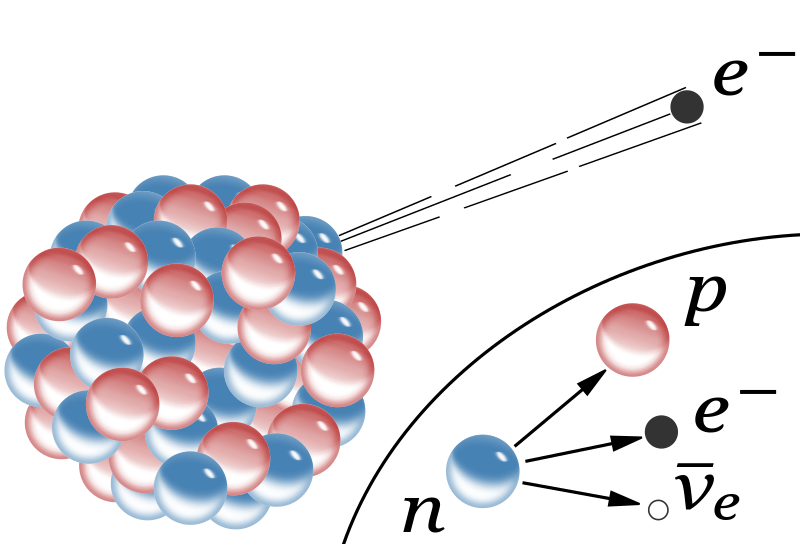
beta decay
emmision of beta particles by a decaying radioactive atom

radionuclide
thumb|Chart of known nuclides . The vast majority are radionuclides.

gray
SI unit of absorbed dose of ionizing radiation

alpha decay
emission of alpha particles by a decaying radioactive atom

nuclide
Nuclides (or nucleides, from nucleus; also known as nuclear species) are a class of atoms characterized by their number of protons, Z, their number of neutrons, N, and their nuclear energy state.

transuranium element
element whose atomic number is greater than 92

emission spectrum
frequencies of light emitted by atoms or chemical compounds

electron capture
process in which a proton-rich nuclide absorbs an inner atomic electron

nucleosynthesis
thumb|alt=Diagram|Diagram illustrating the creation of new elements by the
Nucleosynthesis is the process that creates new atomic nuclei from nucleons (protonsand neutrons) and nuclei. According to current theories, the first nuclei were formed a fewminutes after the through nuclear reactions in a process called BigBang nucleosynthesis. After about 20minutes, the universe had expanded and cooled to a point at which these collisions among nucleons ended, so only the fastest and simplest reactions occurred, leaving our universe containing hydrogen and helium, traces of other elements, such as l
nuclear force
force between nucleons

pair production
interaction of photon with matter resulting into ejection of electron-positron pair

scattering
thumb|A wine glass in an [[LCD projector's light beam makes the beam scatter.]]
In physics, scattering is a wide range of physical processes where moving particles or radiation of some form, such as light or sound, are forced to deviate from a straight trajectory by localized non-uniformities (including particles and radiation) in the medium through which they pass. In conventional use, this also includes deviation of reflected radiation from the angle predicted by the law of reflection. Reflections of radiation that undergo scattering are often called diffuse reflections and unscattered refle
nuclear binding energy
energy required to split an atom's nucleus into its component parts
baryon number
one third of the difference between the number of quarks and antiquarks in a system

nuclear transmutation
conversion of one chemical element or an isotope into another chemical element
heat of combustion
quantity measuring the energy per unit of mass or volume that some substance releases upon oxidation

synthetic element
chemical element that does not occur naturally on Earth, and can only be created artificially
binding energy
forms of energy
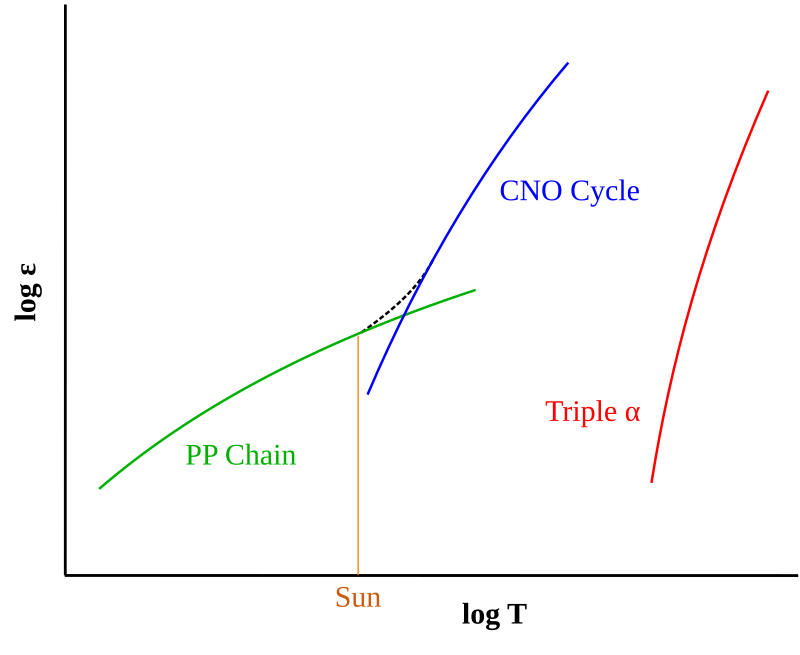
stellar nucleosynthesis
process by which the natural abundances of the chemical elements within stars change due to nuclear fusion reactions in the cores and their overlying mantles
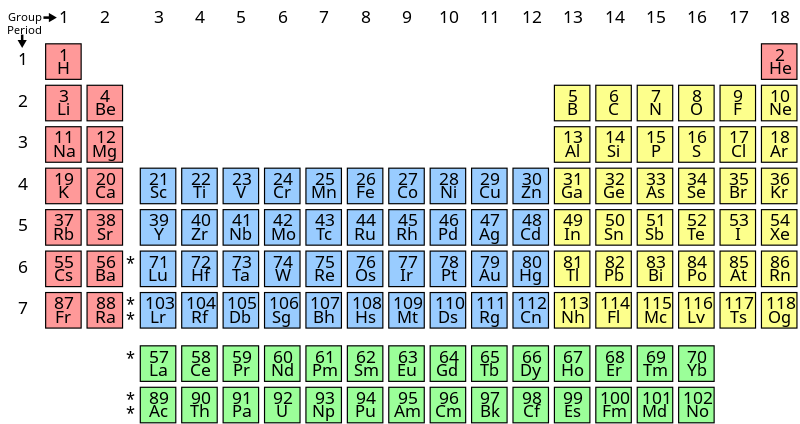
extended periodic table
refers to the extension on the periodic table beyond its current 7 periods including additional periods

nuclear chain reaction
one single nuclear reaction causes more subsequent nuclear reactions
isobar
class of nuclide
parity
flip in the sign of one spatial coordinate, in classical and quantum physics

cold fusion
hypothetical type of nuclear reaction
cross section
measure of probability that a specific process will take place in a collision of two particles
nuclear isomer
metastable excited state of a nuclide
island of stability
region of the chart of the nuclides containing isotopes of super-heavy elements theorized to be much more stable than others

isospin
In nuclear physics and particle physics, isospin is a quantum number related to the up- and down quark content of the particle.
Isospin is also known as isobaric spin or isotopic spin.
Isospin symmetry is a subset of the flavour symmetry seen more broadly in the interactions of baryons and mesons.
Mössbauer effect
resonant and recoil-free emission and absorption of gamma radiation by atomic nuclei

isotone
thumb|300px|Nuclide half-lives color-coded. In this chart, horizontal lines represent isotones.
spontaneous fission
form of radioactive decay found in very heavy chemical elements
decay energy
Energy change of a nucleus after radioactive decay
decay product
The remaining nuclide left over from radioactive decay
nuclear explosion
explosion that occurs as a result of rapid release of energy from a nuclear reaction (fission or fusion)
fissile material
material capable of sustaining a nuclear fission chain reaction
transactinide element
chemical elements with atomic numbers from 104 to 120
neutron capture
atomic nuclear process
radiation protection
protection of man and the environment against the harmful effects of ionizing radiation

tetraquark
In particle physics, a tetraquark is an exotic meson composed of four valence quarks. A tetraquark state has long been suspected to be allowed by quantum chromodynamics, the modern theory of strong interactions. A tetraquark state is an example of an exotic hadron that lies outside the conventional quark model classification. A number of different types of tetraquark have been observed.
neutron emission
decay where a neutron is ejected from the nucleus
Xi baryon
subatomic particle
Coulomb barrier
electrostatic energy barrier that must be overcome for nuclear reactions to occur

spallation
thumb|Spallation as a result of impact can occur with or without penetration of the impacting object.
internal conversion
radioactive decay process wherein an excited nucleus interacts electromagnetically with one of its electrons, causing it to be ejected from the atom
proton emission
radioactive decay where a proton is ejected from the nucleus

s-process
The slow neutron-capture process, or '''s-process', is a series of reactions in nuclear astrophysics that occur in stars, particularly asymptotic giant branch stars. The s''-process is responsible for the creation (nucleosynthesis) of approximately half the atomic nuclei heavier than iron.
r-process
In nuclear astrophysics, the rapid neutron-capture process, also known as the '''r-process', is a set of nuclear reactions that is responsible for the creation of approximately half of the atomic nuclei heavier than iron, the "heavy elements", with the other half produced largely by the s-process. The r-process synthesizes the more neutron-rich of the stable isotopes of even elements, and those separated from the beta-stable isotopes by those that are not often have very low s-process yields and are considered r-only nuclei; the heaviest isotopes of most even elements from zinc to mercury fall
effects of nuclear explosions
Type and severity of damage caused by nuclear weapons
double beta decay
decay mode