File:Beta-minus_Decay.svg · Wikimedia Commons · See Wikimedia Commons
beta decay
Sign in to saveAlso known as β-decay
emmision of beta particles by a decaying radioactive atom
Beta decay is when a radioactive atom releases a tiny, fast-moving particle called a beta particle as it breaks down into a different element. This process is important because it helps scientists understand radioactivity, develop medical treatments, and study the fundamental forces that hold atoms together.
AI-generated from the Wikipedia summary — may contain errors.
Wikidata facts
- Instance of
- decay mode
- Subclass of
- radioactive decay
- Image
- Beta-plus Decay.svg
Show 4 more facts
- Commons category
- Beta decay
- has effect
- beta radiation
- on focus list of Wikimedia project
- Wikipedia:Vital articles/Level/4
- different from
- beta particle
via Wikidata · CC0
~36 min read
Encyclopedic overview
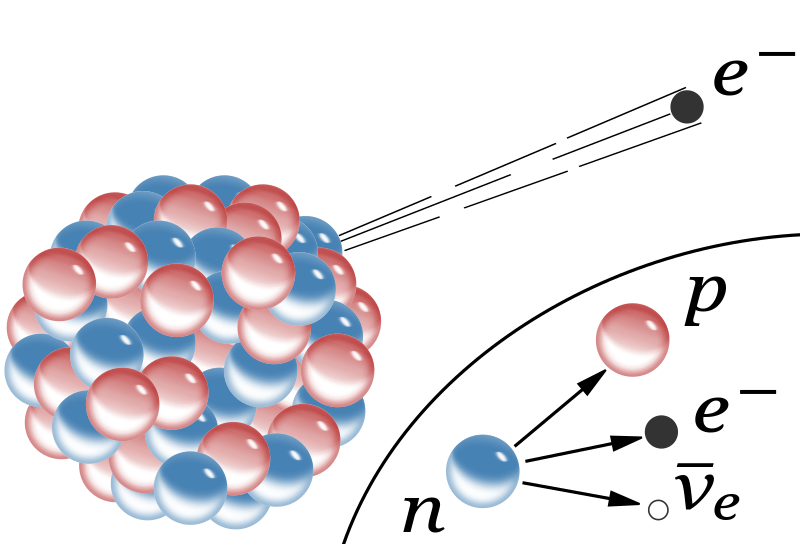
β decay in an atomic nucleus (the accompanying antineutrino is omitted). The inset shows beta decay of a free neutron. Neither of these depictions shows the intermediate virtual W boson.
In nuclear physics, beta decay (β-decay) is a type of radioactive decay in which an atomic nucleus emits a beta particle (fast energetic electron or positron), transforming into an isobar of that nuclide. For example, beta decay of a neutron transforms it into a proton by the emission of an electron accompanied by an antineutrino; or, conversely a proton is converted into a neutron by the emission of a positron with a neutrino in what is called positron emission. Neither the beta particle nor its associated (anti-)neutrino exist within the nucleus prior to beta decay, but are created in the decay process. By this process, unstable atoms obtain a more stable ratio of protons to neutrons. The probability of a nuclide decaying due to beta and other forms of decay is determined by its nuclear binding energy. The binding energies of all existing nuclides form what is called the nuclear band or valley of stability. For either electron or positron emission to be energetically possible, the energy release or Q value must be positive.
Excerpted from Wikipedia’s “beta decay” article, available under the CC BY-SA 4.0 licence.
Gallery (8)
Available in 68 languages
- Español
- Français
- Deutsch
- 中文
- 日本語
- Русский
- Português
- Italiano
- العربية
- हिन्दी
- Afrikaans
- Aragonese
- Armenian
- Asturian
- azb
- Bahasa Indonesia
- Bangla
- Basque
Show 49 more
- Belarusian
- Bulgarian
- Catalan
- Croatian
- Danish
- Esperanto
- Estonian
- Finnish
- Galician
- Georgian
- Greek
- Hebrew
- Hungarian
- Icelandic
- Ido
- Irish
- Kazakh
- Kyrgyz
- Latvian
- Lithuanian
- Low German
- Macedonian
- Malay
- Nederlands
- Norwegian
- Norwegian Nynorsk
- Polski
- Punjabi
- Romanian
- Serbian
- Serbian (Latin)
- simple
- Sinhala
- Slovak
- Slovenian
- Svenska
- Tajik
- Tamil
- Tatar
- Tiếng Việt
- Türkçe
- Ukrainian
- Urdu
- Uzbek
- Wu Chinese
- zh_yue
- فارسی
- ไทย
- 한국어
via Wikidata sitelinks · CC0