Category
page 1Nucleic acids

deoxyribonucleic acid
thumb|right|upright=1.33|The structure of the DNA double helix (type [[B-DNA). The atoms in the structure are colour-coded by element and the detailed structures of two base pairs are shown in the bottom right.]] thumb|Simplified diagram

ribonucleic acid
thumb|A hairpin loop from a pre-mRNA. Highlighted are the nucleobases (green) and the ribose-phosphate backbone (blue). This is a single strand of RNA that folds back upon itself.

nucleic acids
large biomolecules essential to known life
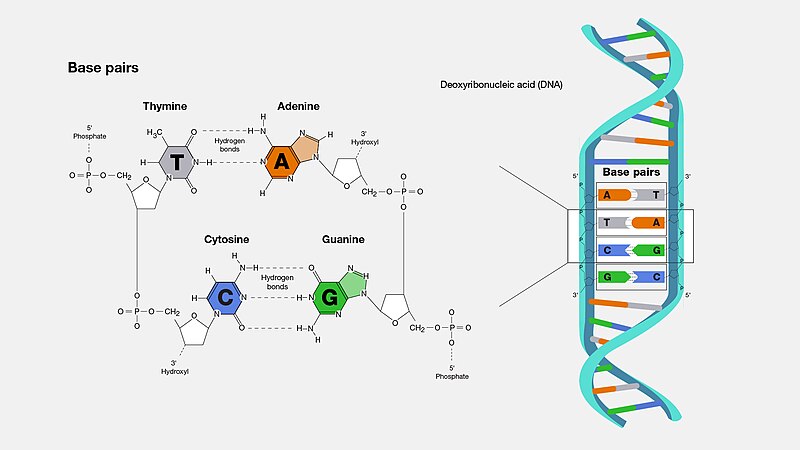
base pair
unit consisting of two nucleobases bound to each other by hydrogen bonds: either adenine–thymine or guanine–cytosine in natural DNA (additional types occur in RNA)

denaturation
chemical process by which proteins lose their three-dimensional structure
nucleic acid sequence
succession of letters that indicate the order of nucleotides within a DNA (using GACT) or RNA (GACU) molecule
non-coding RNA
class of RNA that is not translated into proteins
oligonucleotide
Oligonucleotides are short DNA or RNA molecules, oligomers, that have a wide range of applications in genetic testing, research, and forensics. Commonly made in the laboratory by solid-phase chemical synthesis, these small fragments of nucleic acids can be manufactured as single-stranded molecules with any user-specified sequence, and so are vital for artificial gene synthesis, polymerase chain reaction (PCR), DNA sequencing, molecular cloning and as molecular probes. In nature, oligonucleotides are usually found as small RNA molecules that function in the regulation of gene expression (e.g. m
Template:Nucleic acids
Wikimedia template
peptide nucleic acid
biological molecule

aptamer
thumb|425x170 px|Left: Unbound aptamer. Right: the aptamer bound to its target protein. The protein is in yellow. Parts of the aptamer that change shape when it binds its target are in blue, while the unchanging parts are in orange. The parts of the aptamer that contact the protein are highlighted in red.
exosome (RNase complex)
multi-protein intracellular complex capable of degrading various types of RNA molecules
nucleoside triphosphate
class of chemical compounds
structural motif
(in a chain-like biological molecule, such as a protein or nucleic acid) supersecondary structure, which also appears in a variety of other molecules
glycol nucleic acid
polymer similar to DNA
threose nucleic acid
chemical compound
conserved sequence
similar DNA, RNA or protein sequences within genomes or among species
nucleic acid analogue
compound which is analogous (structurally similar) to naturally occurring RNA and DNA, used in medicine and in molecular biology research
nucleic acid structure
organization of DNA and RNA molecules at different scales
nucleic acid secondary structure
basepairing interactions within a single nucleic acid polymer or between two polymers, list of bases which are paired in a nucleic acid molecule
Morpholino
chemical compound
wobble base pair
RNA base pair that does not follow Watson-Crick base pair rules; guanine–uracil (G-U), hypoxanthine–uracil (I-U), hypoxanthine–adenine (I-A), or hypoxanthine–cytosine (I-C)
xeno nucleic acid
group of compounds
nucleic acid thermodynamics
The study of how temperature affects the nucleic acid structure of double-stranded DNA (dsDNA)
nucleic acid tertiary structure
three-dimensional shape of a nucleic acid polymer
Molecular Structure of Nucleic Acids: A Structure for Deoxyribose Nucleic Acid
article published 1953 describing the structure of DNA
locked nucleic acid
modified RNA nucleotide in which the ribose moiety is modified with an extra bridge connecting the 2' oxygen and 4' carbon, providing increased stability against enzymatic degradation
pyrimidine dimers
type of DNA damage
Hoogsteen base pair
variation of base-pairing in nucleic acids
Nucleic acid quaternary structure
Interactions between nucleic acid modules
nucleic acid metabolism
virome
Virome refers to the assemblage of viruses that is often investigated and described by metagenomic sequencing of viral nucleic acids that are found associated with a particular ecosystem, organism or holobiont. The word is frequently used to describe environmental viral shotgun metagenomes. Viruses, including bacteriophages, are found in all environments, and studies of the virome have provided insights into nutrient cycling, development of immunity, and a major source of genes through lysogenic conversion. Also, the human virome has been characterized in nine organs (colon, liver, lung, heart
nucleic acid methods
techniques used to study nucleic acids: DNA and RNA
K-mer
thumb|The sequence ATGG has two 3-mers: ATG and TGG.
In bioinformatics, '''k-mers' are substrings of length k contained within a biological sequence. Primarily used within the context of computational genomics and sequence analysis, in which k-mers are composed of nucleotides (i.e. A, T, G, and C), k-mers are capitalized upon to assemble DNA sequences, improve heterologous gene expression, identify species in metagenomic samples, and create attenuated vaccines. Usually, the term k''-mer refers to all of a sequence's subsequences of length k, such that the sequence AGAT would have four monomers
double-stranded RNA
type of RNA
nucleic acid notation
universally accepted notation uses the Roman characters G, C, A, and T, to represent the four nucleotides commonly found in DNA
expanded genetic code
Modified genetic code