File:Pre-mRNA-1ysv-tubes.png · Wikimedia Commons · See Wikimedia Commons
ribonucleic acid
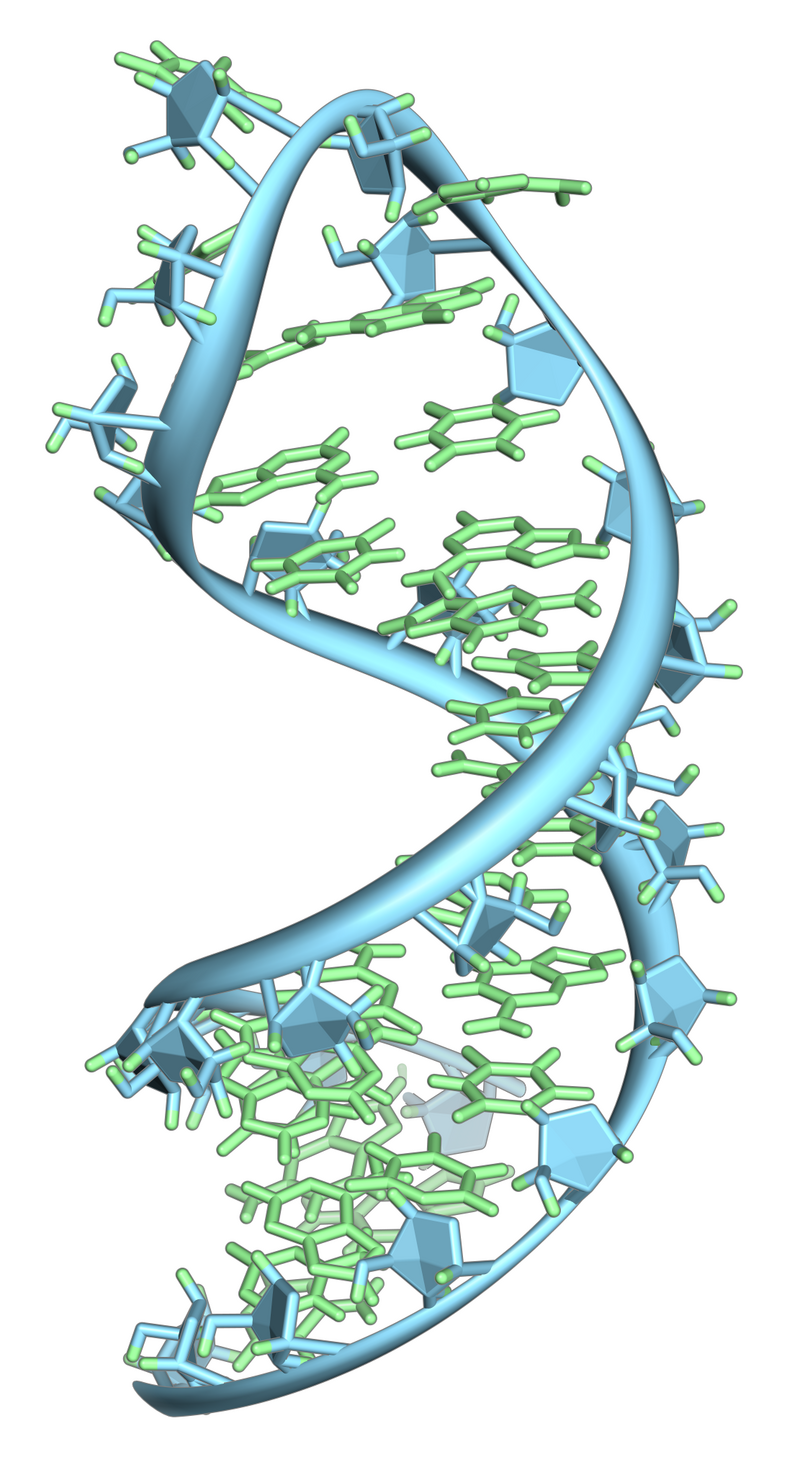
Sign in to savethumb|A hairpin loop from a pre-mRNA. Highlighted are the nucleobases (green) and the ribose-phosphate backbone (blue). This is a single strand of RNA that folds back upon itself.
Ribonucleic acid (RNA) is a molecule made up of a sugar-phosphate backbone with nucleobases attached, similar in structure to DNA but typically existing as a single strand that can fold back on itself. RNA plays a crucial role in cells by helping to decode genetic information and carry out the instructions stored in DNA.
AI-generated from the Wikipedia summary — may contain errors.
Research
1,537,216 papers- Infectious ribonucleic acid.Survey of biological progress · 1962FRAENKEL-CONRAT H
- Synthesis of ribonucleic acid.Nature · 1958MICHELSON AMDOI: 10.1038/181303a0
- Ribonucleic acid and bacterial genetics.British medical bulletin · 1962BROWN GLDOI: 10.1093/oxfordjournals.bmb.a069925
- Ribonucleic acid from Escherichia coli; preparation, characterization and physical properties.Biochimica et biophysica acta · 1959LITTAUER UZ, EISENBERG HDOI: 10.1016/0006-3002(59)90604-3
- Actionmycin D inhibition of deoxyribonucleic acid-dependent synthesis of ribonucleic acid.Science (New York, N.Y.) · 1962GOLDBERG IH, RABINOWITZ MDOI: 10.1126/science.136.3513.315
- Ribonucleic acid-induced changes in mammalian cells.Proceedings of the National Academy of Sciences of the United States of America · 1961NIU MC, CORDOVA CC, NIU LCDOI: 10.1073/pnas.47.10.1689
- Studies on the role of ribonucleic acid in the growth of bacteria.Biochimica et biophysica acta · 1960NEIDHARDT FC, MAGASANIK BDOI: 10.1016/0006-3002(60)90757-5
- Fractionation of transfer ribonucleic acid.Biochimica et biophysica acta · 1959SMITH KC, CORDES E, SCHWEET RSDOI: 10.1016/0006-3002(59)90541-4
via PubMed
Wikidata facts
- Image
- RNA pol.jpg
Show 6 more facts
- Commons category
- RNA
- topic's main category
- Category:RNA
- Commons gallery
- RNA
- topic has template
- Template:Types of RNA
- short name
- RNA
- on focus list of Wikimedia project
- Wikipedia:Vital articles/Level/4
via Wikidata · CC0
~26 min read
Encyclopedic overview
28 sectionsContents
- Chemical structure of RNA
- Basic chemical composition
- Differences between DNA and RNA
- Secondary and tertiary structures
- Chemical modifications
- Types of RNA
- RNAs involved in protein synthesis
- Regulatory RNA
- MicroRNA (miRNA) and small interfering RNA (siRNA)
- Long non-coding RNAs
- Enhancer RNAs
- Small RNA in prokaryotes
- Small RNA
- CRISPR RNA
- RNA synthesis and processing
- Synthesis
- RNA processing
- RNA in genetics
- RNA genomes
- Reverse transcription
- Double-stranded RNA
- Circular RNA
- Key discoveries in RNA biology
- Relevance for prebiotic chemistry and abiogenesis
- Medical applications
- See also
- References
- External links
thumb|A hairpin loop from a pre-mRNA. Highlighted are the nucleobases (green) and the ribose-phosphate backbone (blue). This is a single strand of RNA that folds back upon itself.
Ribonucleic acid (RNA) is a polymeric molecule that is essential for most biological functions, either by performing the function itself (non-coding RNA) or by forming a template for the production of proteins (messenger RNA). RNA and deoxyribonucleic acid (DNA) are nucleic acids. The nucleic acids constitute one of the four major macromolecules essential for all known forms of life. RNA is assembled as a chain of nucleotides. Cellular organisms use messenger RNA (mRNA) to convey genetic information (using the nitrogenous bases of guanine, uracil, adenine, and cytosine, denoted by the letters G, U, A, and C) that directs synthesis of specific proteins. Many viruses encode their genetic information using an RNA genome.
Excerpted from Wikipedia’s “ribonucleic acid” article, available under the CC BY-SA 4.0 licence.
Gallery (31)
Available in 118 languages
- Español
- Français
- Deutsch
- 中文
- 日本語
- Русский
- Português
- Italiano
- العربية
- हिन्दी
- Afrikaans
- Albanian
- Amharic
- Aragonese
- Armenian
- Asturian
- azb
- Azerbaijani
Show 99 more
- Bahasa Indonesia
- Balinese
- Bangla
- Bashkir
- Basque
- be_x_old
- Belarusian
- Bikol
- Bosnian
- Breton
- Bulgarian
- Catalan
- Central Kurdish
- Chuvash
- Croatian
- Czech
- Danish
- Esperanto
- Estonian
- Extremaduran
- Faroese
- Filipino
- Finnish
- Galician
- gcr
- Georgian
- Gorontalo
- Greek
- Haitian Creole
- Hebrew
- Hungarian
- Icelandic
- Ido
- Inari Sami
- Interlingua
- Irish
- Javanese
- Kannada
- Kazakh
- Kurdish
- Kyrgyz
- Lao
- Latin
- Latvian
- Lithuanian
- Lombard
- Luxembourgish
- Macedonian
- Madurese
- Malay
- Malayalam
- Marathi
- Mingrelian
- Mongolian
- Nederlands
- Nepali
- Northern Frisian
- Norwegian
- Norwegian Nynorsk
- Occitan
- Oromo
- Pashto
- Piedmontese
- Polski
- Romanian
- Rusyn
- Sardinian
- Serbian
- Serbian (Latin)
- Sicilian
- simple
- Sinhala
- skr
- Slovak
- Slovenian
- Somali
- Sundanese
- Svenska
- Swahili
- Tamil
- Tatar
- Telugu
- Tiếng Việt
- Türkçe
- Ukrainian
- Urdu
- Uzbek
- Venetian
- Waray
- Welsh
- Western Panjabi
- Wu Chinese
- Yoruba
- zh_min_nan
- zh_yue
- Zulu
- فارسی
- ไทย
- 한국어
via Wikidata sitelinks · CC0