File:DNA_base-pair_diagram.jpg · Wikimedia Commons · See Wikimedia Commons
base pair
Sign in to saveAlso known as bp, pb
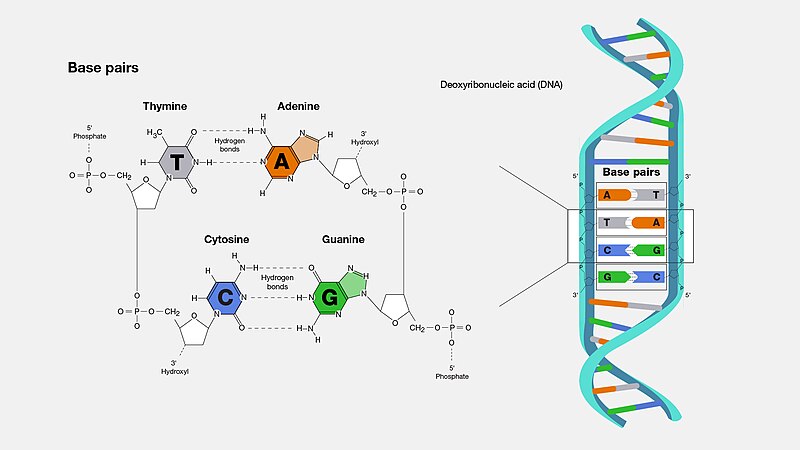
unit consisting of two nucleobases bound to each other by hydrogen bonds: either adenine–thymine or guanine–cytosine in natural DNA (additional types occur in RNA)
A base pair is two nucleobases (the building blocks of DNA) linked together by chemical bonds, with adenine always pairing with thymine and guanine always pairing with cytosine. Base pairs matter because they form the rungs of DNA's double helix structure and determine how genetic information is stored and copied.
AI-generated from the Wikipedia summary — may contain errors.
Wikidata facts
Show 3 more facts
- Commons category
- Base pairing
- unit symbol
- pb
- Wikidata SPARQL query equivalent
- wd:Q145911 p:P2370/psn:P2370 [wikibase:quantityAmount ?source; wikibase:quantityUnit ?base]. ?item p:P2370/psn:P2370 [wikibase:quantityAmount ?target; wikibase:quantityUnit ?base]. BIND(?source / ?target as ?value)
Sources (3)
via Wikidata · CC0
~18 min read
Encyclopedic overview
The chemical structure of DNA base-pairs A base pair (bp) is a fundamental unit of double-stranded nucleic acids consisting of two nucleobases bound to each other by hydrogen bonds. They form the building blocks of the DNA double helix and contribute to the folded structure of both DNA and RNA. Dictated by specific hydrogen bonding patterns, "Watson–Crick" (or "Watson–Crick–Franklin") base pairs (guanine–cytosine and adenine–thymine/uracil) allow the DNA helix to maintain a regular helical structure that is subtly dependent on its nucleotide sequence. The complementary nature of this based-paired structure provides a redundant copy of the genetic information encoded within each strand of DNA. The regular structure and data redundancy provided by the DNA double helix make DNA well suited to the storage of genetic information, while base-pairing between DNA and incoming nucleotides provides the mechanism through which DNA polymerase replicates DNA and RNA polymerase transcribes DNA into RNA. Many DNA-binding proteins can recognize specific base-pairing patterns that identify particular regulatory regions of genes.
Intramolecular base pairs can occur within single-stranded nucleic acids. This is particularly important in RNA molecules (e.g., transfer RNA), where Watson–Crick base pairs (guanine–cytosine and adenine-uracil) permit the formation of short double-stranded helices, and a wide variety of non–Watson–Crick interactions (e.g., G–U or A–A) allow RNAs to fold into a vast range of specific three-dimensional structures. In addition, base-pairing between transfer RNA (tRNA) and messenger RNA (mRNA) forms the basis for the molecular recognition events that result in the nucleotide sequence of mRNA becoming translated into the amino acid sequence of proteins via the genetic code.
Excerpted from Wikipedia’s “base pair” article, available under the CC BY-SA 4.0 licence.