Category
page 1Organic polymers

polymer
thumb|upright=0.8|Appearance of real linear polymer chains as recorded using an atomic force microscope on a surface, under liquid medium. Chain [[contour length for this polymer is ~204 nm; thickness is ~0.4 nm.]]

tannin
thumb|Representative chemical structure of a tannic acid, a type of tannin
thumb|Tannin powder (mixture of compounds)
thumb|A bottle of tannic acid solution in [[water ]]

polystyrene
thumb|Expanded polystyrene packaging
thumb|A polystyrene yogurt container
thumb|Bottom of a vacuum forming|vacuum-formed cup; fine details such as the glass and fork [[food contact materials symbol and the resin identification code symbol are easily molded]]

Kevlar
Kevlar (para-aramid) is a strong, heat-resistant synthetic fiber, related to other aramids such as Nomex and Technora. Developed by Stephanie Kwolek at DuPont in 1965, the high-strength material was first used commercially in the early 1970s as a replacement for steel in racing tires. It is typically spun into ropes or fabric sheets that can be used as such, or as an ingredient in composite material components.
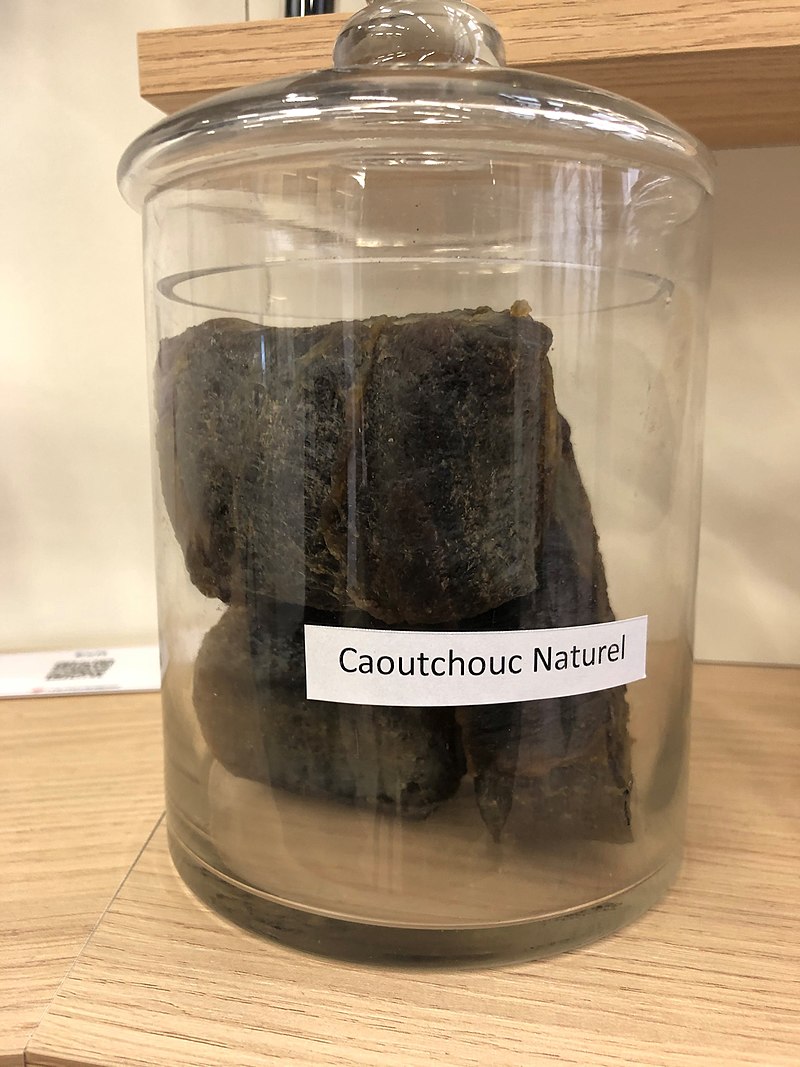
natural rubber
polymers of the organic compound isoprene, with minor impurities of other organic compounds; refined from latex harvested from rubber trees

epoxy resins
thumb|A syringe of "5-minute" epoxy glue, containing separate compartments for the epoxy resin and the hardener
thumb|Structure of the epoxide group, a reactive functional group present in all epoxy resins

ebonite
thumb|Ebonite applications from the 19th century
rayon
thumb|Rayon is made by dissolving cellulose and then precipitating it into a fiber. One method is shown here using a blue solution of cellulose (Schweizer's reagent|cuprammonium hydroxide used to dissolve) and colorless sulfuric acid to precipitate. The blue color fades from the fiber over time.

tholin
thumb|Neverland Regio, a dark region on Charon's north pole. The region is stained a dark brown by deposits of tholins
Tholins (after the Greek ('''') "hazy" or "muddy"; from the ancient Greek word meaning "sepia ink") are a wide variety of organic compounds formed by solar ultraviolet or cosmic ray irradiation of simple carbon-containing compounds such as carbon dioxide (), methane () or ethane (), often in combination with nitrogen () or water (). Tholins are disordered polymer-like materials made of repeating chains of linked subunits and complex combinations of functional groups, typically

polyol
In organic chemistry, a polyol is an organic compound containing multiple hydroxyl groups (). The term "polyol" can have slightly different meanings depending on whether it is used in food science or polymer chemistry. Polyols containing two, three and four hydroxyl groups are diols, triols, and tetrols, respectively.
synthetic rubber
any artificial elastomer

aramid
thumb|right|Spools of aramid yarn destined for body armor
thumb|right|Fiberglass–aramid hybrid cloth
Aramid, or aromatic polyamide fibers are a class of strong, heat-resistant, synthetic fibers, commonly used in aerospace and military applications - e.g., ballistic-rated body armor fabric and ballistic composites, marine cordage and hull reinforcement - as a substitute for asbestos, and in lightweight consumer items, such as phone cases and tennis rackets.
polynucleotide
In molecular biology, a polynucleotide () is a biopolymer composed of nucleotide monomers that are covalently bonded in a chain. DNA (deoxyribonucleic acid) and RNA (ribonucleic acid) are examples of polynucleotides with distinct biological functions. DNA consists of two chains of polynucleotides, with each chain in the form of a helix (like a spiral staircase).

polybutadiene
thumb|About 70% of polybutadiene is used in tire manufacturing.

Manilkara bidentata
species of plant
%20V1.png)
polyimide
thumb|right|Chemical structure of Kapton, a polyimide.
Polyimide (sometimes abbreviated PI) is a polymer containing imide groups belonging to the class of high-performance plastics. With their high heat-resistance, polyimides enjoy diverse applications in roles demanding rugged organic materials, such as high temperature fuel cells, displays, and various military roles. A classic polyimide is Kapton, which is produced by condensation of pyromellitic dianhydride and 4,4'-oxydianiline.

polycaprolactone
thumb|PCL beads, as sold for industrial or hobbyist use.
Polycaprolactone (PCL) is a synthetic, semi-crystalline, biodegradable polyester with a melting point of about 60 °C and a glass transition temperature of about −60 °C. The most common use of polycaprolactone is in the production of speciality polyurethanes. Polycaprolactones impart good resistance to water, oil, solvent and chlorine to the polyurethane produced.

polyacetylene
Polyacetylene (IUPAC name: polyethyne) usually refers to an organic polymer with the repeating unit . The name refers to its conceptual construction from polymerization of acetylene to give a chain with repeating olefin groups (a conjugated polyene). This compound is conceptually important, as the discovery of polyacetylene and its high conductivity upon doping helped to launch the field of organic conductive polymers. The high electrical conductivity discovered by Hideki Shirakawa, Alan Heeger, and Alan MacDiarmid for this polymer led to intense interest in the use of organic compounds in mic
polyether ether ketone
semicrystalline thermoplastic with high mechanical and chemical resistance

polyisoprene
alt=Pieces of polyisoprene in a jar|thumb|upright|Pieces of polyisoprene in Hutchinson SA|Hutchinson's Research and Innovation center in France

sporopollenin
thumb|right|270px|Scanning electron microscope (SEM) image of [[pollen grains]]
poly(p-phenylene sulfide)
polymer
Polyaniline
thumb|right|400px|Space-filling model of the local structure of a polyaniline chain in the reduced leucoemeraldine base (LEB) oxidation state, based on the crystal structure of the tetramer.
butyl rubber
synthetic rubber; a copolymer of isobutylene with isoprene

polypyrrole
class=skin-invert-image|thumb|Polypyrrole
class=skin-invert-image|thumb|Pyrrole can be polymerised electrochemically.
Polypyrrole (PPy) is an organic polymer obtained by oxidative polymerization of pyrrole. It is a solid with the formula H(C4H2NH)nH. It is an intrinsically conducting polymer, used in electronics, optical, biological and medical fields.
molecular electronics
branch of chemistry and electronics
Polymethylpentene
Polymethylpentene (PMP), also known as poly(4-methyl-1-pentene). It is used for gas-permeable packaging, autoclavable medical and laboratory equipment, microwave components, and cookware. It is commonly called TPX, which is a trademark of Mitsui Chemicals.
polystyrene sulfonate
polymer
polyglycerol polyricinoleate
chemical compound
melamine resin
resin based on melamine and formaldehyde that forms a hard thermoset plastic
hydroxyl-terminated polybutadiene
oligomer of butadiene

Polythiophene
thumb|The monomer repeat unit of unsubstituted polythiophene.
thumb|Polythiophenes demonstrate interesting optical properties resulting from their conjugated backbone, as demonstrated by the fluorescence of a substituted polythiophene solution under UV irradiation.
thumb|Space-filling model of poly(3-butylthiophene) from the crystal structure.
thumb|Atomic force microscopy|AFM image of poly(3-decylthiophene-2,5-diyl) on hexagonal [[boron nitride (top-right inset).]]
polyisobutene
Polyisobutene (polyisobutylene) is a class of organic polymers prepared by polymerization of isobutene. The polymers often have the formula Me3C[CH2CMe2]nH (Me = CH3). They are typically colorless gummy solids.
artificial silk
any synthetic fiber which resembles silk
poly(p-phenylene oxide)
polymer

Starlite
thumb|270px|White sands test sample, owned by Thermashield, LLC
patiromer
Patiromer, sold under the brand name Veltassa, is a medication used to treat high blood potassium. It is taken by mouth. It works by binding potassium in the GI tract.
Styrofoam
thumb|Styrofoam insulation extruded polystyrene foam (XPS), owned and manufactured by DuPont
Styrofoam is a brand of closed-cell extruded polystyrene foam (XPS), manufactured to provide continuous building insulation board used in walls, roofs, and foundations as thermal insulation and as a water barrier. This material is light blue in color and is owned and manufactured by DuPont. DuPont also has produced a line of green and white foam shapes for use in crafts and floral arrangements.
polyhexamethylene guanidine
polymer
Poly(p-phenylene vinylene)
polymer
lignosulfonates
Lignosulfonates (LS) are water-soluble anionic polyelectrolyte polymers: they are byproducts from the production of wood pulp using sulfite pulping. LS's are used for emulsion stabilization and Dispersants,a binder to suppresses dust on unpaved roads, and in water treatment.
acrylonitrile styrene acrylate
chemical compound
anoxomer
Anoxomer is a food additive with E number E323. It is a non-digestible polymeric antioxidant. It was designed to allow the introduction of established antioxidants in a non-absorbable manner in order to avoid potential health risk associated with their digestion.
Polyketone
thumb|right|General chemical structure of a polyketone. In practice, R is usually H.
Polyketones are a family of high-performance thermoplastic polymers. The polar ketone groups in the polymer backbone of these materials gives rise to a strong attraction between polymer chains, which increases the material's melting point (255 °C for copolymer (carbon monoxide ethylene), 220 °C for terpolymer (carbon monoxide, ethylene, propylene). Trade names include Poketone, Carilon, Karilon, Akrotek, and Schulaketon. Such materials also tend to resist solvents and have good mechanical properties.
polybenzimidazole
Polybenzimidazole (PBI, short for 'poly[2,2’-(m-phenylen)-5,5’-bisbenzimidazole]') fiber is a synthetic fiber with a very high decomposition temperature. It does not exhibit a melting point, does not readily ignite, and has exceptional thermal and chemical stability. It was first discovered in 1961, by American polymer chemist Carl Shipp Marvel in the pursuit of new materials with superior stability, retention of stiffness, and toughness at elevated temperature. Due to its high stability, polybenzimidazole is used to fabricate high-performance protective apparel such as firefighter's gear, ast
dialdehyde starch
chemical compound
Vinyl polymer
group of polymers derived from substituted vinyl monomers
Cutan
Biopolymere
Twaron
Twaron (a brand name of Teijin Aramid) is a para-aramid, high-performance yarn. It is a heat-resistant fibre, helps in ballistic protection and cut protection. Twaron was developed in the early 1970s by the Dutch company Akzo Nobel's division Enka BV, later Akzo Industrial Fibers. The research name of the para-aramid fibre was originally Fiber X, but it was soon called Arenka. Although the Dutch para-aramid fiber was developed only a short time after DuPont's Kevlar, the introduction of Twaron as a commercial product came much later than Kevlar due to financial problems at the Akzo company in
poly(methacrylic acid)
chemical compound
Polybrene
chemical compound
Poly(3,4-ethylenedioxythiophene)
thumb|right|200px|PEDOT
Poly(3,4-ethylenedioxythiophene) (PEDOT or PEDT; IUPAC name poly(2,3-dihydrothieno[3,4-b][1,4]dioxane-5,7-diyl)) is a conducting polymer based on 3,4-ethylenedioxythiophene or EDOT. It was first reported by Bayer AG in 1989.
PEDOT:PSS
thumb|PEDOT:PSS
thumb|Electrochromic switching in two PEDOT:PSS [[electrodes connected by a piece of PhastGel SDS buffer strips. The electrodes were reversibly and repeatedly oxidized and reduced by switching the polarity of an applied 1 V potential. This was observed by a color change between dark (reduced PEDOT) and light (oxidized PEDOT) blue within the electrodes, demonstrating the transport of ions between and into the electrodes.]]
dextranomer
Dextranomer (trade name Debrisan, Exudex) is a cicatrizant used in dressings for wound healing, and in pharmaceutical products to treat fecal incontinence. It consists of dextran polymer chains cross-linked into a three-dimensional network.
polyDADMAC
Polydiallyldimethylammonium chloride (shortened polyDADMAC or polyDDA), also commonly polyquaternium-6, is a homopolymer of diallyldimethylammonium chloride (DADMAC). The molecular weight of polyDADMAC is typically in the range of hundreds of thousands of grams per mole, and even up to a million for some products. PolyDADMAC is usually delivered as a liquid concentrate having a solids level in the range of 10 to 50%. It is a high charge density cationic polymer. The charge density makes it well suited for flocculation. Actually, pDADMAC or DMDAAC, is used as a coagulant - a charge neutralizati