Category
page 1Oxide minerals

ruby
thumb|upright=1.25|The main ruby-producing countries

sapphire
thumb|upright=1.25|Main sapphire-producing countries

corundum
Corundum is a crystalline form of aluminium oxide () typically containing traces of iron, titanium, vanadium, and chromium. It is a rock-forming mineral. It is a naturally transparent material, but can have different colors depending on the presence of transition metal impurities in its crystalline structure. Corundum has two primary gem varieties: ruby and sapphire. Rubies are red due to the presence of chromium, and sapphires exhibit a range of colors depending on what transition metal is present. A rare type of sapphire, padparadscha sapphire, is pink-orange.

hematite
Hematite (), also spelled as haematite, is a common iron oxide compound with the formula Fe2O3 and is widely found in rocks and soils. Hematite crystals belong to the rhombohedral lattice system which is designated the alpha polymorph of . It has the same crystal structure as corundum () and ilmenite (). With this crystal structure geometry it forms a complete solid solution at temperatures above .
lime
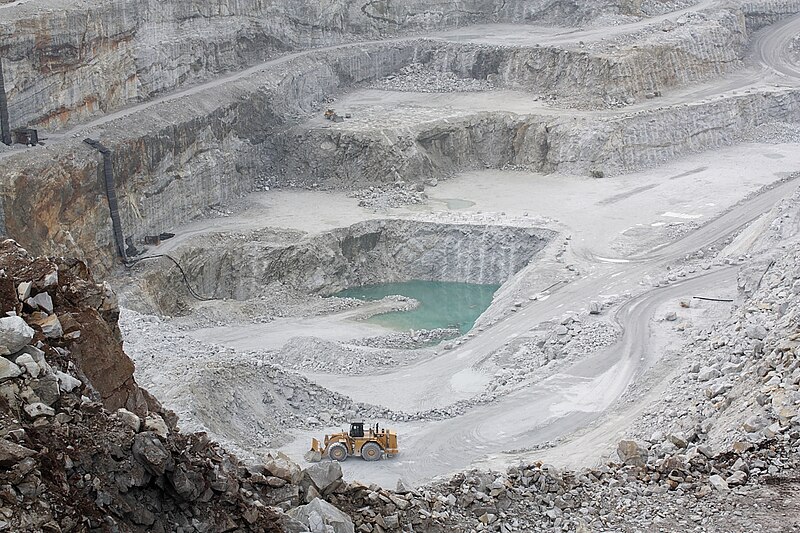
calcium oxide or hydroxide

rutile
Rutile is an oxide mineral composed of titanium dioxide (TiO2), the most common natural form of TiO2. Rarer polymorphs of TiO2 are known, including anatase, akaogiite, and brookite.

uraninite
Uraninite, also known as pitchblende, is a radioactive, uranium-rich mineral and ore with a chemical composition that is largely UO2 but because of oxidation typically contains variable proportions of U3O8. Radioactive decay of the uranium causes the mineral to contain oxides of lead and trace amounts of helium. It may also contain thorium and rare-earth elements.

ilmenite
Ilmenite is a titanium-iron(II) oxide mineral with the idealized formula . It is a weakly magnetic black or steel-gray solid. Ilmenite is the most important ore of titanium and the main source of titanium dioxide, which is used as white pigment in paints, printing inks, fabrics, plastics, paper, sunscreen, food and cosmetics.

cassiterite
Cassiterite is a tin oxide mineral, SnO2. It is generally opaque, but it is translucent in thin crystals. Its luster and multiple crystal faces produce a desirable gem. Cassiterite was the chief tin ore throughout ancient history and remains the most important source of tin today.

chrysoberyl
thumb|Main chrysoberyl producing countries

pyrolusite
Pyrolusite is a mineral consisting essentially of manganese dioxide (MnO2) and is important as an ore of manganese. It is a black, amorphous appearing mineral, often with a granular, fibrous, or columnar structure, sometimes forming reniform crusts. It has a metallic luster, a black or bluish-black streak, and readily soils the fingers. The specific gravity is about 4.8. Its name is from the Greek for fire and to wash, in reference to its use as a way to remove tints from glass.
thumb|Acicular radiating pyrolusite

cuprite
Cuprite is an oxide mineral composed of copper(I) oxide Cu2O, and is a minor ore of copper.
thumb|left|Cuprite from Tsumeb Mine (size:2.3 x 2.1 x 1.2 cm
Its dark crystals with red internal reflections are in the isometric system hexoctahedral class, appearing as cubic, octahedral, or dodecahedral forms, or in combinations. Penetration twins frequently occur. In spite of its nice color, it is rarely used for jewelry because of its low Mohs hardness of 3.5 to 4. It has a relatively high specific gravity of 6.1, imperfect cleavage and is brittle to conchoidal fracture. The luster is sub-metallic

coltan
thumb|upright|right|A piece of columbite–tantalite, size 6.0 × 2.5 × 2.1 cm
Coltan (short for columbite–tantalite and known industrially as tantalite) is a dull black metallic ore from which the elements niobium and tantalum are extracted. The niobium-dominant mineral in coltan is columbite (after niobium's original name columbium), and the tantalum-dominant mineral is tantalite.
%20crystallographic%20standard%20alignment.png)
perovskite
Perovskite (pronunciation: ) is an orthorhombic calcium titanium oxide mineral composed of calcium titanate (chemical formula ). Its name is also applied to the class of compounds which have the same type of crystal structure as , known as the perovskite structure, which has a general chemical formula for chalcogen (group 16) perovskites, or for the halogen (group 17) perovskites (the kind typically found in modern photovoltaics like photodiodes and solar panels). Many different cations can be embedded in this structure, allowing the development of diverse engineered materials.

anatase
Anatase is a metastable mineral form of titanium dioxide (TiO2) with a tetragonal crystal structure. Although colorless or white when pure, anatase in nature is usually a black solid due to impurities. Three other polymorphs (or mineral forms) of titanium dioxide are known to occur naturally: brookite, akaogiite, and rutile, with rutile being the most common and most stable of the bunch. Anatase is formed at relatively low temperatures and found in minor concentrations in igneous and metamorphic rocks. Glass coated with a thin film of TiO2 shows antifogging and self-cleaning properties under u
columbite
Columbite, also called niobite, niobite-tantalite and columbate, with a general chemical formula of , is a black mineral group that is an ore of niobium. It has a submetallic luster, a high density, and is a niobate of iron and manganese. Niobite has many applications in aerospace, construction and the medical industry. Dating columbite minerals is primarily completed by uranium–lead dating, a slow process.
braunite
Braunite is a silicate mineral containing both di- and tri-valent manganese with the chemical formula:
Mn2+Mn3+6[O8|SiO4]. Common impurities include iron, calcium, boron, barium, titanium, aluminium, and magnesium.
emery
metamorphic rock

brookite
Brookite is the orthorhombic variant of titanium dioxide (TiO2), which occurs in four known natural polymorphic forms (minerals with the same composition but different structure). The other three of these forms are akaogiite (monoclinic), anatase (tetragonal) and rutile (tetragonal). Brookite is rare compared to anatase and rutile and, like these forms, it exhibits photocatalytic activity. Brookite also has a larger cell volume than either anatase or rutile, with 8 TiO2 groups per unit cell, compared with 4 for anatase and 2 for rutile. Iron (Fe), tantalum (Ta) and niobium (Nb) are common impu
psilomelane
Psilomelane is a group name for hard black manganese oxides including hollandite and romanechite. Psilomelane consists of hydrous manganese oxide with variable amounts of barium and potassium. Psilomelane is erroneously, and uncommonly, known as black hematite, despite not being related to true hematite, which is an iron oxide.
euxenite-(Y)
Euxenite, or euxenite-(Y) (the official mineralogical name), is a brownish black mineral with a metallic luster.

zincite
Zincite is the mineral form of zinc oxide (ZnO). Its crystal form is rare in nature; a notable exception to this is at the Franklin and Sterling Hill Mines in New Jersey, an area also famed for its many fluorescent minerals. It has a hexagonal crystal structure and a color that depends on the presence of impurities. The zincite found at the Franklin Furnace is red-colored, mostly due to iron and manganese dopants, and associated with willemite and franklinite.

lepidocrocite
Lepidocrocite (γ-FeO(OH)), also called esmeraldite or hydrohematite, is an iron oxide-hydroxide mineral. Lepidocrocite has an orthorhombic crystal structure, a hardness of 5, specific gravity of 4, a submetallic luster and a yellow-brown streak. It is red to reddish brown and forms when iron-containing substances rust underwater. Lepidocrocite is commonly found in the weathering of primary iron minerals and in iron ore deposits. It can be seen as rust scale inside old steel water pipes and water tanks.

tantalite
The mineral group tantalite [(Fe, Mn)Ta2O6] is the primary source of the chemical element tantalum, a corrosion (heat and acid) resistant metal. It is chemically similar to columbite, and the two are often grouped together as a semi-singular mineral called coltan or "columbite-tantalite" in many mineral guides. However, tantalite has a much greater specific gravity than columbite (8.0+ compared to columbite's 5.2). Iron-rich tantalite is the mineral tantalite-(Fe) or ferrotantalite and manganese-rich is tantalite-(Mn) or manganotantalite.
_-_Google_Art_Project.jpg)
umber
thumb|upright=1.0|Jules Bastien-Lepage, Pas Meche, 1882. An example of the shadows created by using umber in a painting.
arsenolite
Arsenolite is an arsenic mineral, with chemical formula As2O3. It is formed as an oxidation product of arsenic sulfides. Commonly found as small octahedra, it is white, but impurities of realgar or orpiment may give it a pink or yellow hue. It can be associated with its dimorph claudetite (a monoclinic form of As2O3) as well as realgar (As4S4), orpiment (As2S3) and erythrite, Co3(AsO4)2·8H2O.
gahnite
Gahnite, ZnAl2O4, is a rare mineral belonging to the spinel group. It forms octahedral crystals which may be green, blue, yellow, brown or grey. It often forms as an alteration product of sphalerite in altered massive sulphide deposits such as at Broken Hill, Australia. Other occurrences include Falun, Sweden where it is found in pegmatites and skarns; and, in the United States, Charlemont, Massachusetts; Spruce Pine, North Carolina; White Picacho district, Arizona; Topsham, Maine; and Franklin, New Jersey.
thorianite
Thorianite is a rare thorium oxide mineral, ThO2. It was originally described by Ananda Coomaraswamy in 1904 as uraninite, but recognized as a new species by Wyndham R. Dunstan. It was so named by Dunstan on account of its high percentage of thorium; it also contains the oxides of uranium, lanthanum, cerium, praseodymium and neodymium. Helium is present, and the mineral is slightly less radioactive than pitchblende, but is harder to shield due to its high energy gamma rays. It is common in the alluvial gem-gravels of Sri Lanka, where it occurs mostly as water-worn, small, heavy, black, cubic c
%20mit%20Azurit%20-%20Nischne%20Tagilsk%2C%20Ural.jpg)
tenorite
Tenorite, sometimes also called Black Copper, is a copper oxide mineral with the chemical formula CuO. The chemical name is Copper(II) oxide or cupric oxide.
pyrochlore
Pyrochlore () is a mineral group of the niobium end member of the pyrochlore supergroup. Pyrochlore is also a term for the crystal structure Fdm. The name is from the Greek , fire, and , green because it typically turns green on ignition in classic blowpipe analysis.
samarskite-(Y)
Samarskite is a radioactive rare earth mineral series which includes samarskite-(Y), with the chemical formula and samarskite-(Yb), with the chemical formula . The formula for samarskite-(Y) is also given as .
periclase
Periclase is a magnesium mineral that occurs naturally in contact metamorphic rocks and is a major component of most basic refractory bricks. It is a cubic form of magnesium oxide (MgO). In nature it usually forms a solid solution with wüstite (FeO) and is then referred to as ferropericlase or magnesiowüstite.

baddeleyite
Baddeleyite is a rare zirconium oxide mineral (ZrO2 or zirconia), occurring in a variety of monoclinic prismatic crystal forms. It is transparent to translucent, has high indices of refraction, and ranges from colorless to yellow, green, and dark brown. See etymology below.

valentinite
Valentinite is an antimony oxide mineral with formula Sb2O3. Valentinite crystallizes in the orthorhombic system and typically forms as radiating clusters of euhedral crystals or as fibrous masses. It is colorless to white with occasional shades or tints of yellow and red. It has a Mohs hardness of 2.5 to 3 and a specific gravity of 5.76. Valentinite occurs as a weathering product of stibnite and other antimony minerals. It is dimorphous with the isometric antimony oxide senarmontite.

armalcolite
Armalcolite () is a titanium-rich mineral with the chemical formula (Mg,Fe2+)Ti2O5. It was first found at Tranquility Base on the Moon in 1969 during the Apollo 11 mission, and is named for Armstrong, Aldrin and Collins, the three Apollo 11 astronauts. Together with tranquillityite and pyroxferroite, it is one of three new minerals that were discovered on the Moon. Armalcolite was later identified at various locations on Earth and has been synthesized in the laboratory. (Tranquillityite and pyroxferroite were also later found at various locations on Earth). The synthesis requires low pressures
litharge
Litharge (from Greek , 'stone' + 'silver' ) is one of the natural mineral forms of lead(II) oxide, PbO. Litharge is a secondary mineral which forms from the oxidation of galena ores. It forms as coatings and encrustations with internal tetragonal crystal structure. It is dimorphous with the yellow orthorhombic form massicot. It forms soft (Mohs hardness of 2), red, greasy-appearing crusts with a very high specific gravity of 9.14–9.35. PbO may be prepared by heating lead metal in air at approximately 600 °C (lead melts at only 300 °C). At this temperature it is also the end product o
.jpg)
franklinite
Franklinite is an oxide mineral belonging to the normal spinel subgroup's iron (Fe) series, with the formula ZnFe3+2O4.

wüstite
thumb|Crystal structure of Wüstite

jacobsite
Jacobsite is a manganese iron oxide mineral. It is in the spinel group and forms a solid solution series with magnetite. The chemical formula is (Mn,Mg)Fe2O4 or with oxidation states and substitutions:
(Mn2+,Fe2+,Mg)(Fe3+,Mn3+)2O4.
thumb|left|Jacobsite, N'Chwaning Mines, Kuruman, Kalahari manganese fields, [[Northern Cape Province, South Africa. Size 3.8 x 3.5 x 3.2 cm]]

kermesite
Kermesite (also known as antimony oxysulfide, red antimony, or purpur blende) is a mineral with the chemical formula Sb2S2O. Its color can range from cherry red to a dark red to a black. Kermesite is the result of partial oxidation between stibnite (Sb2S3) and other antimony oxides such as valentinite (Sb2O3) or stibiconite (Sb3O6(OH)). Under certain conditions with oxygenated fluids the transformation of all sulfur to oxygen would occur but kermesite occurs when that transformation is halted.
maghemite
Maghemite (Fe2O3, γ-Fe2O3) is a member of the family of iron oxides. It has the same formula as hematite, but the same spinel ferrite structure as magnetite () and is also ferrimagnetic. It is sometimes spelled as "maghaemite".
abhurite
Abhurite is a mineral of tin, oxygen, hydrogen, and chlorine with the formula Sn21O6(OH)14Cl16 or Sn3O(OH)2Cl2. It is named after its type locality, a shipwreck with tin ingots at Sharm Abhur, a cove near Jeddah in the Red Sea. Abhurite forms alongside other tin minerals like romarchite and cassiterite. Abhurite can vary in color, from pale green/yellow to darker brown/green.
bismite
Bismite is a bismuth oxide mineral, bismuth trioxide or Bi2O3. It is a monoclinic mineral, but the typical form of occurrence is massive and clay-like with no macroscopic crystals. The color varies from green to yellow. It has a Mohs hardness of 4 to 5 and a specific gravity of 8.5 to 9.5, quite high for a nonmetallic mineral.
.jpg)
cleveite
thumb|The cleveite sample from which Ramsay first purified helium, in the collection of University College London
Cleveite is an impure radioactive variety of uraninite containing uranium, found in Norway. It has the composition UO2 with about 10% of the uranium substituted by rare-earth elements. It was named after Swedish chemist Per Teodor Cleve.
massicot
Massicot is a lead (II) oxide mineral with an orthorhombic lattice structure.
Lead(II) oxide (formula: PbO) can occur in one of two lattice formats, orthorhombic and tetragonal. The red tetragonal form is called litharge. PbO can be changed from massicot to litharge (or vice versa) by controlled heating and cooling. At room temperature massicot forms soft (Mohs hardness of 2) yellow to reddish-yellow, earthy, scaley masses which are very dense, with a specific gravity of 9.64. Massicot can be found as a natural mineral, though it is only found in minor quantities. In bygone centuries it was mi
avicennite
Avicennite (thallium(III) oxide) is an oxide mineral. It was discovered around the Dzhuzumli village, Samarqand, Uzbekistan. It is named after Avicenna, a Persian doctor and polymath.
Manganese oxide
a chemical compound
hollandite
Hollandite (chemical formula: Ba(Mn4+6Mn3+2)O16) is a manganese oxide mineral. Its structure consists of double chains of MnO6 octahedra delimiting 2 × 2 tunnels. The electrostatic charge created by the Mn3+ for Mn4+ substitution is balanced by cations in the tunnels. Their nature determines the mineral species: Ba for hollandite, K for cryptomelane, Pb for coronadite, Sr for strontiomelane, Tl for thalliomelane, and Na for manjiroite. Pure species are rare and most 2 × 2 tectomanganates contain mixtures of several types of tunnel cations.
curite
Curite is a rare mineral with the chemical composition Pb3[(UO2)4O4(OH)3]2·2 H2O. It is therefore a hydrated lead uranyl oxide, which forms red needles or orange, massive aggregates.
becquerelite
Becquerelite is a uranium mineral with the chemical formula: Ca(UO2)6O4(OH)6·8(H2O). It is a secondary mineral which contains calcium and is a bright yellow colour. It has a Mohs hardness of about 2.
betafite
thumb|Betafite, Gunnison, Colorado
microlite
Microlite was once known as a pale-yellow, reddish-brown, or black isometric mineral composed of sodium calcium tantalum oxide with a small amount of fluorine. Its chemical formula is . Today it is a name of a group of oxide minerals of a similar stoichiometry having tantalum prevailing over titanium and niobium. The microlite group belongs to a large pyrochlore supergroup that occurs in pegmatites and constitutes an ore of tantalum. It has a Mohs hardness of 5.5 and a variable specific gravity of 4.2 to 6.4. It occurs as disseminated microscopic subtranslucent to opaque octahedral crystals wi
bixbyite
Bixbyite is a manganese iron oxide mineral with chemical formula: . The iron/manganese ratio is quite variable and many specimens have almost no iron. It is a metallic dark black with a Mohs hardness of 6.0 – 6.5. It is a somewhat rare mineral sought after by collectors as it typically forms euhedral isometric crystals exhibiting various cubes, octahedra, and dodecahedra.

lodestone
thumb|Lodestone attracting some iron nails
thumb|Lodestone in the National Gem and Mineral Collection#Hall of Geology, Gems, and Minerals|Hall of Gems of the [[Smithsonian]]
thumb|Lodestone attracting small bits of iron
Lodestones are naturally magnetized pieces of the mineral magnetite. They are naturally occurring magnets, which can attract iron. The property of magnetism was first discovered in antiquity through lodestones. Pieces of lodestone, suspended so they could turn, were the first magnetic compasses, and their importance to early navigation is indicated by the name lodestone, which
bunsenite
Bunsenite is the naturally occurring form of nickel(II) oxide, NiO. It occurs as rare dark green crystal coatings. It crystallizes in the cubic crystal system and occurs as well formed cubic, octahedral and dodecahedral crystals. It is a member of the periclase group.

cervantite
Cervantite, also formerly known as antimony ochre — is an antimony oxide mineral with formula Sb3+Sb5+O4 (antimony tetroxide).

kyawthuite
Kyawthuite is an extremely rare mineral with formula BiSbO4. It is a natural bismuth antimonate, in which bismuth has oxidation state +3, and antimony oxidation state +5.
loparite
Loparite-(Ce) is a granular, brittle oxide mineral of the perovskite class. It is black to dark grey and may appear grey to white in reflected light on polished thin section with reddish brown internal reflections. It has the chemical formula of . Nioboloparite is a variation of loparite-(Ce) containing niobium.
tellurite
oxide mineral
fergusonite-(REE) series
Fergusonite is a mineral comprising a complex oxide of various rare-earth elements. The general chemical formula of fergusonite is (Y,REE)NbO4, where REE = rare-earth elements in solid solution with Y. Yttrium is usually dominant (the mineral in this case being referred to as fergusonite-(Y)), but sometimes Ce or Nd may be the major rare-earth component (in fergusonite-(Ce) and fergusonite-(Nd), respectively). The other rare-earth elements are present in smaller amounts, and tantalum sometimes substitutes for some of the niobium. There are fergusonite-beta-(Nd), fergusonite-beta-(Y), fergusoni