Category
page 1Persecution

bullying
thumb|A poster defining types of bullying actions.
thumb|Share of children who report being bullied (2015)
Bullying is the use of force, coercion, hurtful teasing, comments, or threats, in order to abuse, aggressively dominate, or intimidate one or more others. The behavior is often repeated and habitual. One essential prerequisite is the perception (by the bully or by others) that an imbalance of physical or social power exists or is currently present. This perceived presence of physical or social imbalance is what distinguishes the behavior from being interpreted or perceived as bullying fro

ethnic cleansing
various ways of displacing or exterminating human beings from another ethnic group from a territory
political repression
persecution of an individual or group within society for political reasons, for the purpose of restricting or preventing their ability to take part in the political life of a society

persecution
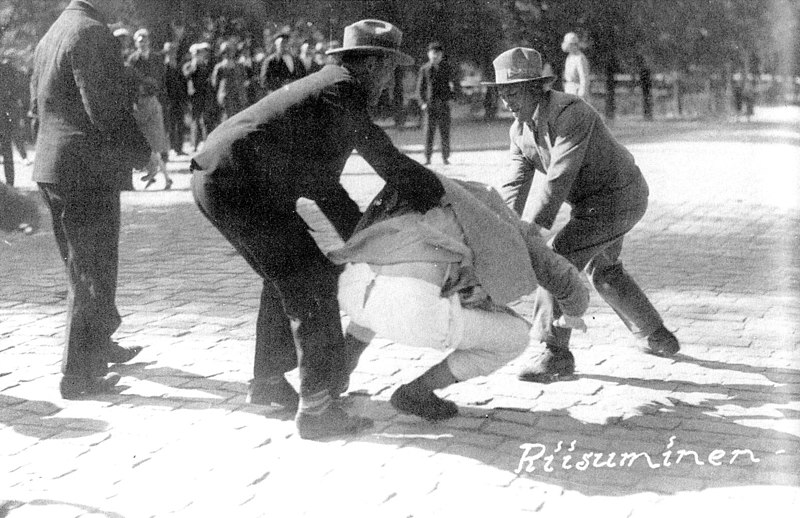
thumb|Members of the right-wing Lapua Movement assault a former Red officer and the publisher of the communist newspaper at the [[Vaasa riot on June 4, 1930, in Vaasa, Finland.]]
Persecution is the systematic mistreatment of an individual or group by another individual or group. The most common forms are religious persecution, racism, and political persecution, though there is naturally some overlap between these terms. The inflicting of suffering, harassment, imprisonment, internment, fear or pain are all factors that may establish persecution, but not all suffering will necessarily establish
mobbing
Mobbing, as a sociological term, refers either to bullying in any context, or specifically to that within the workplace, especially when perpetrated by a group rather than an individual.
.jpg)
scapegoat
thumb|upright=1.35|Scapegoat ceremony depicted at [[Lincoln Cathedral in stained glass: "[Aaron] is to take the two goats and present them before the Lord at the entrance to the tent of meeting. He is to cast lots for the two goats—one lot for the Lord and the other for the scapegoat. Aaron shall bring the goat whose lot falls to the Lord and sacrifice it for a sin offering. But the goat chosen by lot as the scapegoat shall be presented alive before the Lord to be used for making atonement by sending it into the wilderness as a scapegoat." (NIV, Leviticus 16:7–10)]]
internally displaced person
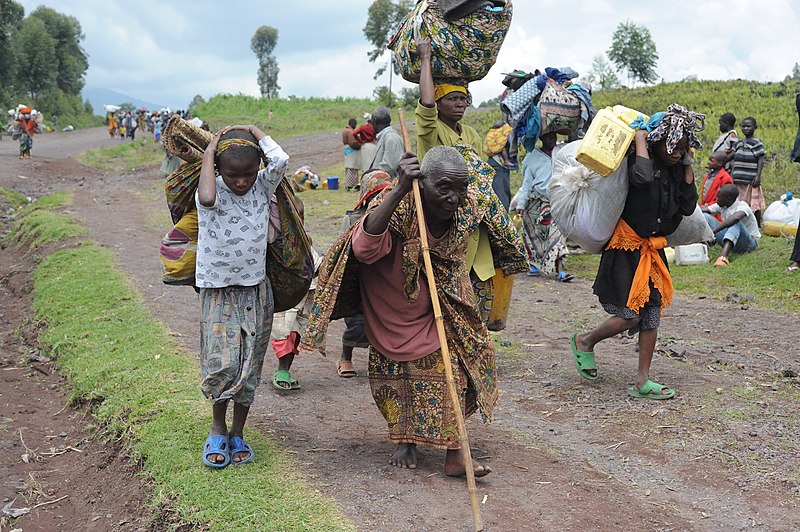
person forced to leave their home who remains within their country
school bullying
type of bullying that occurs in an educational setting
forced displacement
involuntary or coerced movement of a person or persons away from their home or home region

purge
thumb|Russian Count Nikolay Yevdokimov, who organized the extermination campaigns of "[[Tsitsekun", designated Russian military operations targeting Circassian natives by the term ochishchenie ("cleansing").]]
In history, religion and political science, a purge is a position removal or execution of people who are considered undesirable by those in power from a government, another, their team leaders, or society as a whole. A group undertaking such an effort is labeled as purging itself.

untouchability
Untouchability is a form of social institution that legitimises and enforces practices that are discriminatory, humiliating, exclusionary and exploitative against people belonging to certain social groups. Untouchability also refers to the condition of belonging to such groups, members of whom are historically called untouchables, outcastes, or archaically pariahs. Although comparable forms of discrimination are found all over the world, untouchability involving the caste system is largely unique to South Asia.

scapegoating
thumb|upright=1.1| (), drypoint by Albrecht Dürer 1512 depicting [[Jesus Christ]]
Scapegoating, sometimes called playing the blame game, is the practice of singling out a person or group for unmerited blame and consequent negative treatment. Scapegoating may be conducted by individuals against individuals (e.g., "he did it, not me!"), individuals against groups (e.g., "I couldn't see anything because of all the tall people"), groups against individuals (e.g., "He was the reason our team didn't win"), and groups against groups.
expulsion of Asians from Uganda
expulsion of Asian minority's in Uganda ordered by the President of Uganda, Idi Amin, in August of 1972,
persecution of people with albinism
Tanzanian et al Albianism
Sexual bullying
bullying associated with sexual activity or orientation
gay bashing
verbal or physical abuse/bullying against people perceived to be LGBT

badge of shame
distinctive symbol required to be worn by a specific group or an individual for the purpose of public humiliation, ostracism or persecution

relational aggression
type of aggression
ideological repression
forceful activities against competing ideologies and philosophies

classicide
300px|thumb|A Soviet parade between 1929 and 1934 under the banners "We will Dekulakization|liquidate the [[kulaks as a class" and "All to the struggle against the wreckers of agriculture"]]
300px|thumb|Bolsheviks in 1918 in Petrograd under a propaganda poster saying "Death to the bourgeoisie and its lapdogs – Long live the [[Red Terror!!"]]
300px|thumb|A wealthy Peasant#Chinese farmers|farmer in front of a Chinese Communist "people's court" in [[Fogang County, Guangdong Province on July 23, 1952 during the Land Reform Movement, which saw the mass killings of landlords]]
Mimetic theory
Theory of human desire by René Girard
Eliminationism
Eliminationism is a political ideology that views a group within a larger social group as harmful and therefore believes it must be eliminated—by separation, censorship, or extermination—for the benefit of the larger group and in order to preserve its "purity."
Folk devil
a person or group of people who are portrayed in folklore or the media as outsiders and deviant