Category
page 1Personifications

Ra
Ra (; ; also transliterated , ; cuneiform: ri-a or ri-ia; Phoenician: 𐤓𐤏, romanized: rʿ) or Re () was the ancient Egyptian deity of the Sun. By the Fifth Dynasty, in the 25th and 24th centuries BC, Ra had become one of the most important gods in ancient Egyptian religion, identified primarily with the noon-day Sun. Ra ruled in all parts of the created world: the sky, the Earth, and the underworld. He was believed to have ruled as the first pharaoh of Ancient Egypt. He was the god of the Sun, order, kings and the sky.

Inside Out
2015 animated film directed by Pete Docter

Gaia
In Greek mythology, Gaia (; , a poetic form of (''''), meaning 'land' or 'earth'), also spelled Gaea (), is the personification of Earth. She is the mother of Uranus (Sky), with whom she conceived the Titans (themselves parents of many of the Olympian gods), the Cyclopes, and the Giants, as well as of Pontus (Sea), from whose union she bore the primordial sea gods. Her equivalent in the Roman pantheon was Terra.

Amaterasu
, often called Amaterasu () for short, also known as and , is the goddess of the sun in Japanese mythology. Often considered the chief deity (kami) of the Shinto pantheon, she is also portrayed in Japan's earliest literary texts, the () and the (720 CE), as the ruler (or one of the rulers) of the heavenly realm Takamagahara and as the mythical ancestress of the Imperial House of Japan via her grandson Ninigi. Along with two of her siblings (the moon deity Tsukuyomi and the impetuous storm-god Susanoo) she ranks as one of the "Three Precious Children" (, ), the three most important offspring of

Tartarus
thumb|right|250px|alt=Sisyphus depicted on a black-figure amphora vase |Persephone supervising [[Sisyphus in the Underworld, Attic black-figure amphora, ]]

Maat
'''Ma'at or Maat' (Egyptian: ma’at /ˈmuʀʕat/, Coptic: ⲙⲉⲓ) comprised the ancient Egyptian concepts of truth, balance, law, morality, and justice. Maat was also the goddess who personified these concepts, and regulated the stars, seasons, and the actions of mortals and the deities who had brought order from chaos at the moment of creation. Her ideological opposite was Isfet (Egyptian jzft''), meaning injustice, chaos, violence or to do evil.

Nut
goddess of the sky in the Ennead of Egyptian mythology
.jpg)
Atum
Atum (, Egyptian: jtm(w) or tm(w), reconstructed ; Coptic Atoum), sometimes rendered as Atem, Temu, or Tem, is the primordial God in Egyptian mythology from whom all else arose. He created himself and is the father of Shu and Tefnut, the divine couple, who are the ancestors of the other Egyptian deities. Atum is also closely associated with the evening sun. As a primordial god and as the evening sun, Atum has chthonic and underworld connections. Atum was relevant to the ancient Egyptians throughout most of Egypt's history. He is believed to have been present in ideology as early as predynastic

Apophis
Apophis (; from ), also known as Apep () or Aphoph (, ), usually depicted as a giant snake or serpent, is the ancient Egyptian deity of chaos, darkness and fire, and is thus the opponent of light and Maat (order/truth). Ra was the bringer of light and hence the biggest opposer of Apophis.
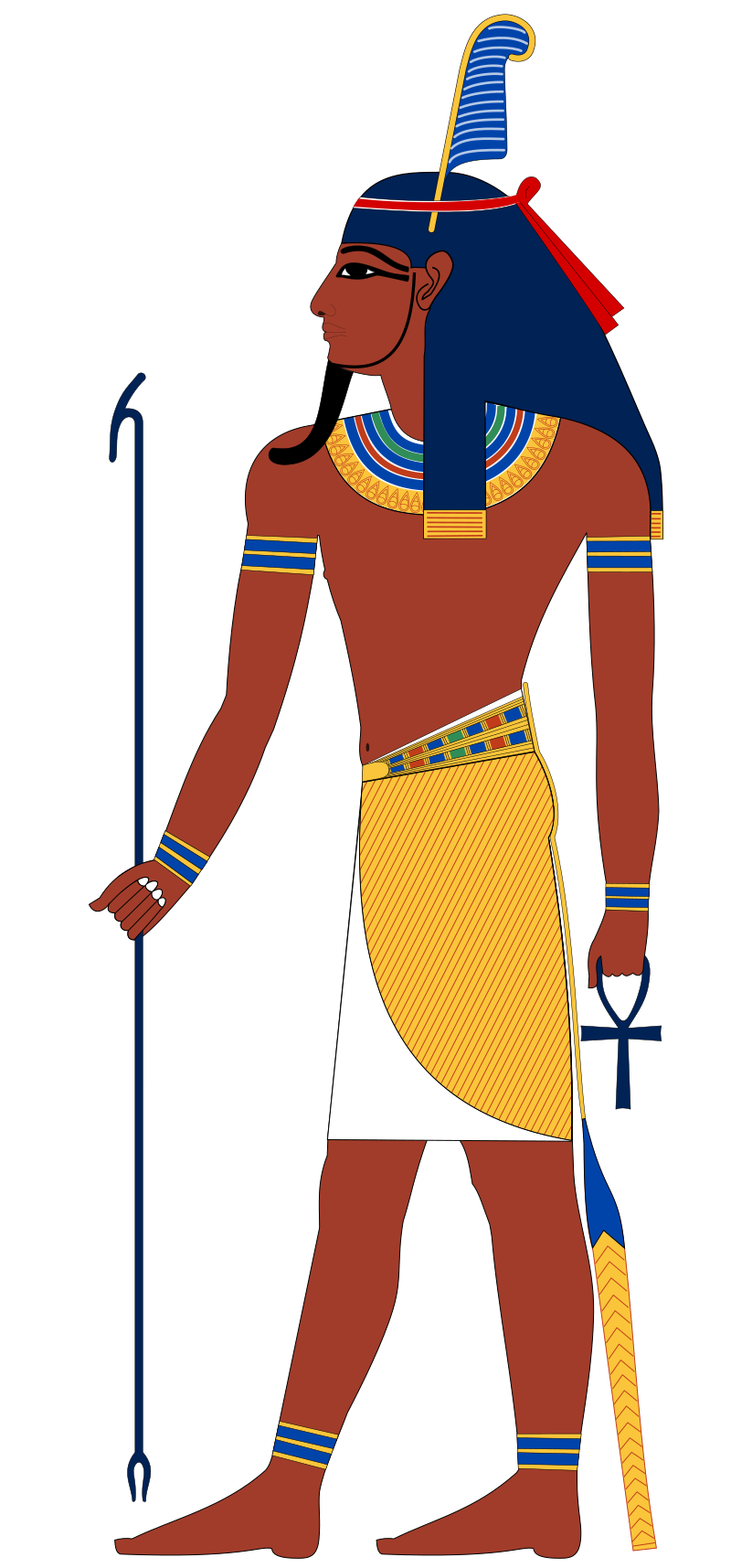
Shu
primordial Egyptian god, a personification of dry air, spouse and counterpart to goddess Tefnut

Geb
Geb (, Egyptological pronunciation: Gebeb), also known as Ceb, ), was the Egyptian god of the Earth and a mythological member of the Ennead of Heliopolis. He could also be considered a father of snakes. It was believed in ancient Egypt that Geb's laughter created earthquakes and that he allowed crops to grow.
%20(cropped).jpg)
personification
thumb|upright=1.35|Set of porcelain figures of personifications of the [[four continents, Germany, , from left: Asia, Europe, Africa, and America. Of these, Africa has retained her classical attributes. Formerly James Hazen Hyde collection.]]
Personification is the representation of any thing, being, or abstraction as a person or with person-like qualities. In the arts and as a literary device, personification is common for: places, especially cities, countries, and continents; elements of the natural world, such as trees, the seasons, the traditional "four elements", the four cardinal winds,
%20at%20the%20National%20Archaeological%20Museum%20of%20Athens%20on%2030%20August%202018.jpg)
Thanatos
In Greek mythology, Thanatos (; , Thánatos, pronounced in "Death", from θνῄσκω thnēskō "(I) die, am dying") was the personification of death. He was a minor figure in Greek mythology, often referred to but rarely appearing in person.

Khonsu
Khonsu (; also transliterated Chonsu, Khensu, Khons, Chons, Khonshu, or Konshu; ) is an ancient Egyptian god of the Moon. His name means 'traveller', and this may relate to the perceived nightly travel of the Moon across the sky. Along with Thoth, he marked the passage of time and is associated with baboons. Khonsu was instrumental in the creation of new life in all living creatures. At Thebes, he formed part of a family triad (the "Theban Triad") with Mut his mother and Amun his father.

Tefnut
Tefnut ( ; ) is a deity in Ancient Egyptian religion, the feminine counterpart of the air god Shu. Her mythological function is less clear than that of Shu, but Egyptologists have suggested she is connected with moisture, based on a passage in the Pyramid Texts in which she produces water, and on parallelism with Shu's connection with dry air. She was also one of the goddesses who could function as the fiery Eye of Ra.
.jpg)
Khepri
Khepri (Egyptian: ḫprj, also transliterated Khepera, Kheper, Khepra, Chepri) is a scarab-faced god in ancient Egyptian religion who represents the rising or morning sun. By extension, he can also represent creation and the renewal of life.
%20-%20Day%20(1884).jpg)
Hemera
thumb|Hemera (1884) by William-Adolphe Bouguereau

Nun
Egyptian deity
%20-%20Time%20Clipping%20Cupid's%20Wings%20(1694).jpg)
Chronos
thumb|''Time Clipping Cupid's Wings'' (1694), by Pierre Mignard
Chronos (; ; , Modern Greek: ), also spelled Chronus, is a personification of time in Greek mythology, who is also discussed in pre-Socratic philosophy and later literature. His consort is the goddess Ananke.

Mammon
250px|thumb|1909 painting The Worship of Mammon by Evelyn De Morgan
Mammon (Aramaic: מָמוֹנָא, māmōnā) in the New Testament is commonly thought to mean money, material wealth, or any entity that promises wealth, and is associated with the greedy pursuit of gain. The Gospel of Matthew and the Gospel of Luke both quote Jesus using the word in a phrase often rendered in English as "You cannot serve both God and mammon."

Ananke
thumb|Ananke as represented by a modern illustration of Plato's Republic
%2002.JPG)
Tsukuyomi
or , also , is the moon kami in Japanese mythology and the Shinto religion. The name "Tsukuyomi" is a compound of the Old Japanese words and . The Nihon Shoki mentions this name spelled as , but this yumi is likely a variation in pronunciation of yomi. An alternative interpretation is that his name is a combination of and . -no-Mikoto is a common honorific appended to the names of Kami; it may be understood as similar to the English honorific 'the Great'.

Eye of Providence
symbol of the all-seeing eye (usually shown surrounded by rays of glory and/or in a triangle)
Terra
personification of the Earth in ancient Roman religion and mythology

Sól
Norse deity
Kek
ancient Egyptian deity

Máni
thumb|A depiction of Máni and Sól (1895) by Lorenz Frølich.
Father Christmas
Folkloric personification of Christmas in several English‐speaking parts of the world
Yamato nadeshiko
Japanese term meaning the "personification of an idealized Japanese woman"
Spirit of Ecstasy
bonnet ornament on Rolls-Royce cars
Ecclesia and Synagoga
pair of the personifications of the Christian and Jewish religion
Father Time
personification of time passing
May Queen
personification of the May Day holiday, and of springtime and also summer, often part of Pentecostal traditions

Euthenia
thumb|Euthenia depicted in a garden, tempera on linen wall hanging (first century AD), Metropolitan Museum of Art 1984.178.
Euthenia () was the Greek name for a personification of abundance. As the Greek equivalent of either of the Roman goddesses Annona or Abundantia, she appeared on the coinage of Roman Imperial Egypt. She was associated with Nilus, the Greek god of the Nile, and was syncretized with the Egyptian goddess Isis. There are no ancient literary sources for the goddess. She is known all most entirely from her iconography.
==Role==
Euthenia was, from the reign of the Roman emperors
Dolos
In Classical mythology, Dolus () is a figure who appears in an Aesopic fable by the Roman fabulist Gaius Julius Phaedrus, where he is an apprentice of the Titan Prometheus. According to the Roman mythographer Hyginus, Dolus was the offspring of Aether and Terra (Earth), while Cicero has Dolus being the offspring of Erebus and Nox (Night).
Tepegoz
In Turkic mythology, Tepegoz or Tepegöz is a legendary creature who has only one eye on his forehead – a kind of cyclops. He is an ogre that appears in the Book of Dede Korkut, a famous epic story of the Oghuz Turks.
Rebis
thumb|Rebis from the Viatorium Spagyricum (1625)|alt=A wood carving of a human with two heads, one male and one female, standing on a dragon on top of the world. Above, astrological symbols for the classical planets hover.
Fjörgyn and Fjörgynn
norse mythical characters

Herman's Head
American television series
Telugu Thalli
personification of the Telugu people, their language and their culture
Prosopon
Prosopon is a theological term used in Christian theology as designation for the concept of a divine person. The term has a particular significance in Christian triadology (study of the Trinity), and also in Christology.
I Want You (She's So Heavy)
episode of The Simpsons (S30 E16)
Finger of God
Description of god in Bible
Roger Bontemps
French poet
Spirit of Communication
sculpture serving as a symbol of AT&T
Ayudhapurusha
thumb|Vishnu's Vaikuntha Chaturmukha form holding Gadadevi (right hand) and Chakrapurusha in his hands.
Hermathena
composite statue