Category
page 1Physical cosmology

universe
The universe comprises all of existence: all forms of matter and energy, and the structures they form, from sub-atomic particles to entire galactic filaments. Since the early 20th century, the field of cosmology establishes that space and time emerged together at the Big Bang ago and that the universe has been expanding since then. The portion of the universe that can be seen by humans is approximately 93 billion light-years in diameter at present, but the total size of the universe is not known.

Big Bang
hypothetical begin of the Universe through expansion out of an infinitely small and infinitely dense state

cosmology
thumb|upright=1.35| Except for the few stars in the foreground (which are bright and easily recognizable because only they have diffraction spikes), every speck of light in the composite photo is an individual [[galaxy, some of them as old as 13.2 billion years; the observable universe is estimated to contain more than 2 trillion galaxies. From the Hubble eXtreme Deep Field.]]

redshift
thumb|upright|Spectral line|Absorption lines in the [[visible spectrum of a supercluster of distant galaxies (right), as compared to absorption lines in the visible spectrum of the Sun (left). Arrows indicate redshift. Wavelength increases up towards the red and beyond (frequency decreases).]]

multiverse
The multiverse is the hypothetical set of all universes. Together, these universes are presumed to comprise everything that exists: the entirety of space, time, matter, energy, information, and the physical laws and constants that describe them. The different universes within the multiverse are called "parallel universes", "flat universes", "other universes", "alternate universes", "multiple universes", "plane universes", "parent and child universes", "many universes", or "many worlds". One common assumption is that the multiverse is a "patchwork quilt of separate universes all bound by the sa

cosmogony
thumb|The Big Bang theory of modern cosmology postulates the universe evolved from a hot dense state.
Cosmogony, also spelled as cosmogeny, or cosmogenesis, is any model concerning the origin of the cosmos or the universe.

Hubble–Lemaître law
observation in physical cosmology
.jpeg)
cosmos
thumb|Stars rotating in the night sky
The cosmos (, ; ) is an alternative name for the universe or its nature or order. Usage of the word cosmos implies viewing the universe as a complex and orderly system or entity.
physical cosmology
branch of cosmology which studies mathematical models of the universe

metallicity
thumb|250px|right|The globular cluster M80. Stars in globular clusters are mainly older metal-poor members of [[population II.]]
In astronomy, metallicity is the abundance of elements present in an object that are heavier than hydrogen and helium. Most of the normal currently detectable (i.e. non-dark) matter in the universe is either hydrogen or helium, and astronomers use the word metals as convenient shorthand for all elements except hydrogen and helium. This word-use is distinct from the conventional chemical or physical definition of a metal as an electrically conducting element. Sta
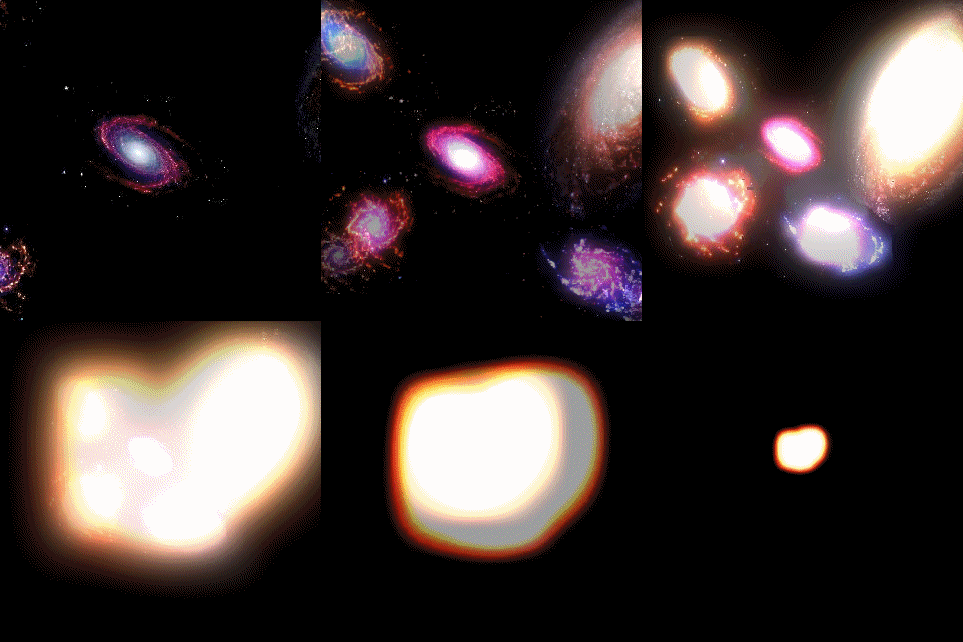
Big Crunch
hypothetical recollapse of the universe

anthropic principle
philosophical consideration that observations of the Universe must be compatible with the conscious and sapient life that observes it
steady-state model
alternative to the Big Bang model of the evolution of the universe

Timaeus
dialogue by Plato

Webb's First Deep Field
first image taken by the James Webb Space Telescope, of galaxy cluster SMACS 0723

Olbers's paradox
cosmological contradiction between the observed darkness of the night sky and a static universe model

Hubble Deep Field
multiple exposure image of deep space in the constellation Ursa Major

extragalactic astronomy
astronomy dealing with objects outside the Milky Way
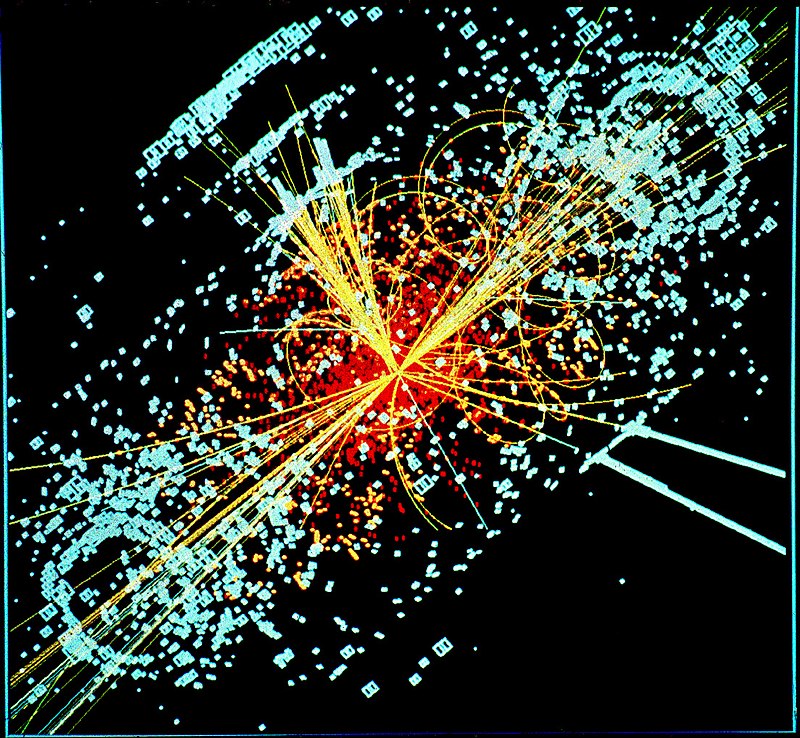
grand unified theory
quantum field theory in which the three gauge groups of the standard model combine into subgroups of a larger gauge group
Big Rip
possible fate of universe in which all matter is torn apart by the gravitational influence of dark energy
chronology of the universe
history and future of the universe according to Big Bang cosmology
Hubble Ultra-Deep Field
multiple exposure image of deep space in the constellation Fornax
ultimate fate of the universe
topic in physical cosmology
Boltzmann brain
physics thought experiment pointing out the improbability of the universe as described by thermodynamics
absolute time and space
theoretical foundation of Newtonian mechanics
Friedmann–Lemaître–Robertson–Walker metric
metric properties of the spacetime based on Albert Einstein's metric tensor and field solution for the spacetime

cosmography
The term cosmography has two distinct meanings: traditionally it has been the protoscience of mapping the general features of the cosmos, heaven and Earth; more recently, it has been used to describe the ongoing effort to determine the large-scale features of the observable universe.
Copernican principle
model in cosmology
cosmic calendar
visual illustration of the history of the Universe
Kaluza–Klein theory
field theory on a spacetime with small, compact extra dimensions beyond the large observed dimensions
ex nihilo
Latin phrase meaning "out of nothing"
fine-tuned universe
the proposition that the occurrence of life in the universe is very sensitive to the values of certain fundamental physical constants and that the observed values are, for some reason, improbable
Great Debate
astronomy debate held on 26 April 1920 at the Smithsonian Museum of Natural History between Harlow Shapley and Heber Curtis about whether spiral nebulae were different galaxies or part of the Milky Way
location of Earth
overview about the location of Earth in the Universe
hydrogen line
spectral line of hydrogen state transitions
cyclic model
cosmological model involving repetitions of Big Bangs followed by Big Crunches

protogalaxy
In physical cosmology, a protogalaxy, which could also be called a "primeval galaxy", is a cloud of gas which is forming into a galaxy. It is believed that the rate of star formation during this period of galactic evolution will determine whether a galaxy is a spiral or elliptical galaxy; a slower star formation tends to produce a spiral galaxy. The smaller clumps of gas in a protogalaxy form into stars.
cosmic latte
name assigned to the average color of the universe
comoving distance
measurement of distance in which the change due to the expansion of the universe is factored out
grand unification epoch
period very shortly after the Big Bang where the universe was hotter than the grand unification scale
future of an expanding universe
future scenario (heat death or the Big Freeze): observations suggest that the expansion of the universe will continue forever. If so, then a popular theory is that the universe will cool as it expands, eventually becoming too cold to sustain life
scale factor
parameter which characterizes the expansion of the universe
quark epoch
period in the evolution of the early universe prior to hadron confinement, during which the universe consisted of quark–gluon plasma
static universe
model of the universe that is not expanding or contracting, e.g. one in which the cosmological constant exactly balances things
particle horizon
the maximum distance from which light from particles could have traveled to the observer during the age of the universe
brane cosmology
several theories in particle physics and cosmology related to superstring theory and M-theory
dark matter halo
theoretical component of a galaxy that envelops the galactic disc and extends well beyond the edge of the visible galaxy
de Sitter universe
cosmological solution to the Einstein field equations of general relativity
Big Bounce
hypothetical cosmological model for the origin of the known universe
hadron epoch
period in the evolution of the early universe
physics beyond the Standard Model
theories attempting to explain the deficiencies of the Standard Model, Quantum field theory and general relativity
quantum cosmology
attempts to develop a quantum mechanical theory of cosmology
observational cosmology
cosmology
lepton epoch
period (~1 to 10 seconds after the Big Bang) in the early universe in which leptons dominated the mass of the Universe, after hadron–antihadron annihilation ended the hadron epoch but before Big Bang nucleosynthesis and the photon epoch
celestial spheres
in ancient cosmological models, rotating spheres made of aether in which the stars or planets are embedded
photon epoch
period in the evolution of the early universe in which photons dominated the energy of the universe
Hubble Deep Field South
multiple exposure image of deep space in the constellation Tucana
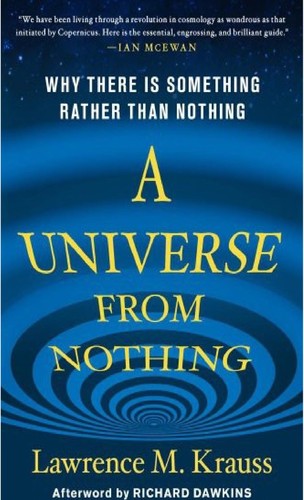
A Universe from Nothing
book by Lawrence Krauss
recombination
epoch at which charged electrons and protons first became bound to form electrically neutral hydrogen atoms, around 378 thousand years after the Big Bang
ekpyrotic universe
cosmological model which identifies the Big Bang with a collision between branes and which solves the flatness and homogeneity problems via the flatness of the branes without invoking inflation