Category
page 1Polynomials

polynomial
In mathematics, a polynomial is a mathematical expression consisting of indeterminates (also called variables) and coefficients, that involves only the operations of addition, subtraction, multiplication and exponentiation to nonnegative integer powers, and has a finite number of terms. An example of a polynomial of a single indeterminate x is x^2 - 4x + 7. An example with three indeterminates is x^3 + 2xyz^2 - yz + 1.
coefficient
In mathematics, a coefficient is a multiplicative factor involved in some term of a polynomial, a series, or any other type of expression. It may be a number without units, in which case it is known as a numerical factor. It may also be a constant with units of measurement, in which it is known as a constant multiplier. In general, coefficients may be any expression (including variables such as , and ). When the combination of variables and constants is not necessarily involved in a product, it may be called a parameter.
For example, the polynomial 2x^2-x+3 has coefficients 2, −1, and 3, and
binomial
polynomial with two terms
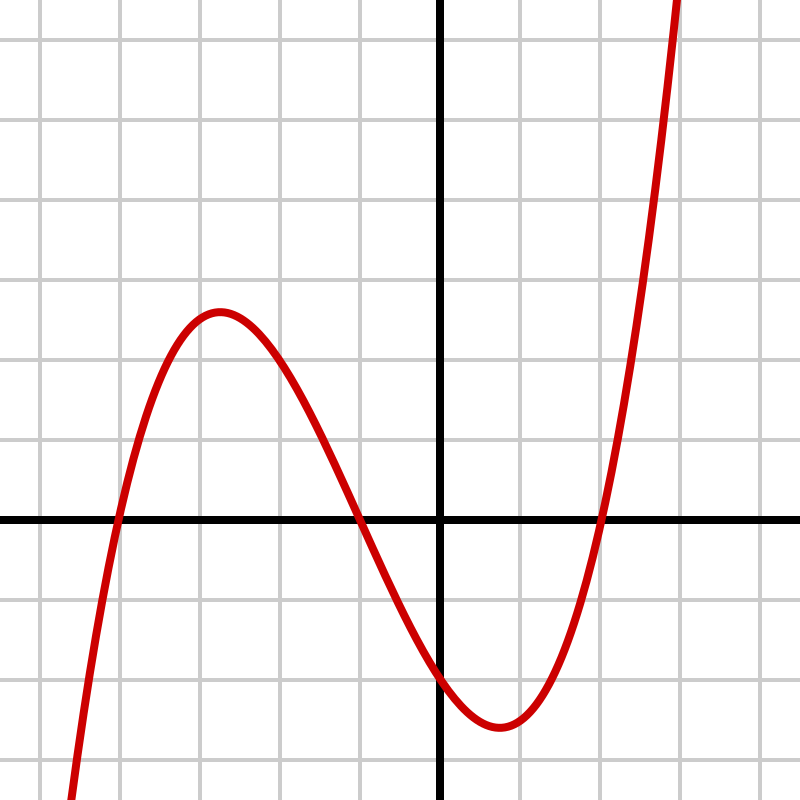
cubic equation
a polynomial equation in a single variable where the highest exponent of the variable is 3.

discriminant
In mathematics, the discriminant of a polynomial is a quantity that depends on the coefficients and allows deducing some properties of the roots without computing them. More precisely, it is a polynomial function of the coefficients of the original polynomial. The discriminant is widely used in polynomial factoring, number theory, and algebraic geometry.
algebraic equation
equation of the form of equality of two polynomials
Vieta's formulas
relations between the coefficients and the roots of a polynomial
cyclic redundancy check
type of hash function used to detect errors in data storage or transmission
root of unity
complex number whose positive integer power equals one
algebraic function
function that can be defined as the root of a polynomial equation
Legendre polynomial
solutions to Legendre's differential equation
quartic equation
polynomial equation of degree four
Horner's method
algorithm for polynomial evaluation
Hermite polynomial
polynomial sequence
completing the square
method for solving quadratic equations
degree of a polynomial
highest power of the variables occurring in a monomial in a given polynomial
characteristic polynomial
polynomial with roots that are the eigenvalues of a given matrix
Lagrange polynomial
polynomials used for interpolation
polynomial ring
ring of polynomials (with one or several variables) with coefficients in a given ring
Chebyshev polynomial
two sequences of polynomials
polynomial long division
dividing polynomials similar to long division for regular numbers
Laguerre polynomial
polynomial sequence
Bernstein polynomial
type of polynomial used in Numerical Analysis

trinomial
thumb|upright=2|Layers of Pascal's pyramid derived from [[coefficients in an upside-down ternary plot of the terms in the expansions of the powers of a trinomial ]]
In elementary algebra, a trinomial is a polynomial consisting of three terms or monomials.
monic polynomial
univariate polynomial in which the leading coefficient is equal to 1
resultant
In mathematics, the resultant of two polynomials is a polynomial expression of their coefficients that is equal to zero if and only if the polynomials have a common root (possibly in a field extension), or, equivalently, a common factor (over their field of coefficients). In some older texts, the resultant is also called the eliminant.
irreducible polynomial
irreducible element in the ring of polynomials; a non-constant polynomial that is not the product of two non-constant polynomials
minimal polynomial
minimal polynomial of a matrix
Hilbert's Nullstellensatz
Theorem: polynomials without common complex zeros generate the unit ideal
symmetric polynomial
polynomial where any interchange in variables results in the same polynomial
Bernoulli polynomials
polynomial sequence
Eisenstein's criterion
theorem
minimal polynomial
given an element α of a field extension E/F, the unique monic polynomial p∈F[x] of minimal degree such that p(α) = 0
cyclotomic polynomial
irreducible polynomial of integer coefficients whose roots are nth roots of unity
polynomial interpolation
interpolation of a given data set by the polynomial of lowest possible degree that passes through the points of the dataset
sextic equation
polynomial equation of degree six
trigonometric polynomial
mathematical function
Ruffini's rule
Polynomial division computation method
Routh–Hurwitz stability criterion
Mathematic test in control system theory
septic equation
mathematical equation
Sylvester matrix
square matrix associated to two univariate polynomials with coefficients in a field or a commutative ring
factorization of polynomials
computational method
Newton polynomial
mathematical expression
series expansion
concept in mathematics
Rosenbrock function
function used as a performance test problem for optimization algorithms
Tschirnhaus transformation
mathematical term; type of polynomial transformation
casus irreducibilis
one case when solving a cubic equation
umbral calculus
historical term in mathematics
Abel polynomials
polynomial sequence
Theory of equations
Study of polynomial equations
Alexander polynomial
knot invariant
constant term
term in an algebraic expression which does not contain any variables
Fibonacci polynomials
polynomial sequence considered as a generalization of Fibbonacci numbers

Bring radical
(of a real number a) unique real root of the polynomial x^5+x+a
Jacobian conjecture
conjecture asserting that, over a characteristic-zero field K, given a polynomial map f: Kⁿ → Kⁿ, if its Jacobian determinant J: Kⁿ → K is a nonzero constant map, then f admits a polynomial inverse g: Kⁿ → Kⁿ
Jones polynomial
mathematical invariant of a knot or link

polylogarithmic function
polynomial in the logarithm of n
Bell polynomials
triangular array of polynomials in combinatorial mathematics
separable polynomial
expression whose number of distinct roots is equal to its degree
symmetric algebra
algebra of all possible symmetric tensors over a vector space or ring module