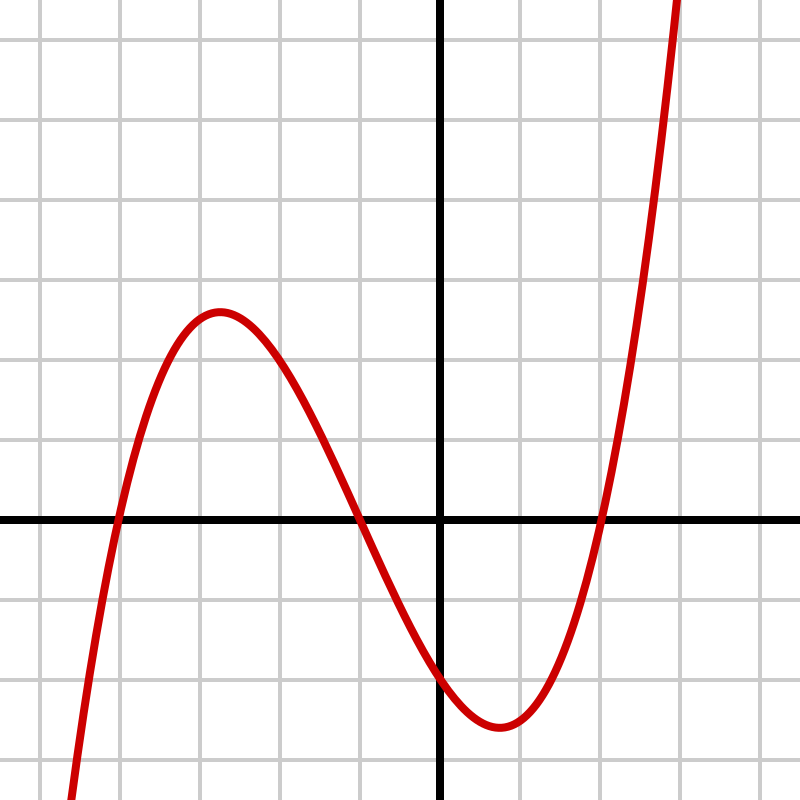
File:Polynomialdeg3.svg · Wikimedia Commons · See Wikimedia Commons
polynomial
Sign in to saveAlso known as polynomial expression
In mathematics, a polynomial is a mathematical expression consisting of indeterminates (also called variables) and coefficients, that involves only the operations of addition, subtraction, multiplication and exponentiation to nonnegative integer powers, and has a finite number of terms. An example of a polynomial of a single indeterminate x is x^2 - 4x + 7. An example with three indeterminates is x^3 + 2xyz^2 - yz + 1.
A polynomial is a mathematical expression made up of variables and numbers combined using only addition, subtraction, multiplication, and powers (with whole number exponents), with a limited number of terms—for example, x² - 4x + 7. Polynomials are fundamental building blocks in mathematics that appear throughout algebra, calculus, and countless practical applications in science and engineering.
AI-generated from the Wikipedia summary — may contain errors.
Wikidata facts
- Part of
- polynomial ring
- Has part
- monomial
- Image
- Polynomialdeg5.svg
- Has parts of class
- monomial
Show 7 more facts
- topic's main category
- Category:Polynomials
- Commons gallery
- Polynomial
- Commons category
- Polynomials
- Stack Exchange tag
- math.stackexchange.com/tags/polynomials
- different from
- trigonometric polynomial
- on focus list of Wikimedia project
- Wikipedia:Vital articles/Level/4
- maintained by WikiProject
- WikiProject Mathematics
via Wikidata · CC0
~38 min read
Encyclopedic overview
36 sectionsContents
- Etymology
- Notation and terminology
- Definition
- Classification
- Operations
- Addition and subtraction
- Multiplication
- Composition
- Division
- Factoring
- Calculus
- Polynomial functions
- Graphs
- Equations
- Solving equations <span class="anchor" id="Solving polynomial equations"></span>
- Polynomial expressions
- Trigonometric polynomials
- Matrix polynomials
- Exponential polynomials
- Related concepts
- Rational functions
- Laurent polynomials
- Power series
- Polynomial ring
- Divisibility
- Applications
- Positional notation
- Interpolation and approximation
- Other applications
- History
- History of the notation
- See also
- Footnotes
- Notes
- References
- External links
In mathematics, a polynomial is a mathematical expression consisting of indeterminates (also called variables) and coefficients, that involves only the operations of addition, subtraction, multiplication and exponentiation to nonnegative integer powers, and has a finite number of terms. An example of a polynomial of a single indeterminate x is x^2 - 4x + 7. An example with three indeterminates is x^3 + 2xyz^2 - yz + 1.
Polynomials appear in many areas of mathematics and science. For example, they are used to form polynomial equations, which encode a wide range of problems, from elementary word problems to complicated scientific problems; they are used to define polynomial functions, which appear in settings ranging from basic chemistry and physics to economics and social science; and they are used in calculus and numerical analysis to approximate other functions. In advanced mathematics, polynomials are used to construct polynomial rings and algebraic varieties, which are central concepts in algebra and algebraic geometry.
Excerpted from Wikipedia’s “polynomial” article, available under the CC BY-SA 4.0 licence.
Gallery (10)
Available in 83 languages
- Español
- Français
- Deutsch
- 中文
- 日本語
- Русский
- Português
- Italiano
- العربية
- हिन्दी
- Afrikaans
- Albanian
- Armenian
- Asturian
- Azerbaijani
- Bahasa Indonesia
- Bangla
- Bashkir
Show 64 more
- Basque
- be_x_old
- Belarusian
- Bosnian
- Bulgarian
- Catalan
- Central Kurdish
- Chuvash
- Croatian
- Czech
- Danish
- Esperanto
- Estonian
- Filipino
- Finnish
- Galician
- Georgian
- Greek
- Hebrew
- Hungarian
- Iban
- Icelandic
- Ido
- Irish
- Kazakh
- Khmer
- Latin
- Latvian
- Lithuanian
- Macedonian
- Malagasy
- Malay
- Malayalam
- Marathi
- Nederlands
- Norwegian
- Norwegian Nynorsk
- Polski
- Romanian
- Serbian
- Serbian (Latin)
- simple
- Sinhala
- Slovak
- Slovenian
- Svenska
- Tajik
- Tamil
- Tiếng Việt
- Türkçe
- Ukrainian
- Urdu
- Uzbek
- Welsh
- Western Frisian
- Wu Chinese
- Yiddish
- Yoruba
- Zaza
- zh_classical
- zh_yue
- فارسی
- ไทย
- 한국어
via Wikidata sitelinks · CC0